
How Can You Miss Someone You Hardly Know?
A Surprising Social Stickiness — and Why We Must Pay Attention

Missing Pierre
Pierre, a handyman (not pictured above) works in the Washington, D.C. building I lived for six months before moving to Paris. Between May and November, I saw Pierre maybe three or four times. Still, I miss him.
Pierre did things for me that I couldn’t or didn’t want to do myself. One needs such people in her life. I truly appreciated his presence, scant though it was.
On the relationship continuum that ranges from stranger to soulmate, Pierre is one of my least-close consequential strangers — acquaintances who are neither family nor dear friends. What little I know of his biography, I surmised from random clues.
In real life, Pierre appears to be in his 30s and of Latin American or Middle Eastern dissent. He’s a good guy who is good with his hands.
I imagine that he relied on similar broad biographical clues to piece together my identity: an older woman, a published writer, who bothers to have conversation with him. She sometimes needs help, tips well and often says how much she “appreciates” him.
Pierre and I were never destined to progress along the relationship continuum, as less important relationships sometimes do. (Your best friend was initially a casual acquaintance.) Still, we meant a small something to one another.
The small somethings from another human add up. Like “stickiness” in marketing jargon, the positive interactions inspire you to keep coming back for more.
One day I run into Pierre on the elevator.
“Oh, good, this saves me a text,” I blurt out, excited to see him. “I canceled that IKEA piece you promised you’d assemble for me. But do you have a minute now for two minor repairs?”
He promises to text me when he is free. I don’t know whether he’s a spouse or parent or whether he’s making ends meet. But I know from our brief history that he’s not a guy who flakes. He’ll be there.
The door closes behind him on the fourth floor, the elevator continues to ascend, and I have a moment of sadness: When I leave this building I won’t have Pierre.
That’s the thing about consequential strangers. They all matter.
Discovering My Consequential Strangers
When I moved to Massachusetts from Manhattan in 1990 — years before my co-author, Karen Fingerman coined the term “consequential strangers” — I learned how important were.
Leaving New York, the city of my childhood, my college ties, and my first marriage, I suddenly found myself without any connections. I naturally stayed in touch with family and close friends. Some would come up to Northampton for the weekend.
But the in-betweens were hard. It took me a few months to realize what was else missing: acquaintances. They ran the gamut from people I barely knew, like the nice lady at the greengrocer on 11th Street, to brunch friends — close enough for the occasional meal but not necessarily an overnight stay.
As I then explained it to friends from my old life.
“I don’t need any more good friends. I just want to go into stores or walk down the street and be recognized by someone.”
To that end, I launched my “acquaintanceship campaign.” I introduced myself to merchants and waitresses and gas station attendants. I took numbers from friends who “knew someone” in Northampton. I made cold-calls to local editors, explaining that I was new to the area. I wasn’t looking for an assignment, just conversation.
I had coffee or lunch with anyone who was willing.
To this day — and several new cities later — I continue to cultivate relationships with random others. I cherish them. You never know what bounty awaits. Most important to one who moves a lot, a town or city doesn’t feel like home until you have at least a few consequential strangers.
Consequential-Stranger Relationships Rock
Weak ties, as sociologists call them, tend to serve a specific purpose. They lend an ear, a hand, or a different viewpoint. They can connect you to opportunity more readily than your strong ties, who tend to know what you know.
Consequential strangers can be of a particular place — a man from the park or a woman you encounter on your morning commute. They can be connected to your work, school, spiritual practice, a hobby or other interest. They might anchor you in a community or a “tribe.”
These are no-muss/no-fuss “wash and wear” connections — often easier to maintain than more intimate ties. You don’t have to recall a consequential stranger’s birthday.
But they are relationships nonetheless. They allow us to practice key skills that help any bond grow and deepen — communicating, being respectful of one another, listening.
The term “consequential strangers” captures a fascinating paradox about casual relationships: They are as vital to our well-being, growth, and day-to-day existence as family and close friends.
This doesn’t mean that our intimates aren’t there for us or good for us. I have a great partner, beloved family and friends. But in the course of a day, I have social exchanges with other dog-owners, fellow writers, and random street encounters in Paris. Each of these peripheral others exposes me to new experiences and ideas, new leads.
Consequential strangers energize and enrich us. They also hold up a mirror. We retell our stories from a new perspective — for example, I describe my divorce differently to someone I meet now than I did in 1983!
We can catch a fresh glimpse of ourselves in a consequential stranger’s eyes. She laughs easily at my jokes; I must be funny.
Our Social Convoys
Developmental psychologist Tony Antonucci came up with the term “social convoy” to illustrate how our individual constellations of connection —our weak and strong ties—shape and support us.
Life isn’t a series of events; it’s a cavalcade of people.
Imagine yourself driving down the road of your life. Closest to you and typically traveling over the longest distances with you are your parents, siblings, children, partners, best friends.
The others in your social convoys are consequential strangers. Some might be people you see often, like colleagues and club members. Others might be minor or fleeting relationships — like my Pierre.
Sometimes, your paths diverge. One takes the exit and travels a different road. A classmate moves away. A marriage ends. A child goes to college.
And sometimes, a member of your social convoy will disappear gradually in the rearview mirror.
“I didn’t need them anymore,” a cancer survivor admitted sheepishly when I interviewed her the “Good for What Ails Us” chapter. Barbara (not her real name) was grateful to members of her support group — they got her through a very difficult time. But she spoke to them less frequently these days.
Wanting not to be defined by cancer, Barbara gradually inched her way out of survivor territory. But she didn’t really lose those connections. Her support-group buddies would always be there for her, part of her social convoy.
We are relational beings. We thrive on connection. We also change from it. In short, you are who know — and everyone you know in your social convoy.
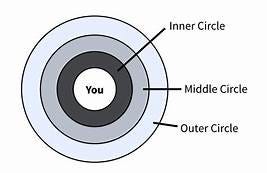
Want to see your social convoy? Here’s a technique used in research: Draw three concentric circles on a sheet of paper. Write the names of your closest relations in the small center circle — those you can’t imagine life without. In the next circle, put those who still close but not quite as important. Finally, fill the outside circle with everyone else you know. (It’s okay to draw additional circles to distinguish more distant consequential strangers.)
Why Do We Miss People Who Don’t Seem to Matter?
If I “mapped” my social convoy, the handyman I knew in D.C. would be a tiny dot in a far outer circle. Still, in getting from there to here, Pierre was part of the journey nonetheless.
Life isn’t a series of events; it’s a cavalcade of people.
Admittedly, I missed Pierre most when I first arrived in Paris. Who will help me assemble the clothes rack or the new TV stand? Eventually, I found another handyman, but he is not merely “another Pierre.” He can’t be.
Like snowflakes, no two relationships are alike. The sum of Pierre’s and my time together created a unique entity formed of the two of us: our respective personalities, our histories, and all the other relationships we carry with us.
All of these factors swirl together in unexpected ways. I have no way of knowing now why Pierre and I seemed to click. But for that brief period in time, we mattered to one another.
Now I think of him fondly. I hope he’s doing well.
###
Let me be your consequential stranger!
Subscribe to my website! Find more here: Consequential Strangers on Psychology Today. And if you’re really intrigued, buy the book (or borrow it from the library!)
###
Postscript
Many readers have told me that the concept inspires them to move through the world with fresh eyes. No surprise that twelve year later I’m still writing about consequential strangers — and now, apparently, so are other writers.
My first piece for Medium about consequential strangers was prompted by a 2020 article in the New York Times in which Jane Brody stresses their importance during the pandemic isolation.
Many articles came out in 2009 when the book was first published. I’m thrilled to see that consequential strangers are still getting people’s attention!
- The William Weiler Stewardship blog covers the concept for its readers, described as “people practicing land and community stewardship.”
- A woman who calls herself “Mardin,” explains why she appropriated the term for her blog.
- All these writers have written about the importance of consequential strangers on Medium, each from a slightly different angle.
Maggie Reed
Dianne Fanucchi
Christie M. Schaefer
Stevie Lynn Weisend
If you write or read about consequential strangers, please let me know.