
The sunken lighthouse of Faros, a once towering structure of 180 meters
Today it rests underwater, but in its heyday it impressed the entire ancient world. The lighthouse on Faros, as this structure is referred to, was a technological masterpiece, so it’s no wonder that today we count it among the seven wonders of the ancient world. Who erected this remarkable structure? What did it look like before it settled into the sea? We answer these and other questions below.
.jpg)
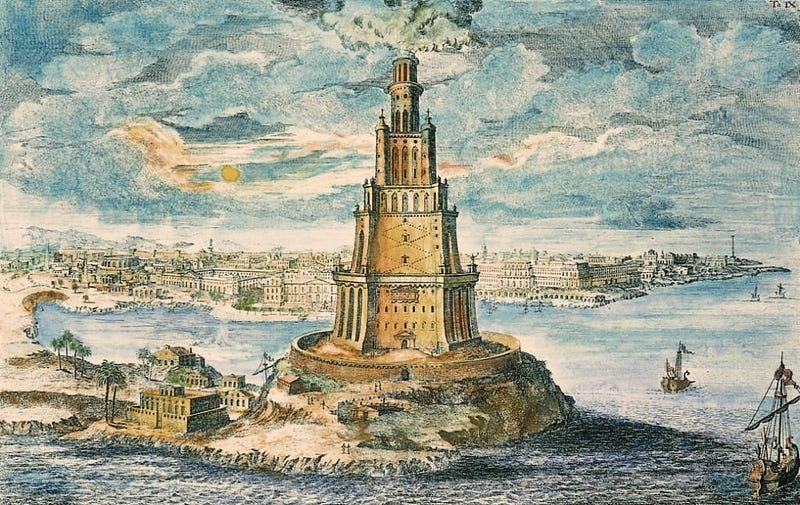
The Alexandria lighthouse, in ancient times located on the northeastern tip of the island of Faros, was the largest structure of Alexandria. By the way, not only Alexandria, because in the whole world at that time no one had erected a higher structure. It was connected to the mainland by an earthen rampart, which, as a result of natural processes, increased its width over the centuries and today is a 1.5 km wide peninsula.
Very little is known about this remarkable object. However, let’s try to summarize all the most important information about the structure, which was admired by the entire ancient world.
Who built the lighthouse on Faros and when?
The lighthouse on the small island of Faros was most likely erected in 280 BC. Construction began at the behest of Ptolemy I — the founder of the Ptolemaic dynasty, ruler of Egypt from 323–83 BC. Sostratos of Knidos — a Greek architect and builder — was responsible for the design.
The initiator did not live to see the completion of the work (Ptolemy I died around 283 BC). The great tower, which was a landmark for ships entering the port, gained its final shape already during the reign of Ptolemy II.
What did the Alexandrian lighthouse look like?
The lighthouse at Faros is the youngest of all the seven wonders of the ancient world. However, it is about it that we know the least. Its appearance largely still remains a mystery, as modern knowledge is based only on ancient sources and a rendering of the lighthouse on a coin of Ptolemy II.
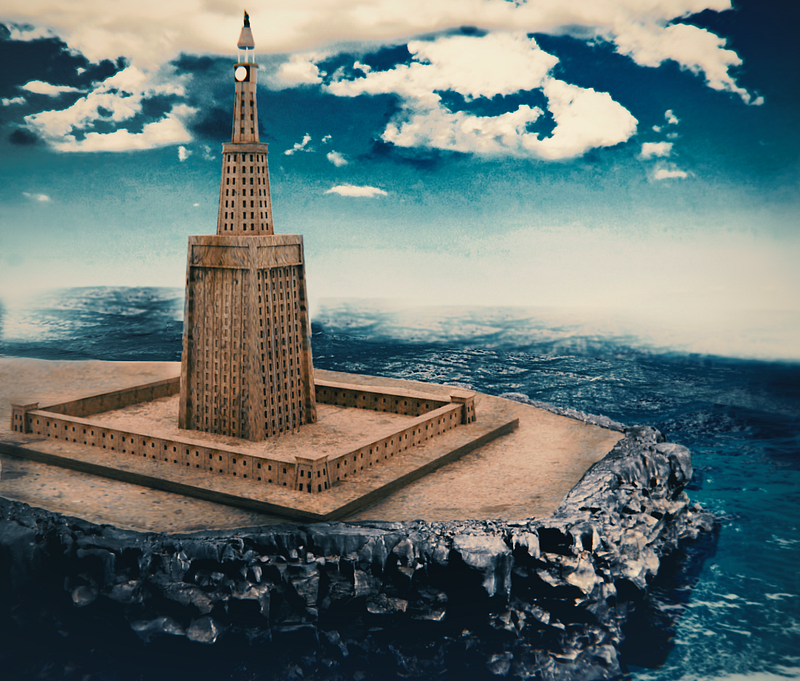
The latter source depicts only a tall building with a figure visible at the top. In “The Jewish War,” Josephus Flavius wrote that it measured 180 meters in height, although contemporary scholars believe that it may have measured “at most” 120 meters. Strabon, Lukian of Samosat and Pliny the Elder wrote that the structure was built on a square plan, the side of which measured 180 meters.
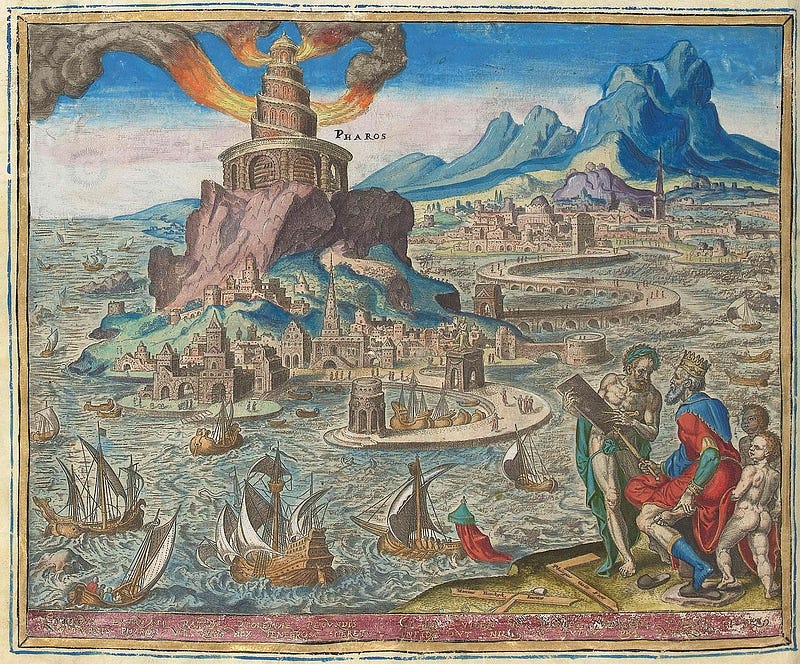
Based on ancient sources, contemporaries visualize the structure as a multi-story tower. At its base lay a single-story palace. On it rested a tower (perhaps octagonal) finished with blanks. From it grew another (perhaps circular), with a smaller diameter. It was crowned by an open columned hall, where a fire was lit. The entire structure was crowned by a statue of Poseidon.
_-_1572.jpg)
What role did the lighthouse on Faros play?
The function performed by this unusual structure did not differ from that of modern lighthouses. The great structure served as a landmark for ships. It should be known that in ancient times the seaport of Alexandria was one of the busiest, and at the same time one of the most demanding.
After all, one can’t help but notice that the harbor entrance area literally swarmed with rocks and shoals. A clear landmark, visible from a considerable distance, undoubtedly made it easier for sailors to maneuver their ships. However, historians have no doubt that the practical function was not the only one performed by this huge structure.
Equally important, and perhaps even more important, was the representative function. In Hellenistic and Roman times, the most beautiful city in the Nile Delta was referred to as lampra kai lamprotate, meaning splendid and most splendid. Alexandria must have deserved such praise. And what is more indicative of the splendor of urban centers than monumental buildings that the whole world talks about?
Thus, it can be said that the lighthouse on Faros was to Alexandria what the Burj Khalifa is to Dubai today, or One World Trade Center to New York. That is, a symbol of power, a showcase that seems to shout: “admire us and humble yourselves before our greatness.”
The destruction of the lighthouse
Unfortunately, time has not spared this remarkable building. As the period of Egyptian splendor passed, the great lighthouse gradually began to decline. It had already been heavily damaged during Caesar’s invasion. Although the damage was later repaired, earthquakes in the 4th and 10th centuries severely damaged its structure.
It is worth mentioning that back in the 9th century its purpose was changed. At that time the lighthouse became a mosque, a rather unusual one, as it was oriented along the north-south axis. The work of destruction was completed by subsequent earthquakes. The cataclysms occurred in 1261 and 1303.
The final blow turned out to be the 1326 earthquake, which pushed the structure into the sea. 151 years later, a fort was erected on its base. Thus, all that is left of the magnificent Alexandrian lighthouse are the memories recorded in ancient works. Its remains still rest at the bottom of the sea, near the entrance to the port.

Interesting facts about the lighthouse on Faros
Finally, we have left some intriguing curiosities about this remarkable structure.
- The lighthouse on Faros was built on the orders of Ptolemy I. However, some historians do not rule out that the actual originator of this structure was Alexander the Great.
- It was an ancient custom to decorate the plaster of a building with praise for its founder. It was no different in the case of the Alexandrian lighthouse. However, the designer of the unusual structure was not about to give up the glory due to him. When the plaster began to fall off, he revealed yet another inscription, carved into the marble: “Sostratos, son of Dexiphanes, dedicated this building to the gods of salvation, on behalf of all those who sail the seas.”
- The world’s tallest modern lighthouse — Jeddah Light in Jeddah — measures 133 meters. It is possible that the Alexandria lighthouse was taller than it! However, if we assume that it measured about 120 meters, as some accounts indicate, today it would still be the second tallest of its kind.
- The light of the Alexandrian lighthouse was probably visible from a distance of 300 stadia, which translates to about 55 kilometers.
Cool that you made it to the end of this article. I will be very pleased if you appreciate the effort of creating it and leave some claps here, or maybe even start following me. It would be nice if you also left a tip! Thank you!