Summer Song Writing Challenge
The Summer of ‘69
Tune in, turn on, drop some music
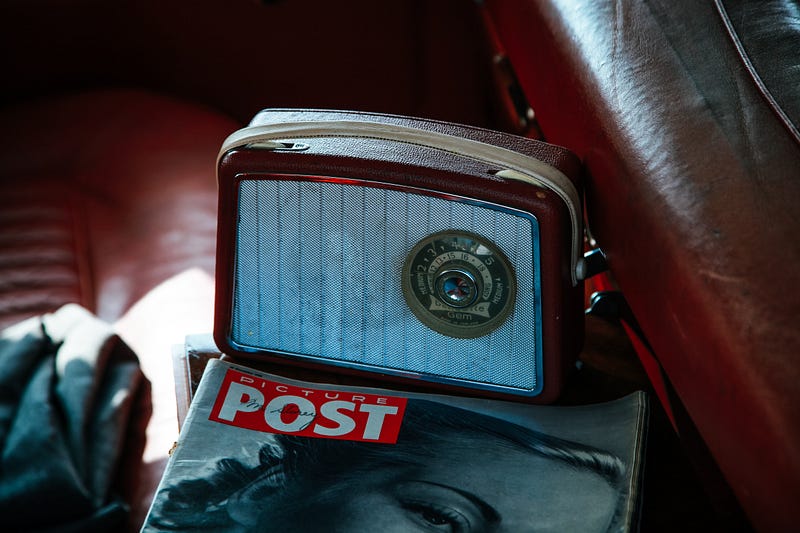
It’s not that my family didn’t listen to the radio before 1969. Every week when we drove to see my grandmother, Dad would turn on one of the local stations that either played standards from Sinatra and even older artists, or engaged in “talk.” I remember radio personality Joe Pine, and of course, Paul Harvey. I don’t remember anything they said, because mainly I didn’t pay attention and instead read one of the comic books I brought to keep myself occupied.
Sometimes, when major news was breaking — Hurricane Camille, the assassination of King and R. Kennedy — Mom might tune in to a random station instead of turning on the TV. Maybe she thought onscreen violence was too much for all of us, though she never said as much aloud.
So I remember once in 1968 during Camille, amidst the blowing winds outside and updated reports from the NWS, I would hear the occasional pop song. This was from WSGN-AM (The Big 610), the most popular Hit radio station of my youth. Why Mom tuned them in, I don’t know either, but for the several hours it was on, the one song I kept hearing on our stereo radio, ironically, was The Temptations’ “I Wish It Would Rain.” Oh, to be a disc jockey.
In July 1969, I’d turn thirteen, a burgeoning eighth grader. My friend Robert hung out at our house a lot that summer, and between outdoor games of whiffle ball and indoor games of Pinochle, Robert insisted that we listen to the radio. Mom didn’t object, so soon our stereo inside and radio in the car, when she’d take us shopping downtown or to suburban plaza stores like Miller’s and K-Mart, was blasting all the hits from WSGN, and the other two pop stations, WVOK-AM (The Mighty 690) and WAQY-AM (Wacky 1220).
This was the summer of hits such as Neil Diamond’s “Sweet Caroline,” Bobby Sherman’s (of TV’s “Here Come the Brides”) “Little Woman,” (I swear and it went №1), The Rolling Stones’ “Honky-Tonk Women,” Johnny Cash’s “A Boy Named Sue,” The Rugby’s “You, I,” Zager and Evans’ “In the Year 2525,” The Beatles’ “Get Back,” Desmond Dekker and the Detroit Aces’ “Israelites,” Marvin Gaye’s “Too Busy Thinking About My Baby,” Tony Joe White’s “Polk Salad Annie,” The Joe Jeffrey Group’s “My Pledge of Love,” The Box Tops’ “Soul Deep,” Electric Indian’s “Keem-O-Sabe,” The Plastic Ono Band’s “Give Peace a Chance,”and Kenny Rogers and the First Edition’s “Ruby, Don’t Take Your Love to Town.”
Whatever you and I might think of this list now, I can say definitively, that when any of these songs blew out of our old Pontiac’s speakers, Robert and I would sing along, loudly, and we knew all the words.
We loved these songs, and while Robert was already active in the land of parties and sweethearts, I was still struggling to understand and navigate that strange and intimidating world.
I always hoped and always thought music would help — that it would save me, if not my soul.
Toward the end of that summer, though, a song emerged that somehow defined this time for me; a song that both navigated change and harkened back to something older: a music I had been listening to for much of my young life.
The song was Bob Dylan’s “Lay Lady Lay,” the hit from Nashville Skyline.
Now, I had heard of Dylan, and likely somewhere on TV’s “American Bandstand” or “Where the Action Is,” (my main vehicles for Pop back in those days before Robert and Radio) I had heard “Mr. Tambourine Man” and “Blowin’ in the Wind,” perhaps even sung by Dylan himself (though The Byrds were probably the source of the former). I also had a 45 rpm copy of Manfred Mann’s “The Mighty Quinn,” and I had noted on the label that the writer was one “Dylan,” so his name, at least, was on my mind.
But in that summer of ’69, when I finally heard, and re-heard almost every hour, Dylan sing “Lay Lady Lay,” I felt something different. Though I couldn’t have said this then, I began understanding what so many had already heard and known about the artist.
What I missed, of course, were these two pop cultural realities.
First, I didn’t know what Dylan’s turn toward Nashville and country music meant to American music (I didn’t even know then the controversy earlier of his “going electric” at Newport). This was not the origin of “Country Rock,” per se, but following Dylan as so many did had to cause an upheaval in critical thinking about Pop itself and all it could and did include. Think just about the pedal steel guitar, an instrument I had been hearing all my life on “The Grand Ol’ Opry,” “The Porter Wagoner Show,” and “The Wilburn Brothers.”
Were such guitars and the longing sounds they made cool?
Robert also got me watching “The Johnny Cash Show” that summer, and you might know that not only did Dylan play with John (as John did with Dylan on Nashville Skyline’s “The Girl from the North Country”), but later, so would Neil Young and many other rockers.
I wondered: What was the difference between Country and Rock/Pop? That I would re-assess again once I started listening to Ray Charles is another wonderfully complicated story in this book.
Man.
Secondly, I am not ashamed to say that in the summer of 1969 when “Lay Lady Lay” spoke of someone “laying across your big brass bed,” I didn’t completely get it. Of course I knew this was a love story, but why a bed?
Sigh.
But it’s good to have been young and naive, and to remember it so well.
What the song did communicate more clearly than I could find my own words for was the longing we all felt for love, and the lack of understanding as to why that love was so hard and incomplete (of course, infidelity complicates things even further).
Dylan put all of this over with his understated singing, that guitar, and an underlying organ.
Right?
And those words:
“Why wait any longer for the world to begin? You can’t have your cake and eat it too. Why wait any longer for the one you love, When he’s standing in front of you?
I long to see you in the morning light I long to reach for you in the night Stay lady stay, stay while the night is still ahead.”
It’s a country story all right with lyrics aching from rural life and blues’ life — a story I’d understand better in the coming years as my tastes kept evolving; as my experience in love and loss grew.
But back then, in 1969’s late summer yearning, I had still so much to negotiate:
Living in that mysterious world of girls.
Being a teenager in a small Alabama town.
And taking eighth grade Geometry with Miss Colvin.
In that coming year, I made low B’s and C’s in each of them.
Thanks to Jessica Lee McMillan and https://readmedium.com/july-writing-challenge-c63c5d014c29


