
The Strange Story of Propaganda
A book about public relations led me down a rabbit hole
People who deal in old books are a strange people. I should know, I’m one of them. Books are my life. I sell and restore them, I help get them published and promoted, in a different part of my life. I spend most of my time with books.
Not much surprises me anymore. I’ve run across some interesting pieces over the years—one of my first real, grown-up bookseller finds was a guide to fallout shelter design—complete with a bunker martini bar.
But every now and then, I find something a little extra special. Like Edward Bernays’ Propaganda. Which…probably isn’t about what you think it’s about.
It’s about public relations.
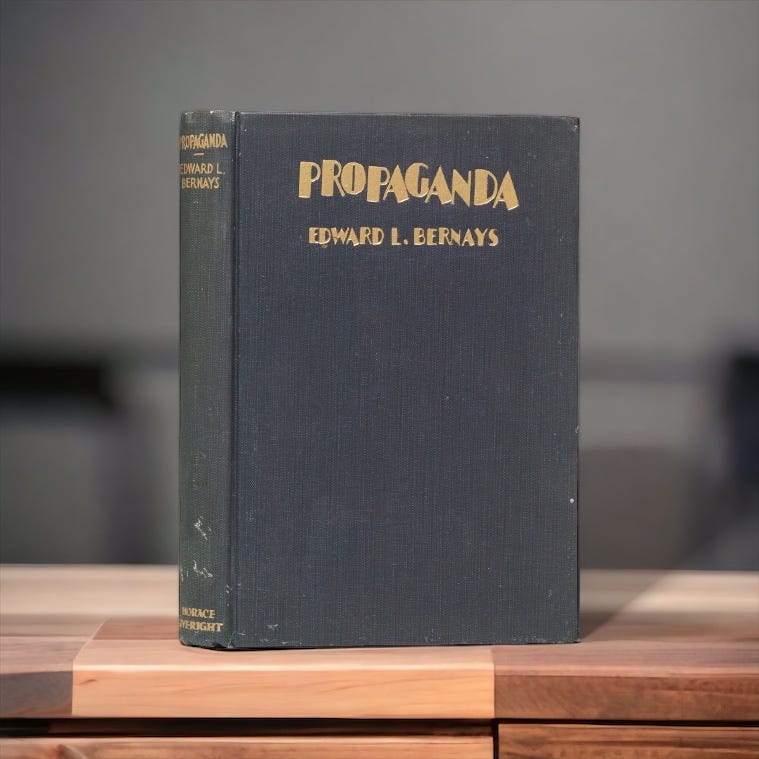
Back in 1928, Ed Bernays, quite literally, wrote the book on propaganda—and on public relations. We still call him, ‘the father of public relations.’ Aside from finding this piece—that’s incredibly hard to find in first edition, it’s interesting for me. As a history nerd, big fan of truth and roasting sacred cows, and someone who handles PR for authors and other creative people.
Bernays made his name working for the tobacco companies, with the campaign, “Torches for Freedom.” In the first wave of feminism, cigarettes were a hot topic—smoking was something for men. Cigarettes became a sign of equality and emancipation. The watershed moment came in March 1929, on Easter Sunday, in New York City. Bernays hired women to march in this parade, smoking like steam powered 1 Trains. And it worked. It was a significant moment for greater equality for women—and Bernays made a killing.
He got the idea from psychoanalyst A.A. Brill, who translated most of Sigmund Freud and Carl Jung’s work into English for the first time, being an Austrian transplant himself. Brill had referred to cigarettes as, “Torches of Freedom,” describing the natural urge for women to smoke—at the time, smoking was seen as a natural act, for men. Brill expanded it to women.
But, remember how I said that it’s hard to find Propaganda, the book? At least in hard copy—it’s in the public domain.
It’s because it didn’t sell well in his lifetime. Bernays became a legend in the then-burgeoning field of PR, taking public relations beyond just advertising and putting products in front of people who might buy them. Bernays was fascinated with the developing fields of psychology and its sister sciences: sociology and anthropology. He’d written on the topic before:
- Crystalizing Public Opinion, in 1923: the first book to try to lay out a framework of what public relations actually is.
- A Public Relations Counsel, in 1927: a memoir of his experiences with public relations techniques.
Among a couple others. He saw Propaganda as both a response to his own work, and a distillation of it. It explored the blurry world between public relations’ use of symbolic action (image management and crisis PR would later benefit heavily from his work) in effecting social change. His mentor, journalist Walter Lippmann published a work that would change Bernay’s path—The Phantom Public, in 1925. His observations on the use of propaganda in World War I, particularly during the rule of Italy’s Benito Mussolini.
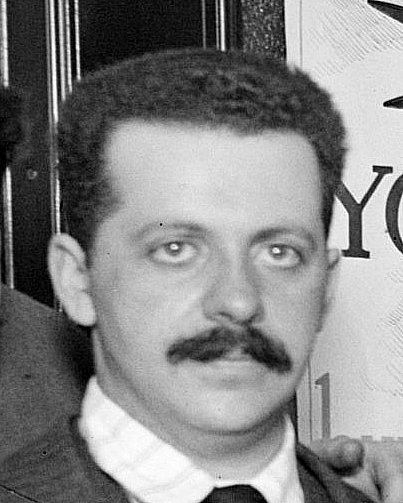
The Phantom Public centers around public opinion, and was his reaction against the populist, mob rule democracy that birthed people like Mussolini. His idea was that the public is a theoretical fiction—that “the public,” is not a singular thing, but a collective one. It’s a superindividual—just like cells make up each of us, each of us makes up the public. And we are all sovereign and capable of making our own choices, having our own beliefs.
Before that, advertising appealed to, “the public,” as a more monolithic phenomenon—it’s why businesses have struggled to adapt to the reality that…Lippmann was right. People don’t buy products. They buy values—because each is sovereign, and each with their own beliefs. Demographics assume something more monolithic—that all, for example, 18–24, male, single people, buy the same way. They don’t. They never really did, except as Lippmann and Bernays noticed: tied to social values.
Bernays believed that the artful use of propaganda could alter politics, change society, and lead to lobbying for gender and racial equality. This, by manipulating the masses through concerted acts of public relations. Public relations scholar Curt Olsen described Bernays’ outlook on propaganda as, “sunny.” It wasn’t until the Second World War that propaganda gained more criticism. That itself was a reason for the shift away from Bernays’ outlook, and public relations doing their own image management, and distancing from the cradle they were born in.
But Bernays himself believed that propaganda was key to the survival of democracy. He said, “Engineering consent of the masses is vital for the survival of democracy.” His idea for propaganda was helping marginalized groups gain greater social acceptance—see above. Torches of Freedom. And that image of marginalized groups could be rehabilitated from years of prejudices. It’s something that groups and organizations representing the marginalized still do today. They focus on the human story, and representing those groups as real people, just like everybody else.
That’s the heart of Propaganda. To work against overarching societal prejudices—we just don’t call it propaganda anymore. We call it public relations. We all do—no matter the color tie we wear.
‘Propaganda producer,’ was the name Bernays gave to the work he did—sunny, right? Propaganda is the work of a master of public relations. Bernays had a skill with language. He replaced ideas like, “indoctrination,” with the happier term: “education.”
That would be a cornerstone of the work Roger Ailes would do for Richard Nixon, decades later. And continued to be refined, up until the topple of the Fairness Doctrine—the idea that media needs to provide balanced, equal news. That, itself, was the public relations, “why,” that Fox News adopted the slogan, “fair and balanced.” Which communicates that they, and only they, are the fair and balanced ones—and how dare anyone suggest that the Fairness Doctrine was needed? That certainly said more about their competition!
What Ailes and Fox did, originated with Lippmann and Bernays. Propaganda, unlike Lippmann’s more thoughtful and scholarly Phantom Public, is instructional. It’s a textbook. And political and corporate campaigns still run on it.
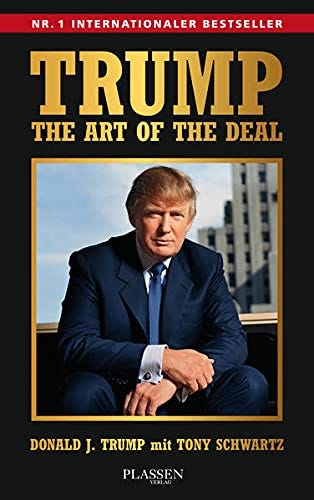
Bernays’ ideas of language use for propaganda live on to this day— ‘alternative facts,’ itself a more professional-sounding version of a phrase ghostwriter and journalist Tony Schwartz used in Donald Trump’s The Art of the Deal: ‘truthful hyperbole.’ A truthful hyperbole, according to Schwartz, is:
an innocent form of exaggeration — and … a very effective form of promotion…People want to believe that something is the biggest and the greatest and the most spectacular. —Donald Trump/Tony Schwartz, ‘The Art of the Deal’
Traditionally, we didn’t see propaganda as a bad thing. Far from it. The term as we know it, comes from the Catholic Church. It’s meant in the sense of propagation—to, as Pope Gregory XV laid out in Congregatio de Propaganda Fide, propagate the faith. There’s still an argument today, as to whether mission work is propaganda. It always was, at least in medieval Europe, thanks to Gregory.
The Ancient Greeks had used the practice, if not the term, for establishing democratic government—from their predecessors’ despotic rule. For them, it was the propagation of ideas.
Propaganda, thanks to the Greeks, became deeply tied into politics—the Romans adopted it from them, in their democratic (and later, less democratic) forms of government. The Empire ran on its military and propaganda—propagating the Empire.
University of Minnesota Professor of Journalism, Ralph Casey published a pamphlet in 1944. What is Propaganda, reflects on the nature and use of propaganda. It’s become a loaded term thanks to the rule of authoritarian fascism in Europe, between WWI and WWII, and the Soviets (and the U.S.) after that.
Casey talked about how to spot it, and how to size it up, saying the basic questions to ask, when coming into contact with propaganda is:
- What is the source of the propaganda?
- What is its authority?
- What purposes prompted it?
- Whom will it benefit?
- What does it really say?
In today’s world of fake news, alternative facts, and a, ‘marketplace of ideas,’ that blurs the line between truth and fiction—the line between fact and opinion—it’s important to keep asking ourselves these things.
And learning from the people who put these ideas onto paper.
Wisdom, having the knowledge and knowing what to do with it, is the best vaccine for that particular virus.
If you enjoyed this, you’ll enjoy all my work — I’m delightful. Mostly. You can obviously check me out here on Medium — you can sign up here, if you need to — or you can creep on me via my Carrd.