
NOVEL — THE JUNGIAN PILGRIM
The Spiritual Dimension of Group Meditation
Chapter Fifty — Skyclad meditation as a spiritual practice.
After an early breakfast, we began a twenty-two-kilometre walk to Barbadelo. It would be a shorter day than had been the norm for the past few days. We wanted to get past Sarria, which would be crawling with pilgrims.
Sarria was the last official starting point for pilgrims bound for Santiago who wanted an official certificate of completion, a compostela. We decided to not take the alternate route to Samos as it would have added seven kilometres to the hike. As well, going through Samos would have meant we would have had to stay in Sarria.
Because of the heated discussions, I had forgotten all about my intention to check the photos I had taken the night before. There was an excitement growing as we neared Santiago, an excitement shared with all the other pilgrims around us.
Three hours into the walk, we reached a tiny village called Pintín, which had a bar-café. Later, as we made our way from Pintín, there weren’t any sites that seemed suitable for meditation, so we pushed on to the centre of Sarria, where we stopped for lunch and for a few hours as tourists.
With only four kilometres remaining to Barbadelo, we were sure that there wouldn’t be a problem in finding accommodation later in the afternoon. If worse came to worst, we could always walk the four kilometres back into Sarria where there would be more than enough bed spaces for us.
A quick lunch was eaten at the bar-café O’Escalinata on Rua Mayor, near the Santa Marina church. Besides the obligatory church photos, I took photos of the sixteenth century pilgrim hospital, San Anton, and the Mosteiro de Santa Maria Magdalena, a thirteenth century convent. Then, we continued on to go across the Río Celeiro and climb up to the village of Barbadelo.
We decided against staying at the Xunta chain of hostels, feeling older albergues or private hostels were better choices if they were available. Searching through the village, we chose a picturesque place called Casa de Carmen, which had Internet, washing facilities, a restaurant, and beautiful rooms, including a few private rooms. We chose to stay together in the dorm.
“We’re making pretty good time,” commented Gabe as the group sat in the restaurant having pre-dinner beverages and tapas. “I figure that tomorrow we can easily make it to Gonzar even though it is a twenty-five kilometre hike. If we walk another twenty-five the next day, we could stay at O’Coto which would leave just sixty kilometres to reach Santiago, another three days of walking.”
“Sounds like you have it all planned out, old boy,” approved Mark. “I agree, we are all stronger and can handle the distances.”
“Miryam, do you want to call ahead and book beds at the Casa de Somoza in O’Coto?” asked Gabe. “The next beds are another six and a half kilometres further in Melida. I don’t think we want to walk over thirty kilometres in one day if we don’t have to. Remember, that’s for two nights from now,” he grinned good-naturedly.
“Not a problem,” agreed Miryam. “Consider it done. Do you have their phone number?”
With the plans for the next two days settled, we talked of the countryside we had been passing through, the sights and sounds of life in Spain, for the rest of the evening until it was time to turn in for the night.
I took advantage of the opportunity to write again in my journal:
Another good day. It looks like we will be in Santiago in five days’ time. In a way, I’m not looking forward to it, as that will be where I will have to say goodbye to these wonderful people. But at the same time, the achievement of completing the Camino will be its own reward. There is no question in my mind that I will take the time to continue on to Finisterre.
I rose early in darkness, as did all the others, intent on getting out the door as soon as the pre-dawn light allowed. We had a twenty-five kilometre walk ahead of us, and there was an increase in pilgrim traffic. Before we had gone very far, dawn spread its rays of approaching sunlight to accentuate the few clouds with a vibrant palette of colour.
We were just passing the Cruce Baxán when the sun broke free on the eastern horizon. We continued on the trail for another half hour, reaching another cross, the Cruce Leiman. We saw a café nearby and decided it would be a good place to stop for a quick coffee and toast.
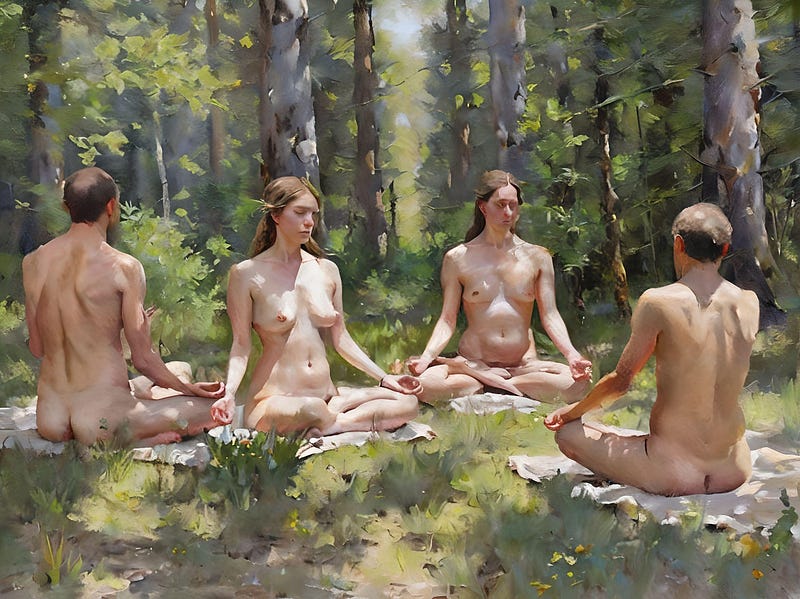
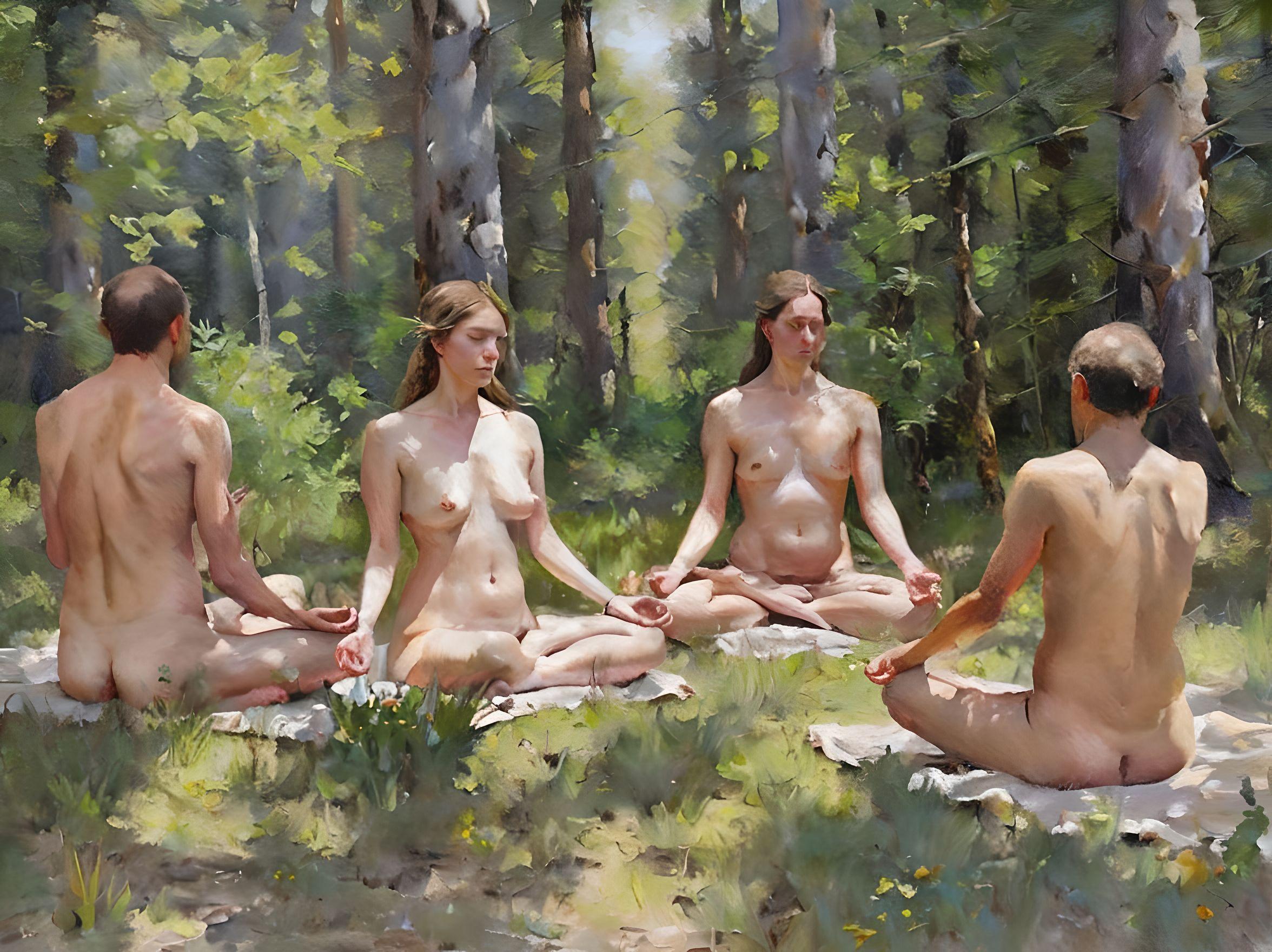
Later, we stopped between Morgade and Ferreios where we found a perfect place for group sky-clad meditation, a spot just off the tree-lined path. Meditation was kept short, at twenty minutes. We soon regained the path and walked another two and a half hours to reach Portomarin for a late breakfast or early lunch, at the popular O’Mirador café.
Two hours after eating lunch, we arrived at Gonzar, settling in for the night at the Xunta Hostel, which had Internet and all the facilities we needed. When post-hiking chores were done, we gathered for a late afternoon lunch, feeling good about having completed the distance in good time. Following the meal, I went for a walk with Fred, who wanted to talk about some ideas that were swirling around in his head.
“You know, René,” he began, “we’ve been meditating nude for so long as a group that it has become almost natural for me. I mean, despite being naked, I can feel a collective spirituality that makes me question my beliefs about nudity and spirituality.”
“Yeah, I can understand that,” I agreed. “It has been pretty much the same for me. Meditation has always been a spiritual practice for me, a private spiritual practice.”
“Well, as I was saying, it got me thinking about taking this home with me to my parishioners. How do I get past the barriers we have about nudity as a church community? It’s hard enough in our private homes, let alone building a spiritual community where we could deepen our spiritual practice by being fully and honestly present, something that being naked almost forces upon people.”
“Well,” I pondered, “I guess you’d have to identify the pros and cons of the idea before coming up with a ‘why’ and ‘how’ for naked spiritual practice as a group. What are your thoughts on that?”
“Well, I could see how for some, seeing others naked would be a distraction. It’s a problem which could only be overcome if personal nudity could become comfortable for them in private. You know, being comfortable in your own skin. I suspect in order for nudity to be accepted in a community, one has to be comfortable first with one’s own nudity.
“Once you have that,” he continued, “then it would become so much easier to be comfortable with others while naked. In any case, branching out to being spiritual with people is not just a question of acceptance of their nakedness, it’s also a question of accepting others unconditionally as people. I wonder if mutual tolerance of nudity makes it easier for acceptance of others.”
“Well, that seems to be what has happened to both of us here, hasn’t it?” I remarked. “I mean, I thought I was comfortable with myself when nude, but when I found myself nude the first time, here with others, I immediately found I still had some hang-ups about myself, which made me uncomfortable with the others. It was actually the calmness and unconditional acceptance by Sid and Asha that had allowed something to shift within me. Perhaps we need to have a guide or guides to help bridge that gap in a community?”
“Another problem that comes up for me was that naked group spiritual practice could easily focus on nudity itself and have the spiritual aspect become lost in the participants awareness of their nudity, and then using it to distance themselves from others, whom they would come to see as “less spiritual” because they weren’t naked. You know, in effect, being naked spiritual exhibitionists. In other words, they could become filled with themselves as being more spiritual than others who were not nude in their spiritual practice.”
“Ha ha ha,” I laughed. “You made me think of some of the Naga Babas I saw in India. Their nudity and spiritual practice seemed to have become more about street theatre than it did about holiness. To me, it seemed that the holy men were more in search of tourist cameras than enlightenment.”
“Exactly!” confirmed Fred. “It’s that ‘look at me’ narcissism that feeds off of being exposed, exhibitionism rather than a spiritual humility.”
“I like that, Fred, spiritual humility. In my Buddhist sangha at home, we often talked about something called spiritual consumerism.”
“The last thing I came up with,” continued Fred, “was about spiritual maturity. For some, there isn’t enough spiritual maturity for group practice, whether or not they are clothed clothed. Nudity could just accentuate spiritual immaturity. In a way, it ties in with what I have already said. Are you mature enough to view nudity as a means of approaching God and not view nudity as the focus of worship. If not, then it is likely one needs to approach nudity as a means of approaching God as a way to build maturity rather than simply discard the idea. People do need time to grow into authentic spiritual practice, naked or clothed.”
I clapped Fred on the back and said, “It sounds like you have it all reasoned out. Now, the hard part comes in risking it, Fred.”
“Yeah, you’re not kidding,” he admitted, “Risking it and likely risking my employment at the same time.”
Find all chapters here
I want to thank my readers for following along with this story of my Camino. There are many chapters left to present here. Special thanks go to:
Benighted, Block Wife, Robert, and Marie A. Rebelle for always being here for me and this story.