
The Sounds and Smells of Classical Gas
Wolfgang Amadeus Mozart was not the only great 18th-century man who enjoyed fart jokes and bathroom humor
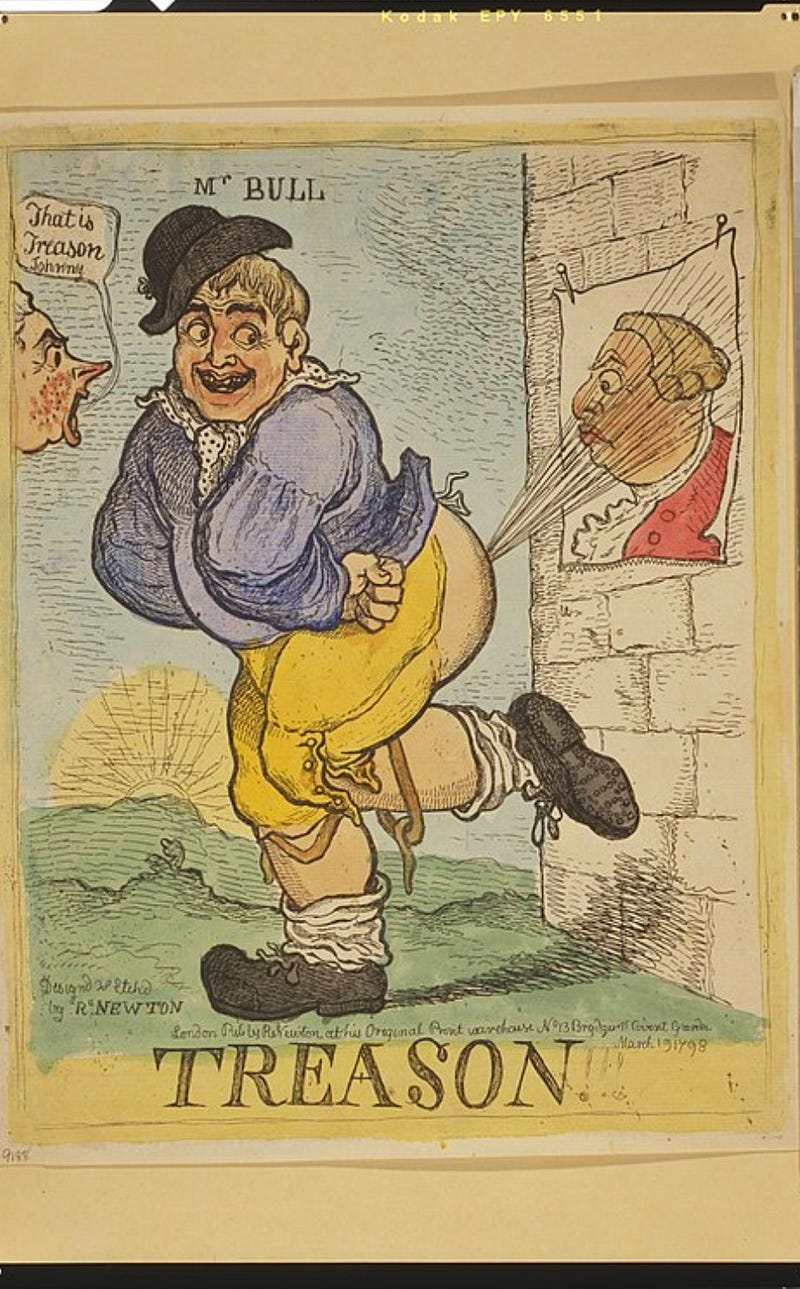
Since January 7th is National Pass Gas day, there’s no better time to take a PEEk–or rather, a whiff–of 18th-century bathroom humor.
Now, some of you may be surprised. Isn’t the 18th-century known as the age of aristocracy? The Augustan age? The classical age of symmetry, balance, powdered wigs, hoop skirts, and all that?
Yes. And no. Because as the early 18th-century scientist Isaac Newton observed, “For every action, there is an equal and opposite reaction.” For all the elegance and opulence of the century, there was also a curious fondness for all things ass-ociated with the latrine and chamber pot: arguably because of the yet undeveloped state of sanitation. The image above — a 1790s political cartoon (to be discussed later) — amply shows that scatological humor was almost unexceptional for the time.
So, let’s take a playful romp through an age where scatological humor thrived until the takeover of the prim and proper Victorians. We’ll see how 18th-century writers and artists used scatological or bathroom humor (as we call it today) which occasionally served as a not-so-covert means of sticking it to the aristocracy, clergy, and monarchy that governed politics and society.
Amadeus and Wolfgang Amadeus Mo-Fart
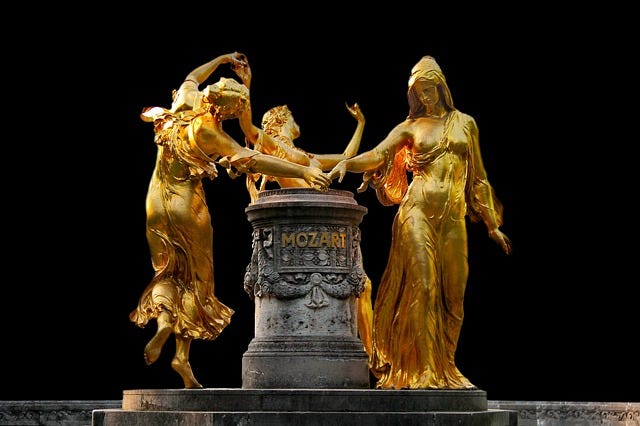
If the vast majority of those who watched Milos Forman’s Amadeus were shocked by Mozart’s potty jokes — including Margaret Thatcher, who vehemently refused to believe that the great composer could be so foul-mouthed — a few of us were not. We’d read Emily Anderson’s edition of Mozart’s letters and see the evidence.
Now, even though it’s difficult to determine if Mozart behaved himself in the presence of the emperor as he did in the film, he did enjoy bathroom humor: especially where messy farts were concerned. Look at these excerpts from a letter he wrote to his cousin, Maria Anna Thekla Mozart (otherwise known as the Basle), on November 5, 1777, when he was nearing his 22nd birthday. First, he bids her good night, encouraging her to: “shit in your bed with all your might, sleep with peace on your mind, and try to kiss your own behind.”
Then he cries out:
Oh my ass burns like fire! what on earth is the meaning of this! — maybe muck wants to come out? yes, yes, muck, I know you, see you, taste you — and — what’s this — is it possible? Ye Gods! — Oh ear of mine, are you deceiving me? — No, it’s true — what a long and melancholic sound! —
That’s right, he just farted! But wait, there’s more:
As I am in the middle of my best writing, I hear a noise in the street. I stop writing — get up, go to the window — and — the noise is gone — I sit down again, start writing once more — I have barely written ten words when I hear the noise again — I rise — but as I rise, I can still hear something but very faint — it smells like something burning — wherever I go it stinks, when I look out the window, the smell goes away, when I turn my head back to the room, the smell comes back — finally My Mama says to me: I bet you let one go? — I don’t think so, Mama. yes, yes, I’m quite certain, I put it to the test, stick my finger in my ass, then put it to my nose, and — there is the proof! Mama was right!
In other words, oops, I farted again! (If he were alive today, he could write and perform a great hit with Britney Spears…)
Incidentally, note how his mother is involved in this. In the full-length version of the letter found in Emily Anderson’s edition of the Mozart family letters, Mama tells him to stick his finger in his you-know-where to see if he’s cut the cheese. You know, she enjoyed this humor just as much when she wrote to her husband, Leopold:
Keep well, my love. Into your mouth your arse you’ll shove. I wish you goodnight, my dear, but first shit in your bed and make it burst.
Both mother and son had an obsession with bed soiling. But even the more strait-laced, business-minded Leopold is said to have had at least one such joke in his correspondence. (Check out some of the target practice pictures that the Mozart family used in this most entertaining Medium article by Tim Ward.)
Certainly, the composer of Don Giovanni and The Magic Flute never tired of bathroom humor. In later years, he would write a letter to his wife, Constanze, suggesting that she engage in a farting duet with her mother. (This idea reminds me of that “Chitty, chitty, bang, bang” song, “TOOT sweet.” But I digress!)
Nor did Mozart refrain from incorporating these jokes in his music — or rather, his lyrics. Again, talk about tooting…one’s horn! One could say he had a canon of bathroom canons, starting with this little gem he composed in his 20s, a canon in A major, “Leck mich im Arsch” or “lick my ass”:
Lick my ass nicely, lick it nice and clean, nice and clean, lick my ass. That’s a greasy desire, nicely buttered, like the licking of roast meat, my daily activity. Three will lick more than two, come on, just try it, and lick, lick, lick. Everybody lick his own ass himself.
This was followed by another canon, “Leck mir den Arsch fein recht schon sauber” (lick my ass well and clean) one in which Mozart wrote the lyrics to the music of another composer, Wenzel Trnka. Mozart would write three more of such canons in his 30s — when he composed his last three and greatest symphonies. (For a list of these canons, see Stieg Hedlund’s Coprophony.)
Even more interestingly, Mozart mocked aristocrats at a concert in Augsburg with similar humor as he mentioned “the Duchess Smackarse, the Countess Pleasurepisser, the Princess Stinkmess, and the two Princes Potbelly von Pigdick” in a letter to his cousin. Could this explain his future interest in writing an opera based on Beaumarchais’ Marriage of Figaro, where a powerful count is outwitted by his servants and wife?
Not surprisingly, psychologists and biographers have had a field day with Mozart’s inclination for all things scatological, from letters to lyrics. The Austrian writer Stefan Zweig sent copies of the Basle letters to Sigmund Freud, suggesting that “It would actually be a very interesting study for one of your pupils.” A century later, a few biographers — particularly, J. P. Davies — would go so far as to claim that Mozart showed signs of Tourette’s syndrome. In 2001, B. Simkin published Medical and musical byways of mozartiana. Common sense finally intervened when Osamu Muramoto noted that such arguments,” failed to understand the historical context, language usage of eighteenth-century Salzburg, and indeed, the personality of Mozart.”
Benjamin Franklin and the Art of Farting Proudly
The historical context mentioned by Muramoto is indeed apt. Because it wasn’t just 18th-century Salzburgers who enjoyed scatological humor but a considerable swathe of Europe and the American colonies, after all, who can forget Jonathan Swift’s “Lady’s Dressing Room” with the famous closing lines, “Celia, Celia, Celia shits?” Or the novels of Scottish novelist Tobias Smollett, many of which invoke accidents involving diarrhea, pee, and chamber pots emptied from windows? (The Adventures of Peregrine Pickle is arguably the most satisfying here!)
Consider Benjamin Franklin’s essay that has come to be popularly known as “Fart Proudly” (1781) — even if there is some confusion as to whether it was initially titled “A Letter to a Royal Academy about farting” or “To the Royal Academy of Farting.”

Not unlike Mozart, Franklin was also stirring the pot of anti-elitist sentiment. For some time, Franklin had been critical of European academic societies, believing they were pretentious and out-of-touch with the real world. Written as a satirical reply to a call for scientific papers from the Royal Academy of Brussels, his letter proposed more down-to-earth subjects for research — literally and figuratively speaking.
For instance, why not find a food additive or med that makes farts smell less nauseating? He begins with a statement worthy of Jane Austen:
It is universally well known, That in digesting our common Food, there is created or produced in the Bowels of human Créatures, a great Quantity of Wind.
That the permitting this Air to escape and mix with the Atmosphere, is usually offensive to the Company, from the fetid Smell that accompanies it.
That all well-bred People therefore, to avoid giving such Offence, forcibly restrain the Efforts of Nature to discharge that Wind.
(Yes, folks, they were already using that expression, “break wind,” for farting.) As such, he goes on to say, why not
discover some Drug wholesome & not disagreable, to be mix’d with our common Food, or Sauces, that shall render the natural Discharges of Wind from our Bodies, not only inoffensive, but agreable as Perfumes.
Because it’s time to declare independence from bad smells! But the following long and windy passage is arguably even more graphic than Mozart’s words on ass-licking and poking (note: a “jake” is a john):
That we already have some Knowledge of Means capable of Varying that Smell. He that dines on stale Flesh, especially with much Addition of Onions, shall be able to afford a Stink that no Company can tolerate; while he that has lived for some Time on Vegetables only, shall have that Breath so pure as to be insensible to the most delicate Noses; and if he can manage so as to avoid the Report, he may any where give Vent to his Griefs, unnoticed. But as there are many to whom an entire Vegetable Diet would be inconvenient, and as a little Quick-Lime thrown into a Jakes will correct the amazing Quantity of fetid Air arising from the vast Mass of putrid Matter contain’d in such Places, and render it rather pleasing to the Smell, who knows but that a little Powder of Lime (or some other thing equivalent) taken in our Food, or perhaps a Glass of Limewater drank at Dinner, may have the same Effect on the Air produc’d in and issuing from our Bowels? This is worth the Experiment. Certain it is also that we have the Power of changing by slight Means the Smell of another Discharge, that of our Water. A few Stems of Asparagus eaten, shall give our Urine a disagreable Odour; and a Pill of Turpentine no bigger than a Pea, shall bestow on it the pleasing Smell of Violets. And why should it be thought more impossible in Nature, to find Means of making a Perfume of our Wind than of our Water?
The trump card is saved for the very end. Research on additives for farts sure beats all of the impractical research being produced by those royal (pain-in-the-ass) academies:
And I cannot but conclude, that in Comparison therewith, for universal and continual UTILITY, the Science of the Philosophers abovementioned, even with the Addition, Gentlemen, of your “Figure quelconque” and the Figures inscrib’d in it, are, all together, scarcely worth a F A R T-H I N G.
Note the pun on FART-hing!
Grossing Out with Grose: Fart-Catchers, Farting Crackers, And Fizzles
Not long after came the publication of Francis Grose’s Classical Dictionary of the Vulgar Tongue (1785), partly modeled on Philibert-Joseph Le Roux’s Dictionnaire Comique, Satyrique, Critique, Burlesque, Libre et Proverbial (1735) and possibly in reaction to Samuel Johnson’s definitive Dictionary published in 1755. In many respects, not unlike Franklin’s “Fart Proudly,” Grose’s Dictionary represented a revolt against elitist decorum and taste with entries drawn from boxers, cockfighters, prostitutes, book-sellers, and stock traders. It was a way of saying, “hey, we proles and plebes have our own traditions and language too”: in fact, Grose would inspire the poet Robert Burns.
The preface to the Classical Dictionary reads:
The Vulgar Tongue consists of two parts: the first is the Cant Language, called sometimes Pedlars French, or St. Giles’s Greek; the second, those burlesque phrases, quaint allusions, and nicknames for persons, things, and places, which, from long uninterrupted usage are claimed by prescriptions.
Note how the idea of the French and Greek as standard-bearers are burlesqued here. As such, we get the following colorful definitions:
- Admiral of the narrow seas: One who from drunkenness vomits into the lap of the person sitting opposite him
- Box the Jesuit: A sea-term for masturbate; a crime, it is said, much practiced by the reverend fathers of that society.
- Bum fodder: toilet paper
- Cascade: to vomit
- Fart catcher: a valet or footman, from his walking behind his master or mistress
- Farting crackers: breeches
- Fizzle: A small windy escape backwards, more obvious to the nose than ears; frequently by old ladies charged on their lap-dogs.
- Just-ass: a punning name for a justice [judge]
- Pissing pins and needles: to have gonorrhea
- Screw: to copulate
The popularity of Grose’s work was such that it continued to be published at least until 1823 — and is one that might have inspired not only Burns, but William Blake.
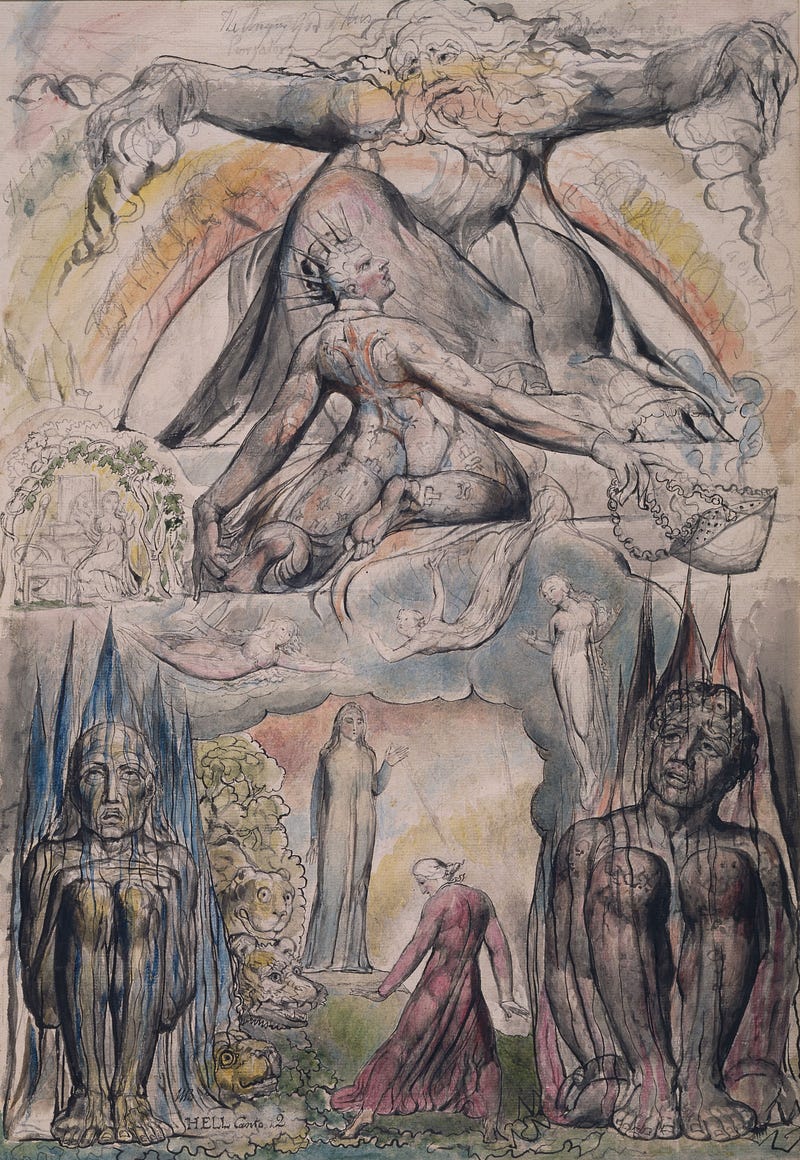
“When He Rose up from Shite”: Billy Blake and Bathroom Humor
No doubt the poet and artist William Blake comes almost as much as a surprise as his close contemporary, Mozart. Much like pre-Amadeus Mozart and other great artists, Blake has long been ass-umed to be too lofty and ethereal to stoop to bathroom humor even if scholars have begun to challenge this view more thoroughly from the early 1990s.
That’s right — the poet who wrote prophetic books such as Milton and Jerusalem. Yet, his marginalia includes images of a king dropping from a horse’s behind. There is also a sketch of a man urinating.
Just take a look at the following lines, replete with visions of the mysterious god-like Nobodaddy farting and belching while Blake is taking a dump by the trees. This poem is all about Blake giving his finger to the German poet, Friedrich Gottlieb Klopstock, who claimed that the English language was “incapable of the epic grandeur of hexameters” which he blamed on Jonathan Swift. Here, Nobodaddy calls on Blake to torture Klopstock. As Blake relieves himself, nature becomes disordered and the devils rise up to churn up Klopstock’s bowels.
When Klopstock England defied Uprose terrible Blake in his pride For old Nobodaddy aloft Farted & Belchd & coughd Then swore a great oath that made heavn quake And calld aloud to English Blake Blake was giving his body ease At Lambeth beneath the poplar trees From his seat then started … The Moon at that sight blushd scarlet red The stars threw down their cups & fled And all the devils that were in hell Answered with a ninefold yell Klopstock felt the intripled turn And all his bowels began to churn And his bowels turned round three times three And lockd in his soul with a ninefold key That from his body it neer could be parted Till to the last trumpet it was farted…
If Blake could do this when he rose up from shite What might he not do if he sat down to write.
Ultimately, Blake takes pity on the constipated Klopstock and saves him — hence the last two lines.
Conclusion
By now, it’s pretty obvious that Mozart was far from being singular or unique in his obsession with fart jokes. Bathroom humor was in fact pervasive throughout the 18th century— not only because of inadequate sanitation but also because it served as an oblique means of dissing the well-born, well-heeled bosses and decorum of their day, whether it was Mozart with Princess Stinkmess, Franklin with the Royal Academy, Grose with classical aristocratic learning or Blake with Klopstock. Screw pompousness. We might even call it a form of the “fearful symmetry” that Blake wrote of in “The Tyger”: the “F you” to highborn anal retentiveness.
So perhaps, having opened this story with Isaac Newton and his principle of equal and opposite forces, it’s only appropriate to conclude this post with a brief statement on that very first image in this story.
That cartoon was drawn by R. Newton (related to Isaac?) in the aftermath of the Reign of Terror when the activities of revolutionary France were truly scaring the wits (and maybe the shits) out of the landed British aristocracy and gentry. By then, Prime Minister William Pitt the Younger had already declared Thomas Paine’s defense of the French Revolution, Rights of Man, seditious libel and in 1794, Pitt rounded up even more so-called Jacobin sympathizers — to the point that even some conservatives were beginning to find the reaction overbearing.
This overreaction is the subject of Newton’s cartoon as Pitt scolds a rowdy, ordinary Englishman, John Bull, for farting at a poster of George III, calling it “treason.” Which brings us back to the idea of a plebeian revolt. After all, if you can’t guillotine a crowned head in your own country, what could be more satisfying than farting at one?
Now for some classical gas:
Sources:
Anderson, Emily. 1966. The Letters of Mozart and His Family. London: Macmillan and Co., Ltd.
Coleman, Julia. 2009. A History of Cant and Slang, Vol. 2. Oxford: Oxford University Press.
Godfrey, Richard and Mark Hallett. 2001. James Gillray: The Art of Caricature. London: Tate Gallery.
Mee, Jon. 1992. Dangerous Enthusiasm. Oxford: Oxford University Press.


