
The sober shaming of men has to stop
Unfortunately, men face some unique societal pressures around drinking.
I assume women do as well, I just can’t speak to them personally because I’m not a woman (though I would absolutely love to hear from you in the comments regarding gender-specific challenges you may have run into and how you dealt with them).
I’ve run into gender-specific pressures of my own throughout my life, most recently last week.
I was at a sports event with a bunch of male acquaintances and I was the only person not drinking beer.
This did not go unnoticed.
I kid you not, I was either offered a drink or asked “you sure you don’t want a beer?” — no exaggeration — about 10 times in the span of one hour.
People were just being nice and I didn’t resent the offers or questions at all, I was just kind of interested in the sheer volume of interactions around whether or not I was going to have a beer.
If you’re around my age (41) and surrounded by other males who are all drinking, you can expect to gain some unwanted attention should decide not to partake.
I don’t talk about my decision to reduce my alcohol intake in my private life, I just politely decline the offers.
But if you don’t drink in those scenarios, expect that some people are going to look at you like you have three heads.
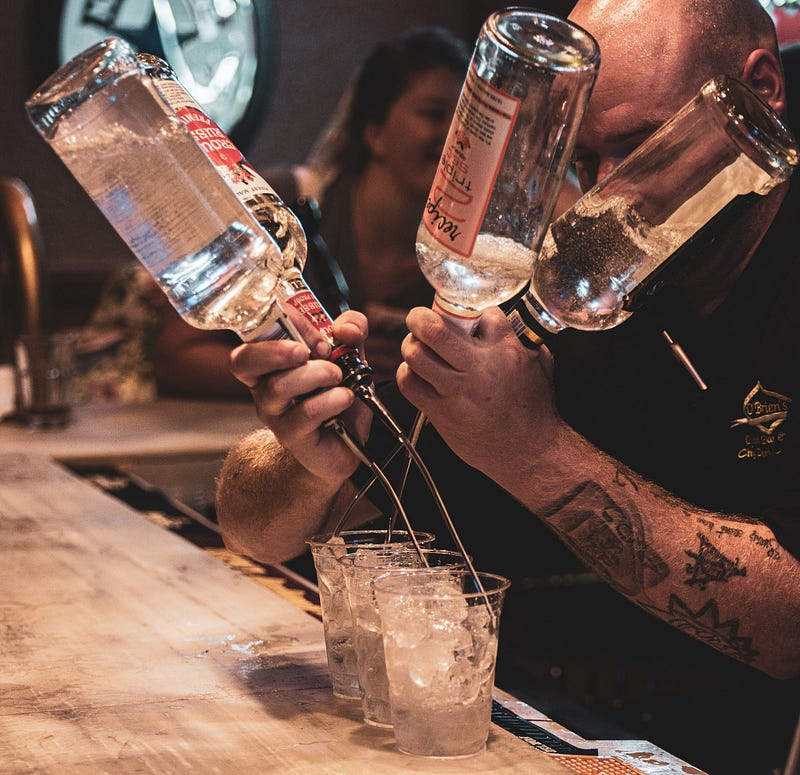
A measure of toughness
In a way, I don’t blame inadvertent sober-shamers.
Popular culture and Big Alcohol have always celebrated drinking as a way for men to prove how tough they are, and we’ve all been trained to look at it as an important factor in the male identity.
“I can drink you under the table.”
Forget arm wrestling. For a lot of guys, the true measure of masculinity is how many shots you can drink without puking or passing out.
I fell into this trap when I was younger.
I was proud of my ability to drink heavily with almost no ill effects in my 20s, and I used it to prove how “cool” and “manly” I could be.
In university, it was a badge of honour to just be happy and chilling as other guys were projectile vomiting on the street or being dragged out of a bar because they were no longer able to walk on their own.
“How embarrassing,” I’d think to myself as I’d order another drink.
When I met my wife’s extended family the first few times, I used my ability to drink with almost no limit and no physical pain to try and get them to like me.
I was a bookish, liberal, skinny journalist. They were big, rough-around-the-edges country folk.
But I could outdrink people twice my weight and barely feel it, and boy did they get a kick out of that.
Once you’re that deep into the booze, everyone is your best friend.
Now that I’m 41 and my body no longer processes alcohol like water, it seems so stupid and unnecessary in retrospect.
Incremental change
Things do seem to be changing, although slowly.
The advent of initiatives like Dry January and Sober October are opening the door to people trying life without alcohol, and I’ve recently run into several fellow competitive sports dads who have taken part this year.
And they aren’t even ashamed to talk about it!
But you’re just as likely to be chirped as praised.
As I wrote here last week, I recently didn’t order a drink — I didn’t even turn one down, I just didn’t order anything — at an event, and one of the guys I knew said in a joking manner: “what, you think you’re better than me?”
I laughed because of the way he said it, but it does speak to how quickly your decision not to consume alcohol gets noticed and pointed out.
Real toughness
In fact, it takes a lot more toughness as a man not to drink.
You can be ostracized, you can be ignored, you can be excluded, you can have your manhood questioned, you can be openly mocked.
Take all that general societal pressure to drink and then throw in gender-specific chirps and it takes a man who is very secure in who he is to stick to his guns.
More and more young people are eschewing the booze-soaked life, however, and among that generation, old-school tests of male virility seem to be waning.
Remember, there was a time when you would be considered less of a man because you didn’t smoke cigarettes.
Now, Dry January-type events and more effective education and regulation seem to be pushing alcohol in the same direction as the cancer sticks.
Heck, my own country recently changed its guidelines to recommend no more than two alcoholic beverages per week (down from 14).
At some point, we may look back and marvel at why we drank at all.
Right now, however, it still takes a great deal of toughness to just say no.
Friends, thank you so much for reading this post all the way to the end! If you enjoyed it, please take a moment to give it some claps so others can find it. I always love to hear from you in the comments, too!
Is this your last free article? Please consider supporting my work directly by using this link to subscribe to Medium ($5 a month, cancel any time)!
My most-read posts:
- I quit alcohol for one month and my side hustle income exploded
- Do these 4 exercises and you’ll be in the best shape of your life
- The one priceless book that kicked off my quit alcohol journey
- Gary Oldman explains why it’s never too late to quit alcohol
- When alcohol trapped Gwyneth Paltrow
The latest from me:
- ‘Staying still scares me’: Why YouTube rap star KSI quit alcohol
- The trauma of being an introverted child
- Quitting alcohol as a status symbol
- ‘Cali Sober’ is a road to ruin
- Is ‘99% sober’ a realistic goal?
- ‘I’m actually gonna ruin my life’: why Bradley Cooper quit alcohol
Get an email every time I publish so you don’t miss a story!


