
The Sleep of the Hydra
New study of a simple brainless animal shows us the deep evolutionary roots of sleep

1. Sleep…
Most of us have pulled all-nighters or operated on little sleep. We sense the deep damage this causes and feel tremendous relief when we manage to “catch up on sleep” — and science confirms those feelings.
A new paper in the journal Science helps us understand how sleep and its regulation evolved, and perhaps why it is so important. This study revealed sleep-like behavior in hydra, the simplest organism confirmed to date and very distantly related to humans. Yet the authors showed that hydra share with us the same genetic machinery to control sleep, and sleep-regulating compounds like melatonin.
I wrote about sleep and its testing in animals here, and pointed out that scientists now know a couple of important things about sleep — yet remain mystified by it.
First. Sleep is essential. If we don’t sleep, we die. If we don’t sleep enough, our bodies break down.
Second. Sleep is a deeply conserved biological trait. Which means we share that trait with a broad range of species with whom we look nothing alike, yet share a common ancestor in deep evolutionary time, from whom this trait comes.
Third. We know almost nothing about why sleep is so important. It is still a fundamental mystery, despite us learning so much about the genetics, the molecular biology, and the biochemistry of sleep.
We know mammals, birds, reptiles, amphibians, fish, flies, worms, and even jellyfish share behaviors we recognize as sleep. We know broadly diverse species share similar sleep genetics and biochemistries, such that similar compounds induce sleep or wakefulness in all.
As we go further back in time to the most primitive organisms that might share a deep common ancestor with humans, we hope to untangle the why’s of sleep, as nicely as we have deciphered the how’s.
One of the important why’s for sleep had been the hypothesis that sleep’s original purpose was to regenerate or renew the brain. My article highlighted the discovery of ever simpler and smaller-brained animals which also showed sleep behaviors and biochemistry, ultimately including the beautiful but brainless Cassiopeia jellyfish — which derailed that hypothesis.
The hydra is well-positioned to help us understand the evolutionary how’s and why’s of sleep. It is the simplest and most basic of multicellular animals that sleep, and which respond to the same sleep-inducing chemicals as humans and the diverse animals we have tested so far.
2. Hydra…
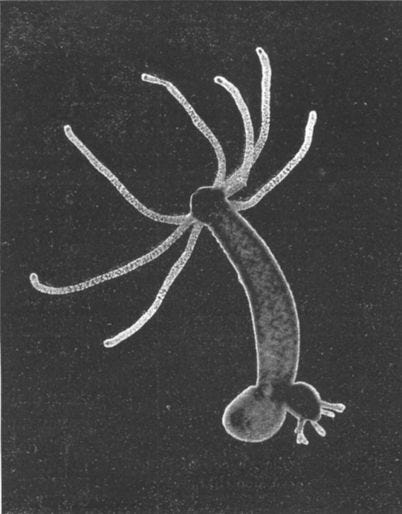
The hydra is a beautiful and compelling creature to study. The photograph of the tiny creature shown above, captured in 1911, bears an uncanny resemblance to John Singer Sargent’s mythological painting done a decade later. And like the mythological beast, if you cut off its head, it will grow a new one. Thankfully it is only about a centimeter long. There is no need to hire Hercules when you run into this one.
It is an extremely simple organism in many ways. It has only two cell layers: the epidermis is the outer layer like our skin, and the gastrodermis is the inner layer that lines its stomach.
The hydra is shaped like a bag, or a hollow tube closed at the “foot” end, with a single opening at the “head” end which is surrounded by up to a dozen tentacles — but it is hollow from end to end. The whole creature is a stomach with tentacles.
The opening is the mouth which it uses to engulf its prey but is also the same opening in which indigestible remnants of its prey are expelled. Its mouth is also its anus. So, the next time you want to call someone a potty mouth but don’t want to be so direct, you can call them a hydra.
The tentacles have stinging cells used to paralyze its prey. It has fairly complex hunting and feeding motions, which can be triggered by chemicals released by its injured prey. Hydra are usually sedentary but move on occasion especially when hunting.
Most important for our discussion, the hydra has a nerve net, rather than the more complex animal’s central nervous system, and it has no brain.
3. Sleep of the hydra…
The lead author of this Science paper, Hiroyuki Kanaya, and senior author Taichi Itoh, both at Kyushu University, worked with an international team from Korea and France. Together they detected sleep behavior in the hydra by recording its movements during an artificial 12-hour light-dark cycle. By analyzing consecutive frames, their R-programmed code could automatically differentiate between quiescence and activity. With this setup, the authors probed the behavior of hydra and confirmed that this brainless animal exhibited sleep responses similar to animals with a central nervous system. These sleep characteristics included:
- Ability to disturb sleep, or as the authors say, “reversible behavioral quiescence”
- Not responding to normal stimuli
- Following an internal sleep clock regulated by daylight
- Sensitivity to sleep-inducing drugs like melatonin
The ability to disturb sleep is a basic characteristic of mammalian sleep. We fall asleep and become unresponsive to normal stimuli (the second sleep characteristic listed above). But a measurably large stimulus (a loud sound, a vigorous shake, etc.) can awaken us. The researchers showed that bright light could “awaken” sleeping hydra and that the delay in waking was shorter for brighter or longer light pulses.
Kanaya et al. also tested hydra under various conditions of light and dark. The normal condition was a 12-hour light/dark cycle. They also exposed hydra to either constant light or constant dark to see if there was any inherent circadian rhythm operating in these animals. None were found. Unlike animals with a central nervous system like humans, it appears hydra sleep is not tied to an internal clock.
4. The chemistry and genetics of sleep…
This research group also tested whether their captive hydra was sensitive to melatonin, a hormone proven to induce sleep in a very broad range of animals from jellyfish to humans. They found that indeed increased melatonin dose increased sleep in their hydra, as it does with us.
Kanaya et al. then examined the genome of the hydra and found genes similar to those which work with sleep-regulating neurotransmitters in more complex animals with a central nervous system. Key genes included:
- Tyrosine hydroxylase — an enzyme which catalyzes the conversion of L-tyrosine to L-DOPA
- 3,4-dihydroxyphenylalanine (DOPA) decarboxylase — which makes dopamine from L-DOPA
- Dopamine receptors — cell-surface receptors which bind to dopamine and transmits its sleep effects
- glutamic acid decarboxylase — converts glutamic acid to GABA
- GABA transporter — transports GABA across the central nervous system neuronal membrane
- GABA receptor — cell-surface receptors which respond to GABA
- GABA transaminase — a series of enzymes which synthesize, transmit, and degrade GABA
GABA (gamma aminobutyric acid) is a powerful inhibitory neurotransmitter in complex animals like vertebrates with a central nervous system — and it acts to reduce neuronal excitability — and induces sleep.
The hydra researchers found GABA was very effective in inducing sleep in their animals, consistent with its effect on vertebrates.
Dopamine, however, known to suppress sleep in vertebrates, did the opposite in hydra. This surprising result was confirmed when they increased doses of the precursor to dopamine, L-DOPA, and otherwise toggled the production of dopamine and got the same result as when they directly added dopamine and caused the hydra to sleep.
These results told Kanaya that GABA and dopamine, despite their similar or different effects on sleep, both evolved early in the development of sleep regulation.
In another fascinating experiment, this team determined which genes were turned up or down when they compared sleep-deprived hydra to control animals. They applied a series of filters to the resulting list of genes and ended up with a hydra gene which was very similar to a sleep-promoting gene in worms, flies, and mammals, called PRKG1. Using drugs known to inhibit or activate this gene, the team showed that PRKG1 also promotes sleep in hydra — and concluded that PRKG must be one of the ancestral genes that regulate sleep in all animals.
There were other genes identified in this experiment, and based on their results with PRKG1, Kanaya et al. speculated that this list of genes may prove to contain more sleep-associated genes. They tested this by genetically knocking down equivalent genes in flies, and finding that these genes did indeed interfere with sleep. One of the fly genes was for a mitochondrial enzyme called ornithine aminotransferase (OAT). Ornithine is a known sleep-promoter, and dietary ornithine is used in animals including humans to promote sleep. The team surprisingly found that dietary ornithine promoted wakefulness in hydra — again the opposite of the effect on vertebrates. But the conclusion was that ornithine has an ancient origin as a sleep regulator.
5. The function of sleep…
The last thing this team examined was the effect of sleep deprivation on cell proliferation (cell division). Sleep deprivation is known to stop cell proliferation (which is necessary for growth and healing) in mammals and flies.
The team found that cells stopped dividing when hydra lacked sleep. This lack of cell proliferation occurred throughout the animal’s body, suggesting that sleep systemically regulates cell division. More importantly, they concluded that the function of sleep may be traced back to such simple organisms without a central nervous system, to the regulation of restorative cell division.
Sleep is an important, essential function in all animals. Lack of sleep is damaging and ultimately lethal. The purpose of sleep is still not fully clear, but these experiments in hydra demonstrate that perhaps one ancient and original purpose of sleep was restorative cell division and growth.
It is possible that as animals developed a central nervous system, and then a brain, the function of sleep retained its restorative function, but also became essential for brain maintenance. How exactly that evolutionary transition occurred is not clear. But these detailed studies on the hydra have shed light on the importance of sleep, and just how ancient the genetic and molecular regulation of sleep is.