
NEGOTIATION
The Skill Everyone in Hoge Army Needs
What I’ve learned from the Black Swan
By Hogefather, aka Jesse J Rogers
“A black swan is an unpredictable event that is beyond what is normally expected of a situation and has potentially severe consequences.” — Investopedia
Most people are terrified of the unknown, and the term Black Swan can especially make some people’s blood run cold in the financial sector, where stability is prized.
But that’s not us. In Hoge Army, we lean into the unknown and relish the unexpected.
I’d like to introduce you to a man who sees Black Swans not with fear, but with excitement.
He’s probably never heard of Hoge Finance. He’s certainly never heard of me. But this man has had a profound impact on my life by training me through books and lectures in the most valuable skill that I possess.
It isn’t writing, although I treasure this skill.
It isn’t mathematics, although that is currently how I make my living.
The skill I speak of is negotiation. And I utilize it in every single interaction.
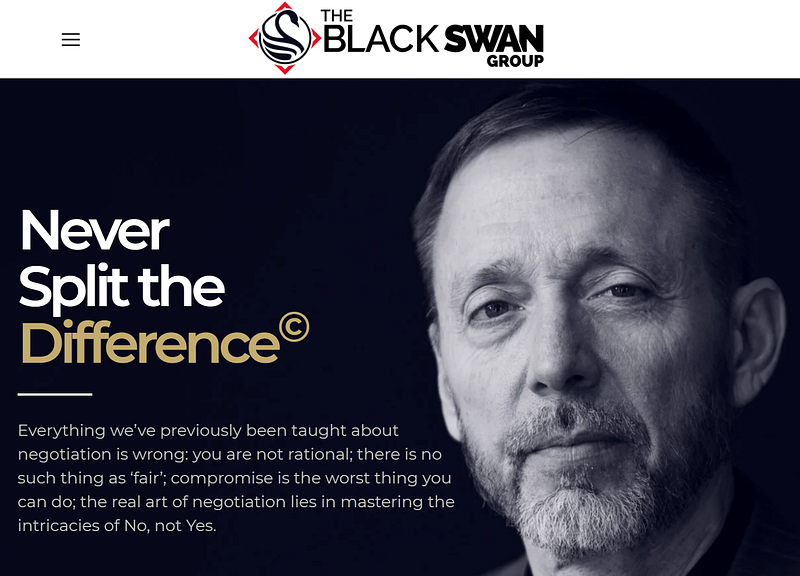
The man who gave me this gift is the former FBI Lead Negotiator Chris Voss.
What Does This Have to Do With Hoge Finance?
Now that I’m the head writer for Hoge Finance, I feel a sense of responsibility to pass on the most powerful skills that I’ve learned to the entire community.
Why? See, when you bought Hoge, you probably had visions of driving a Lambo on the moon after instantly getting 50x returns on your money. But instead, the price dipped and you got locked in for the long haul. That happened to a lot of us that came in at a price spike.
Having to wait for delayed gratification (yes, this token still has a very bright future) might strike you as bad fortune at first glance. But looking at it another way, what buying into Hoge in fact did is give each of us a stake in one another’s success.
In every conversation you have, you’re representing the Hoge brand. That means that no matter who you are or where you come from, I have an incentive to help you to carry yourself well.

Maybe you’re not as committed to the future of Hoge Finance as I am. Maybe you just wanted to turn a quick buck. But because of the price dip, instead of making a nice profit and moving on, we’re bound to this together. The only way this investment will pay off for us now is if we each roll up our own sleeves, pick up a shovel, and get digging. It’s up to us to build Hoge into the thing that it could be.
This is a meme-powered community coin. The original developers gave up on the project a few days after launch. They’re not the ones who took it this far. We did. The community. People just like you and me. It is literally up to each and every one of us because no one is coming to our rescue. We have to put in the work if this thing will succeed. The only way we get there is by helping each other grow.
You might look at your account holdings and think “what bad fortune”. But as Chris Voss likes to say, “Never be so sure of what you want that you wouldn’t take something better.”
So let me explain how you can learn to see the world through the eyes of one of the world’s most effective communicators.
Tactical Empathy
The key to negotiation as taught by Chris Voss is being a good listener. You need to get information about the other person’s feelings, values, and perspective, and then be creative enough in the way you use that information to let the other person have your way.
I’ll say that again. Let the other person “win”. Allow them to have your way.
The ability to get other people to convince you to accept the deal that you planned as if it is their idea is basically the plot of Inception (2010).
It might sound manipulative, and to a degree that’s true. This FBI training is weapons-grade stuff. It doesn’t just work on terrorists and kidnappers. It works on everyone from business leaders to misbehaving teenagers to prospective investors. So use it responsibly. But you’d better use it. Because the thing is that you can’t opt out of the game of negotiation. You’re going to be interacting with other human beings throughout your life. This is the battle-tested instruction manual. These techniques were learned when lives were on the line.
Not only does it work, but if you’re doing it right then it works in an ethical way. You’re coming to an agreement that the other person feels good about. One that doesn’t make them feel defeated and taken advantage of. Instead, they feel heard and valued.
That means the person you’re negotiating with will want to make future deals with you. The goal isn’t to take other people for all they’re worth and leave them with absolutely nothing. The goal isn’t to hurt them by getting them to do something that goes against their interests. The goal is to make sure they’re excited about following through on the implementation of a deal you both really want. It’s not actually a deal if they say “yes” but don’t mean it and flake out.
As I wrote about in The Art of Wealth, trust is the basis for money and wealth. You can’t get there and stay there without sustained loyal relationships. You’ve got to give respect to have respect reciprocated, and that’s all central to this process.
Curiosity isn’t a bad tool to use either. Want to know why Chris Voss named his company the Black Swan Group? It’s explained early on in this video if you want to find out.
Negotiation Within the Hoge Community
In the time that I’ve been part of Hoge, I’ve mostly seen a lot of very chill vibes. One of the things that really drew me in is that so many of us just do what we see needs to be done without anyone telling us we need to do it. Like me writing this article that no one would have even thought to ask for.
But I’ve also seen a handful of childish ultimatums. Usually, that takes the form of “I have [large amount of HOGE] and I will dump them all if I don’t get [demand]!”
Whenever I see this, a few things go through my mind. First and foremost, I think to myself, “PLEASE sell, guy! I want to buy that cheap Hoge at an even steeper discount as I continue to dollar cost average my way in. Plus thank you for my share of the redistribution from that sale!”
But after that reflexive selfish instinct, my second thought is, “Man, that poor fella isn’t a bad person, but they’ve clearly never been trained in how to negotiate. Their life would be a lot better if only they knew how to express their needs and wants more effectively.”
So that’s the training I’d like to help you acquire.
Learning the ability to influence people effectively wouldn’t be a total waste of your time, would it?
The Power of “No”
One of the most fascinating psychological ju-jitsu tools in Chris Voss’ arsenal is called the “calibrated no”.
I just used it on you with my question a few sentences ago. Did you catch it?
“The ability to influence people effectively wouldn’t be a total waste of your time, would it?” Your mind’s immediate reply is “no, of course not! I’d love to know that.” You’re telling me “no”, feeling very comfortable as you do, and then leaning in to keep reading.
The reason being able to say “no” feels so good is that we’ve been “yes’ed to death” by salesmen our whole lives.
It feels like you’re in a timeshare presentation if someone is trying to lock you down with one little yes after another until finally, they trap you into a corner where you have to say “yes, okay, I’ll buy.” Even though it doesn’t feel like it is something you want to say yes to. “Great, sign here.” You feel taken advantage of, and then call up to cancel within 24 hours. The whole high-pressure experience isn’t good for anyone.
That’s what trying to force people with “yes” does.
Instead, allow people to say “no” in a way that leads them on the path that they actually want to go to, but would feel too defensive to follow you down if you tried to trap them with the “Y-word”.
That wouldn’t be totally insane to practice, would it?
“How Am I Supposed To Do That?”
This alternative to saying “no” disarms aggressive demands in a way that in the gamer community we’d call OP. Overpowered.
The word “why?” puts people on the defensive. They have to justify themselves to you.
By contrast, “how am I supposed to do that?” instead enlists them in solving your problem. And sometimes they may even have a creative solution that meets your needs.
For example, your wife wants you to sell your HOGE because she doesn’t see it going anywhere and wants to go on vacation to the Bahamas before the price drops anymore.
“I’ve already put so much of my hopes into this investment and it means a lot to me. How am I supposed to do that?” is a way of saying “no” without saying no. It’s a way of communicating what’s important to you without having to attack the other person for their lack of vision. Instead, frame it as being something that you care about which they should respect and be sensitive to even if they don’t necessarily agree with you about it.
“How am I supposed to enjoy myself on this vacation when I feel like I sacrificed our future to go?” She might be irritated, but if you hold firm I’ve got good news. You’re keeping your bag of HOGE as well as your wife.
Future Orientation
You’re not going to like this. But it’s the truth.
You aren’t going to be able to make a deal with everyone. The sooner you can figure out if the other person is willing to negotiate in good faith the sooner you can figure out if it is worth your time to try to make a deal.
In fact, a majority of the time people are likely to be using you. They have no intention of actually negotiating toward a deal.
Maybe they’re trying to get another job offer so that they can try to twist their boss’s arm into giving them more money. Maybe they’re trying to get a feel for what the prices in a market are like but aren’t really in the market to buy from you. Maybe they don’t really like you and actually just want to make their ex-boyfriend jealous. Whatever the nature of the negotiation is, sometimes a “win” just isn’t possible because the other person’s true motives have not been honestly communicated to you.
It is tempting to feel victimized by this, but really it’s your responsibility to figure out what cards other people are holding in this poker game we call life. It isn’t anyone else’s responsibility to show you their cards.
If you ask the right questions about how they see the future, listen carefully to the language they use in order to see if it includes you, and are honest with yourself, then you can confidently figure out if trying to make a deal is worth your time.
If it isn’t, there’s no need to be resentful or burn a bridge. Give the person a dignified “out” and express your willingness to explore partnerships in the future. You never know. As circumstances change there could be room for mutual gain down the road. Years from now that person whose mind you planted a seed in may need someone like you for something mutually beneficial and think “I’ve got just the right person.”
Mirroring
One of Voss’ favorite techniques is getting the other person to open up and reveal more than they had intended to in a way that builds trust simply by mirroring the last 1–3 words that they said.
This isn’t restricted just to the phone or in person, either.
I often use this in Facebook arguments with the hordes of critics and negative people that you can find on the internet.
“Such foolishness has oft been uttered across time with new tech. Folly.” This was an actual quote from someone responding in a Facebook group to my article The Art of Wealth. My response was simply to give the laugh emoji and respond “Folly?”
“Yes folly…” and on and on they went. Eventually this person, through their criticism which was intended to tear me down, helped me to find an important misspelling that would have lost me some credibility if it had gone unattended.
Even people who outwardly seem like opponents are, from the right perspective, resources that can help you improve the quality of your work. It isn’t easy to put ego out of the way, because for level 1 players in the game of life it feels good to be praised and makes us upset when we feel attacked.
But trust me when I tell you that enlisting your critics into becoming unpaid editors that unwittingly provide you with a valuable service is an even better way to indulge your ego. There is something truly delicious to be savored when people try to pick a fight with you but are instead confounded by your genuine appreciation.
The philosophies I hold about life are somewhere between Seneca and Sun Tzu. But the tone I try to aim for with my voice is Happy Buddha meets late-night easy-listening DJ.
Good luck staying mad at that!
This is an incredibly brief introduction to the world of Chris Voss. I’ve read his book Never Split the Difference several times, taken his Masterclass, and watched many of his interviews but still only feel like I’ve scratched the surface of what’s possible with these tools.
It wouldn’t be a terrible idea to research this on your own and practice negotiating within the community, would it?
One of my favorites drills is “60 seconds or she dies” sparring, so if anyone wants to practice that with me then consider this a standing invitation.
For more articles like this, be sure to follow me on Twitter. @Hogefather.