
CRYPTOCURRENCY
What Makes Something Money?
What gives money value, and what is the best way to build wealth in the 21st century?
By Jesse Rogers
Disclaimer: I am not a financial advisor, and this is not financial advice. This article is for educational purposes only. Do your own research.
Have you ever wondered what gives money so much power?
Why is it that workers are willing to exchange so much time and effort to get their hands on colorful pieces of paper with pictures of dead people drawn on them?
Those are exactly the questions that the famous historian Yuval Noah Harari discusses in lesson 8, part 3 of his course titled A Brief History of Humankind.
According to Dr. Harari, “trust is the real raw material from which all types of money in history have been minted.”
Money is a system of mutual trust. You accept other people’s money for your goods and services precisely because you expect other people to do the same when you offer them money.
But how does this arrangement come about? How did trust develop in the first place? What is happening right now in the world of money? Most importantly, how can we attract wealth to ourselves today?
This article will explore all of those questions.
From Barter to the First Money
Dr. Harari explains that the first known money emerged in ancient Sumer in the Middle East, about 5000 years ago. The money came in the form of barley grains. Barley was measured in fixed amounts called Sila, a volume of about 1 liter.
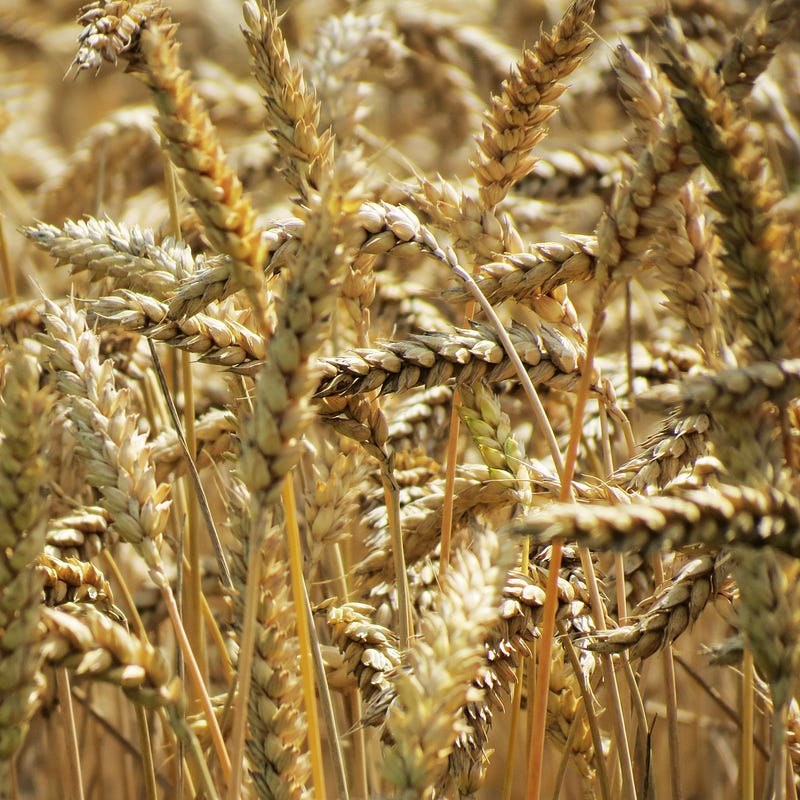
In case you ever feel like you’ve got it rough, a laborer in ancient Sumer would work for a whole month in exchange for 60 Sila. Again, that’s only about 60 liters of barley seeds, and that’s for a man. Female laborers were paid only half of that, while bosses earned around 5,000 Sila per month.
This system may seem unfair to modern minds but it still represented a major advance. To understand why money is so amazing, let’s back up and look at bartering.
Initially, everyone would make everything they needed for themselves. But the quality would be low since we can’t be good at everything.
To get really good at making something, we humans have to focus on one thing and practice it a lot— what economists call a specialization. We develop our skills to be excellent in that one arena and then trade with other people who are each excellent at something else.
But what will the terms of the trade be? Suppose you wanted your neighbor’s goat but they didn’t want to accept your shoes in exchange. What then? In a barter system, the transaction just couldn't happen.
Even when deals could happen, how many shoes was one goat worth? And how does the value of either good compare to that of pottery, or firewood, or spears? It takes a long time and a lot of conversations to figure that out. But suppose that after all this negotiation, we start to come to some agreements on how many of one item another item is worth.
Even after we arrive at some set, stable prices, we still have a big headache to deal with. Let’s illustrate why with a hypothetical Sumerian economy.
Assume there are five goods in our ancient economy: goats (G) shoes (S), pottery (P), firewood (F), and spears (R). Since there is no money, each good has a trade ratio compared with each other good. In other words, instead of 5 prices to remember the way we in the modern world would be used to, there would instead be 10 pairs of exchange rates that everyone would have to remember at the market. See below.
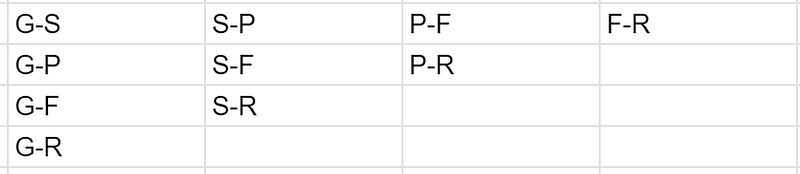
That’s complicated but doable. The number of trading pairs turns out to be n(n-1)/2, where n is the number of goods. Now, thanks to barter, we’ve suddenly invented mathematics!
It’s a good thing we did too because this quickly spirals out of control. If we grow to have 50 types of goods in our ancient barter economy instead of just 5, then that means we have (50)*(50–1)/2 = 1225 trade pairs to remember. We’re going to need to write all these down to keep track of them — and so now writing is also born.
Still, even with writing and mathematics, it’s a whole lot easier to just have one form of money to measure everything else against. 50 prices are a lot easier to remember in the marketplace than 1225 trade pairs.
Money solves this major problem beautifully, simplifying things quite a bit. And barley was a perfect starting point for money because it has a simple and obvious use case that everyone easily understands and universally values. That is to say, you can eat it. But even though barley’s ability to be eaten gave it intrinsic value, it was still harder to set up this arrangement than you might realize.
To illustrate why it was so difficult and took humans such a long time to even get that far, imagine taking a sack of barley to the mall or to a pizza shop in the hopes of exchanging it with the cashier. Would they take your barley? Of course not, because barley is not an accepted medium of exchange in our society. The cashier doesn’t have trust that if they accepted the sack of barley that they’d be able to get anyone else to accept it.
It isn’t a trivial thing to set up that monetary arrangement. Barley money represented a major advance in human development. With money, we can coordinate our efforts and work together to make and distribute far more abundance than any of us would ever be able to produce on our own.
But there were many problems with barley money, as you might imagine. It’s difficult to store and transport. It only keeps for about one year. That’s fine for short-term use, but if we want to have some security for the coming years then barley money won’t do the trick.
Fiat Currency
Since it is so versatile, the value of barley grain came to far exceed its nutritional use case. Therefore, no one will actually eat it anymore. It would be as foolish as eating a $100 bill.
So why not use something else instead that keeps longer?
The next major advance occurred when people solved these problems by building up enough trust in one another that they would accept something as money that didn’t have any intrinsic consumable value at all. This happened about 4500 years ago and came in the form of a silver shekel. Silver obviously couldn’t be eaten. It was money accepted solely out of the belief that other people would accept it and had no other practical purpose beyond that.
This is called “fiat” money.
Sheckles were not initially coins, they were only lumps of silver that had to be measured on scales. They represented a major improvement over the Sila barley money but still had serious drawbacks. How could you trust that the sheckles were pure silver, for example? What if it was lead coated in silver on the outside? No matter how accurate your scales are you still have no way of knowing whether the person was trying to cheat you.
Coinage
The next major advance in money was the coinage pressed by Lydians in Western Turkey. A central authority, such as a king or emperor, mints coins with the face of a person who represents trust and power. That ruler certifies that the coin contains the value it is supposed to contain. This was a major advantage because merchants, soldiers, and workers could accept that coin with confidence and did not have to take time to weigh every transaction anymore. The worth would be printed into the metal itself.
In addition to quickly establishing the quantity of money, the trusted authority’s stamp also verified the quality as well. It was a guarantee that the coin was worth what the king said it was worth. The legitimacy of the ruler and the integrity of the coin were interwoven. Even to this day, the credibility of a currency is assured by the government. US dollar bills, for example, are signed by the Secretary of the Treasury.
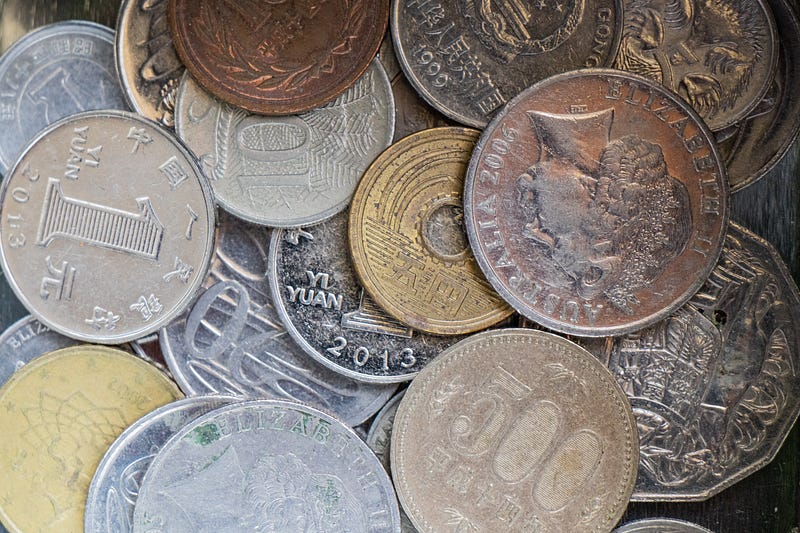
Unfortunately, dollars and coins can be counterfeited, and silver coins can also have the edges shaved down or the percentage diluted with other metals. The penalties for doing things like this were severe because the legitimacy of the ruler was at stake, but it still happened.
Sometimes the perpetrator was the king himself. The erosion of trust and debasement of the currency were among the contributing factors for the decline and collapse of the Roman Empire. Coinage that was initially pure silver began to get diluted by Emperor Nero. Over hundreds of years, each new emperor followed suit. The percentage of silver declined until by the fall of Rome there was almost no silver left in the coins that claimed to be silver. People wouldn’t even accept them as currency anymore. The trust was broken, and soon after so was the political system.
The same was true of the Weimar Republic in Germany during the 1920s, which used paper currency instead of coins. Printing massive amounts of money to pay reparations and deal with economic problems led to hyperinflation. The currency became nearly worthless and led to the collapse of that political system, the rise of Hitler’s Third Reich, and eventually World War 2.
In God We Trust
It is generally taboo to talk about God, faith, and religion in professional settings. I don’t recommend doing it.
People seem to have very different ideas about God, and for the most part, they’re each quite attached to the beliefs they’ve come to be convinced are right and true. People become quite irritated to have their religious beliefs challenged, debated, and examined. There was a time when I was optimistic and believed otherwise, but I’ve come to accept that very few people like to be exposed to different ways of thinking about God than the one they subscribe to.
So be it. Irritating people is bad for business and doesn’t get you promoted. Therefore, in the professional world, we’ve all for the most part agreed as a cultural norm to just not bring God up very much. We mostly keep our private beliefs private.
And yet pull out a dollar from your wallet. What does it say quite prominently on that money? “In God We Trust.”
Why is that? How can such a taboo topic be so foundational to our economic system that it is printed right on our money?
Religious devotion was once seen as a much stronger signal of trustworthiness than it is today. The Queen of England, or the Czar of Russia, or the Sultan of the Ottoman Turks could confidently grant immense powers to their subordinates who believed in the same religion. Leaders could allow subordinates who shared their faith to manage armies and treasuries in faraway places on their behalf with very little oversight because even if the eyes of the monarch could not see what they were doing, both the monarch and the subordinate each believed that the eyes of God were always watching.
Nothing could be hidden from Him. So as long as a person had fear of God, they could be trusted to let their “yes mean yes, and their no mean no”. Trust could be established. And as we’ve talked about before, trust is always the underpinning of money and wealth.
Religion helped develop money in other ways too. Pilgrimages to holy sites like Jerusalem or Mecca created a need for the development of elaborate international banking systems. For travelers to take their possessions with them to the Holy Land would make them attractive targets for pirates and brigands. And so starting in 1150, the Knights Templar began generating encrypted letters of credit. People could deposit their possessions in a Templar preceptory in Europe, and then take those letters of credit to a Templar outpost in the Holy Land to retrieve their funds. This significantly reduced the reward pirates could get from attacking pilgrims. Over time, that discouraged attack and made travel safer.
But now that we live in a modern, pluralistic, religiously tolerant society, has the idea of “In God We Trust” run its course? After all, a Christian’s concept of God is clearly very different from a Muslim’s concept of God, or a Hindu’s concept of many different gods, or an atheist’s rejection of the concept of God altogether. Consensus on this is utterly impossible. But does all this disagreement about God matter?
Maybe. But maybe not.
“Whereas religion wants us to believe in something, like in God, money doesn’t ask us to believe in anything in particular. Money simply asks us to believe that other people believe in something. “— Yuval Noah Harari
As long as you believe other people believe in the dollar and place value on it, you’ll keep using it and wanting it even if you don't personally like the dollar. “Even Osama Bin Ladin used dollar bills”, notes Harari.
Although money has been besmirched by many theologians and philosophers throughout history, and some of them have even said that “love of money is the root of all evil”, Harari argues that money is in fact the most tolerant instrument and belief structure humans have ever developed. The race or gender or religion of the person holding money simply does not matter, transactions and cooperation occur regardless. Therefore, money has these two characteristics.
- Universal Convertibility — money can turn one thing into almost anything else
- Universal Trust — money can allow any two people to cooperate on any project
In Code We Trust
I’m going to make several bold claims that may take you off guard and might even terrify you if you truly understand the broader implications of what I’m saying. So brace yourself.
The next iteration of money has already been created.
You are currently living in the early stages of a global revolution.
“History will eventually come to remember this year not as 2021 AD, but as 12 AB. The 12th year after the Bitcoin genesis block.” — Jesse J Rogers
AD means anno Domini, Latin for “in the year of the lord”. BC means “before Christ”. When the foundation of trust for the world’s dominant powers and their financial systems was the shared belief in Jesus Christ as Lord and Savior, it made sense to set Jesus’ birth as the calendar’s start date.
For centuries, the dominant European imperialist nations could agree on little else, but they at least achieved a consensus on this calendar starting point. Consensus is important.
Bitcoin’s achievement of decentralized consensus is the Holy Grail of trust-building for a global civilization. It is unlike anything else in human history. You may not understand it very well yet, but Bitcoin’s protocol is in many ways going to prove to be an even bigger deal than the internet itself. So yes, I’m not joking when I say that future generations will look at Bitcoin’s genesis blockchain very much the way past generations viewed the birth of Jesus. It is the beginning of a new era.
As we discussed earlier, religion has the incredibly strong upside of facilitating trust but it also has the negative effect of excluding religious minorities who believe differently.
Governments throughout history have often persecuted and dehumanized minorities, including religious minorities. One form this often takes is excluding them from banking systems and from access to the world’s financial markets. Bitcoin and decentralized finance more generally is quickly making it impossible for an oppressive and corrupt government to financially exclude its minority citizens.
I make these claims because crypto dramatically shifts the balance of power away from central governments and back towards The People. You’d have to use it for yourself to really understand. You might not notice how big a deal this is if you live in a country that already has an accountable government and a good banking system. But it is a very big deal for the places that aren’t so blessed.
For this reason, crypto will unleash the spirit of human creativity and cooperation for everyone on Earth in a censorship-proof way. It will unlock possibilities that are hard to imagine until you’ve seen some of the tech for yourself.
The only governments that will be able to endure in this blockchain era are the ones that democratically empower their citizens, honor agreements, and protect human rights. Governments that are responsive and behave with transparency and integrity towards everyone. These kinds of governments are deeply valuable and are worth preserving.
By contrast, corrupt and abusive governments that hold power by lying, cheating, and extortion will not be able to hide their activity when using blockchain ledgers, which are permanent and public. Nor will they be able to exclude people from sovereignty over their own money.
Encryption mathematics combined with several other technologies have created the most powerful tool for unlocking global cooperation and truthful consensus which has ever existed.
We humans may not be able to agree on anything else, but through computations running on millions of computers, we can all agree on the consensus of the blockchain and how much each wallet contains at a given point in time.
This is revolutionary. And the people who invest in this emerging technology will be rewarded with a level of wealth that ancient kings could not even begin to dream of. Some already have been. Those who invested in Bitcoin as little as 5 years ago have made a 13,200% increase in the value of their holdings.
To become a millionaire, you only would have needed to pick up around 17 Bitcoin at some point. If you did that 5 years ago, it would have only cost you $7,600 of investment. Bitcoin’s rate of return leaves every other asset looking like a joke.
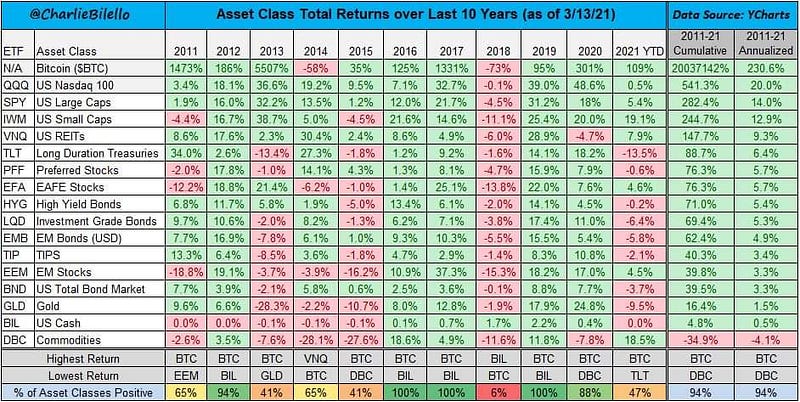
Having said that, and despite the tremendous respect I have for the visionaries that took Bitcoin this far, I don’t personally own much Bitcoin in my own portfolio.
That may surprise you given everything I’ve said up to this point, but Bitcoin is not the right crypto investment for me. It exists to store value. I mainly want to grow value, and am willing to take the risks associated with that. Bitcoin has already achieved a massive price rise and widespread adoption. I want something more cutting edge, more speculative, and potentially more lucrative than the older coins that have already proven themselves like Doge or Bitcoin.
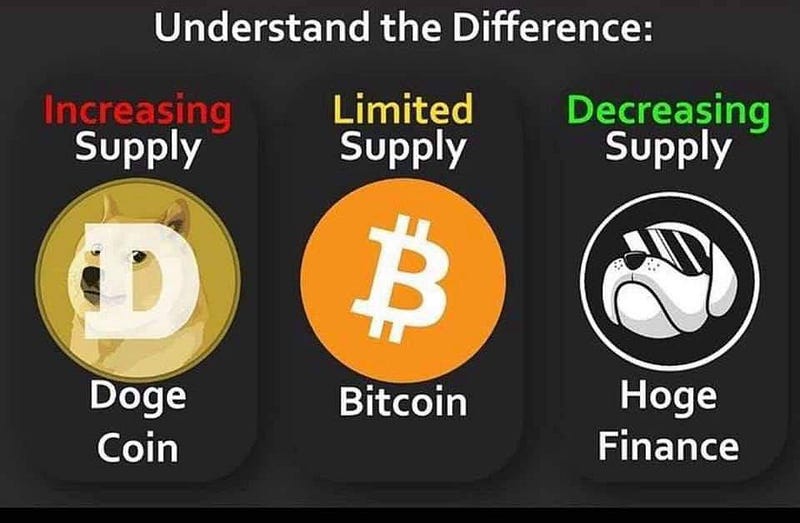
My favorite two coins representing the bulk of my portfolio are HOGE and CRO. If you’re curious about these, I’ve written a great deal about them.
To put it briefly, what Mickey Mouse did to popularize motion pictures is what Hoge will do to popularize DeFi.
I also think Crypto.com is the next Binance.
Just be advised that if you want more than that, you’ll need to ante up a massive investment of $5 for a Medium subscription in order to read the information I share freely that could potentially make you phenomenally wealthy. Does that seem expensive?
My main goal isn’t to make money off of you right now. I want to get you rich first and then collaborate in mutually beneficial ways later down the line.
Therefore, I don’t have any courses to sell you right now. I want your money to grow from being invested in the crypto market (here’s how), earning you financial independence. I don’t want your money to be sponged up by me or anyone else through course fees until you have so much wealth that you won’t miss it. For now, at this critical time, your limited resources need to stay under your control. Your money needs to get to work growing for you, earning you more money.
You may or may not want to invest the way that I do. I have a lot of patience and a very high tolerance for risk and downturns. Dips don’t scare me, I just buy more if I believe in a project. I don’t spend everything at once, I dollar cost average my way into investments so that if they drop, I can buy even more.
We’ll talk a lot more about this if you subscribe to the free newsletter.
By the way, if the education I’m trying to provide you improves your life and transforms things for you, then although I don’t want anything right now, at some future date once you’ve gotten wealthy you can express your gratitude and it would be much appreciated. Donate whatever amount feels right into my HOGE wallet. Many thanks, in advance.
Again, the wallet for donations below is for HOGE only. Send anything else and it will simply be lost.
0x6d7317c4869FBf5CFA9C9911EA47746446ABc045
As always, you can reach me at [email protected] or leave me a comment on the article.