
The Shrine at the Bottom of the Hill
Chapter 5 of The Family Business
I patted my pocket where I had put the keys to our secret, knowing they were safe, making sure they would not wiggle loose and fly away.
Now to find the message.
I sighed and started walking down the steep hill, past the school, past the neighboring school below our school, past the houses perched precariously on the steep grade, lost in thought, hearing the sounds around me but not noticing the world passing me by.
My feet had been this way many times.
My feet knew the way home, and they took over, guiding me quickly down the narrow asphalt lane, nudging my shoes to grip the road with their rubber treads to keep me from slipping.
The road demanded descent at a quick pace, my feet pulling my shins, knees, and legs to keep moving, so as not to feel too much the strain from pushing so hard against the strong pull of the earth.
My thoughts drifted to the upcoming weekend and I started planning what I might do to get out of my house for a while.
About a third of the way down the hill my feet turned slightly to the right, and I found myself stopped in front of a brown steel door set into a gate adjoining the road. My hands checked the silver handle. Locked. No shortcut today.
I continued down the steep grade past the fork in the road which went up into the hills on the other side of the school, switching my book bag from left hand to right hand as I walked.
Finally, the grade started to decrease a little as the road curved sharply to the right and then abruptly ended at an intersection. My feet took me left, then slowed down a bit, joining the flatter, kinder road coming from the Teachers’ Compound a few blocks to the right, which I would have transited had the gate been unlocked.
With the easing of the slope, I imagined a sigh of relief coming from my lower extremities and wiggled my toes a bit as if to give them some breathing room inside my shoes.
A short distance down the street was a Shinto shrine to the left, and beyond that, a police station sat at the corner of the main street and next to the bus station.
I walked along the left edge of the road, carefully avoiding the deep ditch filled with clear, cold rushing water, whispering to me as it passed quickly by.
The meticulously manicured grounds to my left beckoned to me, and I paused for a moment, feet unsure if they should continue down the road or try for another shortcut, this one through the shrine. Then I remembered my mission, my feet rewarded as we quickly pivoted left to enter through the side gate.
I stayed on the left side of the straight, granite-paved path as I walked through to the main buildings of the shrine, careful to observe the Shinto custom of reserving the center of the path for any deity wishing to make use of it.
I thought momentarily of my father and how he would certainly disapprove of my presence at a Shinto site. Likely I should remove myself immediately and spend the next week in church, praying that I might see the true light and be purified. A bit like the Buddha seeking enlightenment, I thought, then shuddered at myself for thinking such thoughts.
Somewhere in the back of my mind, I feared that others, especially my parents, might be able to read my mind at times and that they would know exactly what I was thinking.
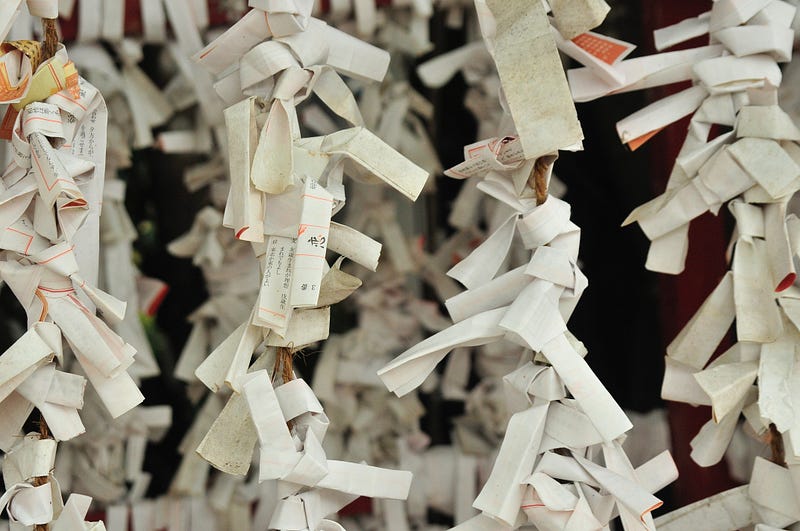
As the footpath joined the main entryway to the shrine, I looked to my left and spotted what I was in search of — a small group of pine trees to which were tied many pieces of white paper.
Most Shinto shrines in Japan operate a concession for dispensing fortunes, which are popular with visitors, especially during the New Year and during other holidays. For a nominal offering, one could shake a bamboo holder filled with rods or sticks, and dispense one marked with a number. This number would then be shown or spoken to an attendant who in return produced a paper upon which the text of a fortune or prediction was written in Japanese.
Upon the paper-strips were written either a blessing or curse, one of seven degrees of blessings including future blessings, or five degrees of curses. The strips also contained predictions for various aspects of a person’s life, to be applied based on personal situation. If a bad fortune were to be received, custom permitted that the fortune strip could be tied to a tree or other object reserved for that purpose, to “be saved for another day,” thus delaying the curse or avoiding it entirely. Periodically, the cursed strips tied at the shrine were burned in a purification ritual to cleanse recipients of any bad luck.
I had a collection of such fortune-strips, omikuji in Japanese, which I had exchanged at various times in the past, each for the customary offering of a five-yen coin, curious about what they were and how they worked. After studying them, I had concealed them between the pages of a Bible, to keep them from being discovered by the ever prying eyes of my father.
Thinking of this, I resolved to have my own fortune-burning ceremony as there were a couple of “curses” in the lot, and I had not left them behind at the shrine, desiring to study them later at my leisure. “Better safe than sorry,” I thought.
I looked around to see if I was being observed, scanning with my peripheral vision so that it wouldn’t look like I was doing what I was doing.
At this time of day, the outbuildings and concessions were closed, and the grounds were deserted. For some reason, there never seemed to be large crowds at any time I had been here. And, more often than not, the people I did meet gave me a strange look.
I suppose I did stand out… a blonde-headed foreign kid wandering around alone at a very Japanese shrine.
I approached the tree and started scanning for my target. After a methodical search, lasting what seemed to be an eternity, I found what I was looking for. There, on a lower branch of the middle tree, was a single fortune with a large red dot near the edge.
I quickly untied the strip and verified that it was what I was searching for. The red dot was actually a set of tiny initials circled in red ink, reading “JR,” telling me that this was indeed the object I came to retrieve. I slipped the message into my bookbag, quickly scanning the vicinity to make sure I was still unobserved.
An elderly couple walked in the distance but did not seem to notice me. I exhaled, realizing I had been holding my breath.
I turned around and walked along the edge of the main path, descending a set of steps under the large stone Torii, passing between the stone lions guarding the gateway, and down the second set to steps toward the bus stop, half expecting to be stopped, but not encountering a soul.
Looking at my watch, I knew the Number 2 bus from Sannomia to the train station at Rokko would be along at any moment, so I quickened my pace to make the rendezvous.
I arrived safely just as the bus was approaching the stop and joined the short queue to board. Once inside the bus, I looked back at the shrine, up the steps through the Torii to the main building, to the “fortune” trees in the distance.
Still deserted.
As the bus pulled into the road, I made a mental note to find out more about this particular shrine.
I slid my hand into my book bag and felt for the strip of paper I had taken.
Still there.
I relaxed, sighed, pulled out a book, and disappeared into it for the rest of the way home.


