
MISOGYNY IN IRELAND
The Shocking Cruelty of Magdalene ‘Mother-And-Baby’ Homes
An Irish scandal comes into elegantly restrained focus in a winner of the Orwell Prize for Political Fiction
Nearly a decade ago, a historian made public her horrific discovery that 796 infants had died and were buried in secret graves near an Irish home for unwed mothers and their babies between 1925 and 1961.
The shocking finding sparked worldwide outrage. It led Ireland to set up a national commission to investigate the deaths at the Tuam Home and others like it, known as “mother-and-baby homes.” In announcing the move in 2014, the Irish prime minister said that for decades Ireland had treated babies born to unmarried parents as “an inferior sub-species.”
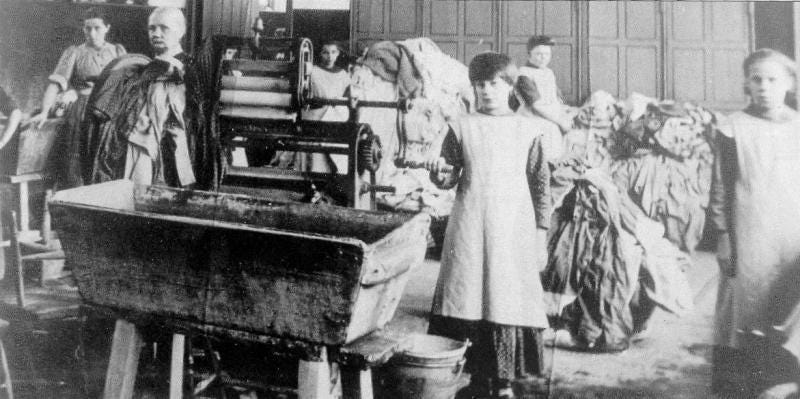
The official investigation found that Tuam women who became pregnant again after their stay were sometimes sent to Ireland’s infamous “Magdalene Laundries,” neo-Dickensian workhouses aptly described by the New York Times:
“Orders of Roman Catholic nuns ran the laundries for profit, and women and girls were put to work there, supposedly as a form of penance. The laundries were filled not only with ‘fallen women’ — prostitutes, women who became pregnant out of marriage or as a result of sexual abuse and those who simply failed to conform — but also orphans and deserted or abused children.”
More than 10,000 women passed through the laundries, where they suffered further abuse or neglect before the last of the institutions closed in 1996. Some of the victims reported being beaten, locked in, fed bread and water, made to work from morning until evening, and forced to stay out in the cold if they broke rules.
The Irish government ignored the cruelty
The Magdalene Laundries were not hidden but operated out of buildings plainly visible to residents of the Irish cities and towns where they existed. They survived in part on fees paid by businesses, hospitals, and government agencies that used their services, many of which turned a blind eye to their cruelties.
The question that lingers is: Why? Why did the state, the Catholic Church, and business look the other way in the face of such astounding misogyny?
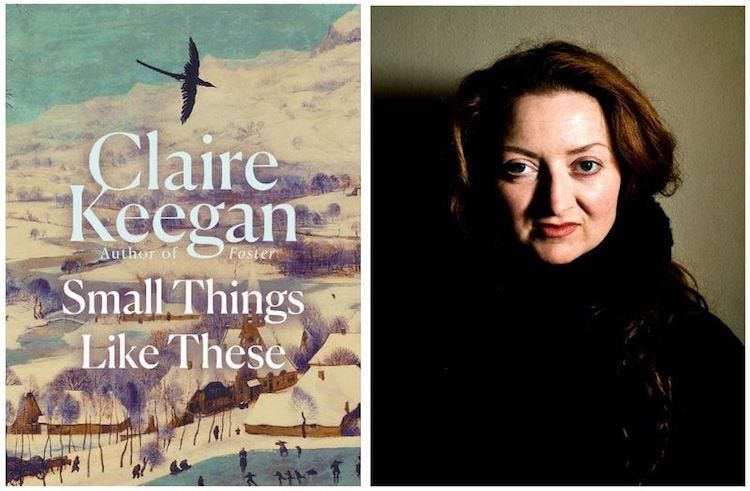
In her fourth book of fiction, Claire Keegan refracts the question through the life of a Catholic man who faces a potentially life-shattering decision after he stumbles on such abuse in New Ross, Ireland, just before Christmas in 1985.
As the novel opens, tectonic plates are shifting under the feet of Bill Furlong, though he won’t fully appreciate their impact until the last pages.
On the cusp of turning 40, Furlong finds himself “inclined to imagine another life, elsewhere.” He sells and delivers coal, a fuel going out of fashion. He has a stable marriage to Eileen and five daughters who are “getting on rightly,” but the Furlongs and their neighbors are financially pinched: Bill saw a schoolboy drinking milk out of the cat’s bowl behind the priest’s house. Ireland has just signed the Anglo-Irish Agreement that is supposed to end the “Troubles” up north but may bring further upheavals.
One day, while delivering coal to a convent, Furlong comes across a dozen girls polishing a chapel floor on their knees with only black socks on their feet. One begs him to take her away. He demurs, but the scene haunts him, and shoes will become a defining metaphor of the novel, steeped in a biblical meaning that Keegan never mentions but that deepens as the plot unfolds.
Furlong’s sense of moral urgency grows on a later visit to convent, when he finds a girl locked in a coal shed. He brings up her wretched condition with the Mother Superior and sees that the nun is forcing the child to say, falsely, that she was imprisoned by mistake while playing a game.
Eileen doesn’t want to get involved, and Bill hears warnings around town of the perils of running afoul of the nuns, whose influence extends far beyond their convent. But Furlong’s mother, a domestic, had fallen pregnant while working for a Protestant widow, who let the two of them live with her. By doing so she may have kept Bill and his mother out of a Magdalene home.
Central questions of the novel become: What do we owe others who have suffered more than we have? What price is too high to pay for helping?
A novel shortlisted for the 2022 Booker Prize
For its masterly exploration of such topics, Small Things Like These won the 2022 Orwell Prize for Political Fiction and other honors, including a shortlisting for the Booker Prize.
But Keegan’s book isn’t a “historical” novel, one of those fat, sprawling epics associated with that genre. With just 118 pages and 35,000 words, it fits the traditional definition of a novella (10,000–40,000 words).
Small Things Like These wears its politics lightly and indicts the Magdalene Laundries without trying to give a comprehensive account of their sordid history. It’s never didactic but focuses tightly on Furlong’s story. Keegan has said the book is, in part, “a portrait of how difficult it was to practice being a good Christian in Catholic Ireland.”
As a boy, Bill received a copy of A Christmas Carol as a gift, and you can read Small Things Like These as a modern response to Dickens’ classic story.
But Keegan’s novel is much less sentimental and ends more ambiguously. Dickens’ story has a happy ending. Keegan’s has one that, though morally satisfying, doesn’t betoken an easier future for him.
Above all, Dickens’ tale — great as it is — was made for its season. Few people might pack it for a Fourth of July weekend at the beach. Small Things Like These transcends the holiday in a different way than A Christmas Carol does. As its major literary prizes suggest, this is a book for all seasons.
Some survivors continue to seek justice through the nonprofit Justice for Magdalenes Research. You can read more about them here.
Jan Harayda is an award-winning journalist and critic who has been a vice-president of the National Book Critics Circle and a judge of its prestigious literary awards. She has written for many major print and online media, including the New York Times, the Wall Street Journal, the Christian Science Monitor, and Salon.
You might also like:


