
BOOK REVIEW | LITERARY FICTION
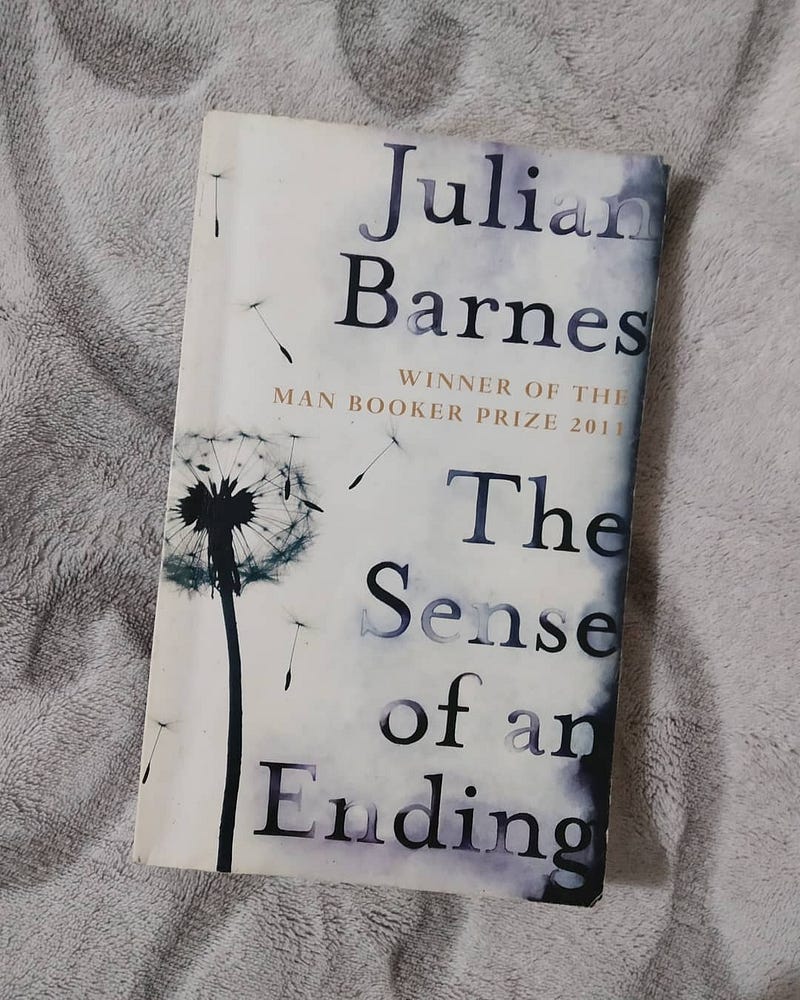
The Sense of An Ending By Julian Barnes
Winner of Man Booker Prize in 2011 — was it deserving?
Our brain, with all due respects to its complexities and evolutionary progresses, is an organ of convenience. And, as it is meant to be, programmed to process things in a way that will facilitate survival and thereby, propagate the species. This immeasurable, yet often surprising, quality of the human brain is very much responsible for moving on and living, if I may say so, an ordinary life.
That is, considering anything extraordinary would occur to those who are easily affected by whatsoever matters or doesn't matter.
But what happens when life puts a power brake and drives back in reverse? And when certain patches of memory get unearthed or unraveled in that rash drive to the past? And those fresh reminiscing is not all that beautiful or even convenient, only to immerse your older self in remorse at the doings of your supposedly more reckless younger self?
What when wanting to change things in the past and realizing you cannot eats you for the rest of your life?
This sounds like The Sense of An Ending.
This short novel by Julian Barnes won the Man Booker Prize in 2011 and here’s why!
To avoid spoiling this short book of 149 pages, let me end it here.
It has got one hell of an ending that made me go 'Ohhhhhh daaymmmmnnn....', as softly and under my breath as possible — or may be it was in my mind — when I read page 147.
This 2011 Booker winner won me over with its sassy, humorous, introspective, sardonic yet sarcastic writing that demands attention to details.
Excerpts
The beginning:
I remember, in no particular order: – a shiny inner wrist; – steam rising from a wet sink as a hot frying pan is laughingly tossed into it; – gouts of sperm circling a plughole, before being sluiced down the full length of a tall house; – a river rushing nonsensically upstream, its wave and wash lit by half a dozen chasing torchbeams; – another river, broad and grey, the direction of its flow disguised by a stiff wind exciting the surface; – bathwater long gone cold behind a locked door. This last isn’t something I actually saw, but what you end up remembering isn’t always the same as what you have witnessed.
On time:
We live in time — it holds us and moulds us — but I’ve never felt I understood it very well. And I’m not referring to theories about how it bends and doubles back, or may exist elsewhere in parallel versions. No, I mean ordinary, everyday time, which clocks and watches assure us passes regularly: tick-tock, click-clock. Is there anything more plausible than a second hand? And yet it takes only the smallest pleasure or pain to teach us time’s malleability. Some emotions speed it up, others slow it down; occasionally, it seems to go missing — until the eventual point when it really does go missing, never to return.
A scene that cracked me into giggles, one of the best in the book:
‘Now, you’ll remember that I asked you to do some preliminary reading about the reign of Henry VIII.’ Colin, Alex and I squinted at one another, hoping that the question wouldn’t be flicked, like an angler’s fl y, to land on one of our heads. ‘Who might like to offer a characterisation of the age?’ He drew his own conclusion from our averted eyes. ‘Well, Marshall, perhaps. How would you describe Henry VIII’s reign?’ Our relief was greater than our curiosity, because Marshall was a cautious know-nothing who lacked the inventiveness of true ignorance. He searched for possible hidden complexities in the question before eventually locating a response. ‘There was unrest, sir.’ An outbreak of barely controlled smirking; Hunt himself almost smiled. ‘Would you, perhaps, care to elaborate?’ Marshall nodded slow assent, thought a little longer, and decided it was no time for caution. ‘I’d say there was great unrest, sir.’ ‘Finn, then. Are you up in this period?’ The new boy was sitting a row ahead and to my left. He had shown no evident reaction to Marshall’s idiocies. ‘Not really, sir, I’m afraid. But there is one line of thought according to which all you can truly say of any historical event — even the outbreak of the First World War, for example — is that “something happened”.’ ‘Is there, indeed? Well, that would put me out of a job, wouldn’t it?’ After some sycophantic laughter, Old Joe Hunt pardoned our holiday idleness and filled us in on the polygamous royal butcher.
Verdict
It’s a tiny novel but deep. And no, you cannot read it in hurry or rush through it because, yes, you are going to have to tax your brain a little to grip the essence of the book if you are used to light reads. I used to read it at bedtime when my brain was free from distractions.
It was a well-deserved award because there’s so much encapsulated in this short book. So much. Do grab a copy because, yes, even as a new reader of literary fiction, this book will always be one of my favorites!
To say the least, it has left me with a subtle sense of endless wonder.
More in book reviews:
Also check out:
Sana Rose is an award-nominated novelist, poet, physician, counseling therapist, freelance writer and mom. She is based out of Kerala, India. Her debut novel ‘Sandcastles’ was shortlisted for ARL Literary Awards 2018 for Best Author soon after publication. Her second novel ‘The Storyteller’ is coming out this year.