
BOOK REVIEW | TRAUMA LITERATURE | PSYCHOLOGICAL FICTION
Eleanor Oliphant Is Completely Fine By Gail Honeyman
Eleanor Oliphant has learned how to survive — but not how to live.
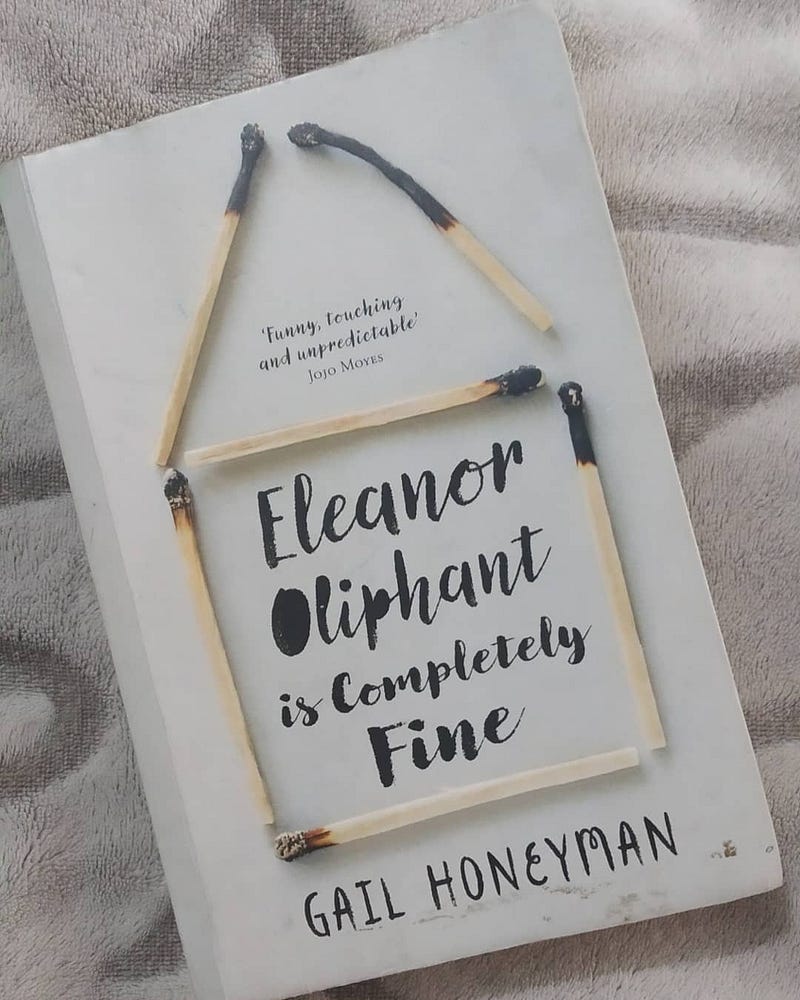
Book lovers form relationships with books they read. Believe me, it is possible and sometimes, enough. If you ask me what kind of relationship I had with this book, I would say it was like When Harry Met Sally.
I bought this book on January 20th, 2019. I began reading this book after the Amazon order delivered. But then, I would leave it aside and read something else, and then return to it, and leave it aside again, tend to my writing needs and return to it. I have returned to this book and left it aside about ten times in the past one year.
Finally on New Year, when my writing tank drained empty and I wanted a break, I picked this book up and again and told myself to be done with it. And on January 9th, 2020, I wrote this review on Instagram, amused, in love, although it was laborious and took me time to admit. Just like When Harry Met Sally.
Right from the beginning, I fell in love with the sassy writing, the immensely impressive vocabulary which has made me move my phone dictionary app from the 'work' folder to the 'shortcuts screen' to the 'home screen' of my phone, very next to the 'call' icon — that's how frequently I needed the dictionary to read through this book and I am generally against using a dictionary while reading fiction and advocate learning words and their usage through context.
Now, that might be a turn-off for many readers. Reading itself is seen as a challenge by a lot of people. So, when a book calls for the dictionary every now and then, it can be tiring. However, I took up the challenge, because primarily I have always been a book worm and later on, a writer. And writers need to read and learn new words, techniques,usages and everything. So I was ready to learn like this, too.
Also, it was indispensable for the author since the protagonist is a socially-challenged woman suffering from verbal, personal and social Obsessive Compulsive Disorder (OCD) and too well-read and addicted to Crossword puzzles.
The use of the most alien synonyms of the most common words was deliberate so as to nourish the character. Narrated in first person by Eleanor Oliphant, the novel shows how the normal world is seen through a person who is not able to adjust to a normal social life and form relationships, and how they adjust to this grey world when all they can be is black and white and nothing in between.
The unfiltered views, thoughts and speech of 30-year old Eleanor Oliphant simplifies this world into a few equations and often, the humor in it is uncompromising. How we, as social animals, really complicate things just to make life interesting, how much we take things and people for granted and how lucky that we are able to — these realization left me bewildered because, they can be seen only when we look at them standing out of the box, as an Eleanor Oliphant, to who the society is an alien planet.
We conform to the world to fit in, to be appreciated and to be loved, and yet that is not enough!
This book is about survival, childhood trauma and mental health. And Eleanor Oliphant is a character that I will never forget because of how unique she is. Gail Honeyman has done a commendable job with her debut book. While writing this book, it was also shortlisted for Lucy Cavendish Fiction Prize as a work in progress.
I saw several negative reviews stating how boring the book was and how tedious it was to go through the day-to-day life of a judgemental, obsessive and drab woman with unrelatable metaphors. But I think that is exactly the point of this book and what makes this book different. The day to day life and observations of an anti-social in a normal society is nothing less than different and interesting.
The Verdict
So this book is not for you if:
- You are looking for a thrilling, plot-driven novel.
- You want a light read to feed an idle brain.
- You want fast-paced novels (but it depends on how you define pace because the second half is pacier than the first).
- You want simple words that will not leave a mark in your thoughts after you are done reading.
- You want tons of dialogues (the book is in first person narrative and has more monologues and stream of consciousness than conversations)
- You are looking for a cliched book.
But pick it if you:
- Want a fresh read.
- Want new perspectives (that defines the book).
- Need a break from stereotypes (because society creates them and this is about an antisocial).
- Love unique, crude and unfiltered observations of the most mundane things.
- Love books that seem like a straight read but surprises you on the second last page with a twist that you didn't see coming (like Julian Barnes did in his Booker winning The Sense of An Ending — review coming soon).
- Love psychological fiction/trauma literature with a difference (usually they are dark and haunting, this was summery, hopeful and still effective).
You might also like:
Sana Rose is an award-nominated novelist, poet, physician, counseling therapist, freelance writer and mom. She is based out of Kerala, India. Her debut novel ‘Sandcastles’ was shortlisted for ARL Literary Awards 2018 for Best Author soon after publication.


