
The Secret Sauce for Creating High-Performance Teams
High-performing teams consistently outperform comparable teams. Here are the ingredients or secret sauce for creating your own high-performance teams.

Heinz, the ketchup people, recently announced that they have developed a ketchup machine that lets you create an infinite number of custom ketchup sauces (well, up to 200 actually). What it won’t do is create the secret sauce for high-performing teams.

And that is OK because you don’t need a machine to create the secret sauce for high-performing teams. We will spell out for you what is in the secret sauce so that you can create your own high-performing teams.
This article explains why high-performing teams are important, debunks some incorrect assumptions about the ingredients, and then reveals the secret sauce for high-performance teams so you can use it in your organization.
Let’s start first by defining what we mean by a high-performing team.
What Is a High-Performing Team?
What exactly do we mean when we say high-performing team? That is a serious question. Many definitions of high-performing teams include things like cross-functional skills, interdependencies, synergism, and collaboration.
Here is an example of a definition from Wikipedia:
A high-performance team can be defined as a group of people with specific roles and complementary talents and skills, aligned with and committed to a common purpose, who consistently show high levels of collaboration and innovation, produce superior results, and extinguish radical or extreme opinions that could be damaging.
Unfortunately, this definition immediately begs a few questions. What if the work of the team does not depend on collaboration and complementary skills? What if the work of the team is better completed by an individual, working solo? Or is that not a team?
Solo work may be essential in a help desk team working on trouble tickets. Solo work is also the focus of sales teams, which really aren’t teams in that respect. And in sports, golf and bowling come to mind. When played as a team sport, neither requires complementary skills and collaboration.
For purposes of this article, let’s focus on teams that are building a product or solution. Is the following an acceptable definition of high-performance team?
A high-performing team is a group of people working interdependently and collaboratively to achieve shared objectives, consistently exceeding expected outcomes and reaching higher performance levels than other comparable teams.
Why High-Performing Teams Are Vital
One could argue that high-performing teams have always been important. You may recall that it was a paper that explored the speed and effectiveness of various styles of product development teams that inspired modern-day Scrum.
High-performing teams have always been valuable assets, able to punch above their weight class when it comes to innovation, productivity, and results.
In today’s hyper-competitive world, organizations won’t be able to effectively compete without teams that can deliver results. When innovation, speed to market, and productivity are important, high-performing teams are essential.
With people costs dominating budgets, and always more high-priority work than available staff hours, wringing peak productivity from teams is imperative.
Clearly, there is massive potential upside for companies that crack the code on constructing truly high-performing teams. Unlocking this “secret sauce” for high-performance teams could provide a decisive competitive advantage and better business outcomes.
My Incorrect Assumptions about High-Performance Teams
What was most interesting to me as I researched this article were the things that I used to think were most important for high performance.
Most of these are indirectly related or correlated to high performance, but they are not the items needed for the secret sauce.
Here is the list of items that I have been encouraging for high-performing teams:
- Co-Location
- Optimal Size of 5 to 9 Members
- Stable Teams
- T-Shaped Skills Sets
- Proper Tools
- Dedicated Team Members
- Good Facilitation and Leadership
- Self-Organizing
- Working Together as a Team
Let’s take a closer look at each of these.
1. Co-Location
I used to think co-locating agile teams was not only important, it was critical to team success. Then we all experienced the pandemic of 2020. We all had to figure out how to work together from anywhere.
Since then, I have begun to see that co-location is correlated to high performance but it doesn’t guarantee high performance. Conversely, the lack of co-location doesn’t guarantee low performance.
There are elements of co-location that make it easier to have high-performing teams including the following, which we will explore in the sections that follow:
- Face-to-face discussions
- Synchronous collaboration
- Shared processes and goals
- Serendipity and shared knowledge
Face to Face Discussions
Distributed teams are less likely to have any face-to-face discussions. My colleague Michael Doughtery suggests that this can be offset if the team is able to meet together in person:
It is best if the team has met in person at least once. This allows high-quality communications where there is ease to communicate with each other singularly or multiple people quickly with little delay or stigma. MS Teams or Slack do that pretty well. There are other tools.
Some remote-only organizations do indeed bring teams together to work together for a period and then follow those up with occasional in-person meetings.
There is also the case with many organizations where there development teams are located in another country. Few if any of them bother to get everyone together. It is costly and they don’t see the value.
Synchronous Collaboration
Another challenge with distributed teams is the amount of time available for team members to interact.
If a team is distributed across multiple time zones, there are fewer possible hours for synchronous communication and collaboration. They are more likely to use documents for communications or do it through the tool.
Shared Processes and Goals
Distributed teams are also more likely to have different native languages, cultures, and employers. These may not be significant unless those differences lead to differences in the team’s processes and goals.
Consider a US-based company that hires an offshore development team from a vendor in Eastern Europe.
What are the goals and objectives of the members of that offshore vendor team? Do their goals and objectives align with the goals and objectives of the US company? Not exactly.
Serendipity and Shared Knowledge
Distributed teams are less likely to bump into each other at the water cooler or in the break room. There are fewer impromptu discussions and most interactions have to be scheduled in advance using MS Teams or Zoom.
While slack channels and other messaging apps can help bridge the gap, they are not nearly as efficient as a 2-minute conversation across the cubicle wall.
Distributed teams also are not able to overhear each other in conversations or on the phone (osmotic communications) and so they have less shared knowledge.
2. Optimal Size of 5 to 9 Members
I have written elsewhere about the optimal size for an agile team. While the Scrum Guide recommends no more than 9, my experience has shown that teams of 5–6 tend to outperform.
But why is the size of the team important? Is team size part of the secret sauce? I would argue that it is not part of the secret sauce.
I believe that team size is correlated to performance, and here is why. Large teams have more challenges when interacting. More people in a meeting slows everything down and ensures less individual participation and engagement. Larger teams can suffer from the bystander effect and lack of accountability.
Smaller teams have fewer communication channels between team members. They find it easier to meet and collaborate which leads to more frequent and convenient interactions.
Small teams also tend to develop deeper relationships and are more likely to hold each other accountable than larger teams.
I tend to recommend “Minimum Agile Attributes” for better performing agile teams. This includes 5–9 people:
-1 dedicated product owner
- 1 dedicated team coach
- End to end value delivery
- Minimal or zero fractional resources
- Minimal dependencies
3. Stable Teams
I’ve long been a fan of stable teams, meaning teams that stay intact for up to 1 or 2 years. This means teams have gone through Tuckman’s development stages of Forming, Storming, Norming and Performing and can stay in performing.
I’ve seen for myself that teams that stay together for one to two years tend to have consistent and steady performance. And other agile experts tend to agree that teams that are long-lived for years are preferable.
If you are truly interested in performance, then it is unskillful to break up high-performing teams. Instead of regrouping teams to fit the work, you can regroup the work to fit the teams.
Craig Larman and Bas Vodde, Scaling Lean and Agile Development
Larman and Vodde go on to cite studies by professor Ralph Katz that showed that stable teams will increase their performance up until it peaks at about 4 years together.
But is having stable teams part of the secret sauce? Other experts would say no. In fact, there is a whole school of thought around purposefully mixing teams up.
In her book Dynamic Reteaming, Heidi Helfand claims that teams are naturally evolving entities that are bound to change. In her view, change, rather than stability, can be a strength in agile environments.
So perhaps I have to let go of my ideas around stable teams? Stable teams doesn’t seem to be an element of the secret sauce for high-performance teams.
4. T-Shaped Skill Sets vs. Specialists
I have long been an advocate of team members with T-Shaped skill sets. That means that team members have a deep primary skill and have augmented that with multiple secondary skills. Others refer to those with T-shaped skillsets as “generalizing specialists”.
But is that a part of the secret sauce? I am not convinced. It certainly will help a team be more agile and flexible, able to take on different kinds of work in stride. It can also help to reduce handoffs and key person dependencies.
But does that lead to high-performance?
Let’s look at sports. With few exceptions, professional sports teams rely on specialists and they encourage them stick to what they do best.
The most popular sports in the US are baseball, American football and basketball. Each of those is quite dependent on specialists rather than generalists.
Relief pitchers never bat, punt kickers are never expected to tackle the receivers, and the center on the basketball team better be good at getting rebounds. So what makes us think that generalizing rather than specializing is going to help our technology team?
5. Tools
Here is a quick thought experiment: If your agile team was co-located, what tools besides a whiteboard would you need and why?
Here is why I ask. With co-located teams, tooling was not required. Early in my coaching days, I would recommend that teams use physical boards for collaboration.
The main benefit of physical boards is their effectiveness in promoting rich communication and collaboration. Physical task boards also provide a view of all the team’s work and encourage collective ownership, something that online tools fail to replicate.
Yet most teams today rely heavily on tools. How much of that is because the tools help them and how much is a necessity because the team is distributed?
There are a few different types of tools that teams rely on:
- Communication Tools — These include Zoom, Webex and MS Teams.
- Visualization and Collaboration Tools — These include Miro, Webex and to a lesser extent, Zoom and MS Teams.
- Agile Lifecycle Management Tools — Azure DevOps, Jira, VersionOne and others.
But just sharing a backlog in an Agile Lifecycle Management tool is insufficient for teamwork or high performance.
Don’t mistake a group of people working on the same backlog for a team! We need to stretch ourselves to change the way we think, communicate, and interact to breakout of role-based silos with competing priorities.
True teams will have a shared goal to which all contribute, have alignment and periodic realignment to this goal, and continuously reflect on how to work together to achieve it.”
Some tools are essential to team work.
I would mention that having one system of record for tracking work helps a lot, but not the secret sauce either.
6. Shared vs. Dedicated Team Members
Having dedicated teams is also something that has been linked to team performance. And it is something that I have written about extensively in For High Performing Teams, Stop Assigning People to Multiple Teams.
Taken by itself, being a member of multiple Scrum teams has a cost in terms of lost productivity. If you are using Scrum, you have to attend Daily Scrum Meetings every day, and Planning, Review and Retrospective every sprint.
These meetings can take as much as 20% of an individual’s bandwidth, which leaves team members with a choice between skipping some meetings or attending them and not getting much work done.
If a team member is on three or more teams (and many are), they are going to spend all their time in meetings talking about the work they are unable to get done.
But even that productivity hit, which can be significant, isn’t the main inhibitor for high performance.
The bigger cost of shared resources IMHO is the fractional people assignment to each team. You simply don’t get much of a “team” to work with.
Fractional team assignments is one of the leading causes of low performance. Yet the practice is used widely and managers and leader defend it vociferously.
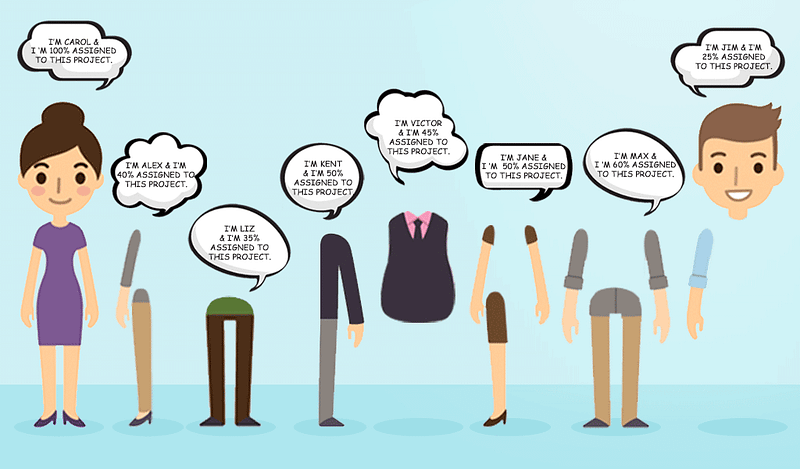
Fractional assignments weaken team buy-in, destroy commitment, undermine shared goals, and obliterate mutual accountability.
These elements (which BTW are all part of the secret sauce to high-performance teams) are weak or nonexistent when team members are shared among multiple teams.
7. Facilitation and Leadership
Most agile teams have a servant leader such as a Scrum Master. (Oddly, most Kanban teams have a Scrum Master even though that isn’t a role in Kanban.)
The Scrum Master performs an important role as a servant leader. They facilitate meetings, remove team impediments, and teach and coach the team on the use of Scrum. They also lead retrospectives which is one of the key tools for continuous improvement.
Do teams with Scrum Masters perform better than those without? I don’t have any data to support this. Anecdotally, I have seen some excellent Scrum Masters who were more like agile ninja’s.
I have also seen more than a few weak Scrum Masters who were simply the team admin, hosting meetings and updating the Jira board. Those teams were not high performing. And in other cases, teams don’t have a dedicated Scrum Master.
I’ve seen high performing scrum masters freely pass the facilitation to whomever wants to run that event. Sometimes it is pre-meditated, sometimes it is not. It works well.
There are many bad roles Scrum Masters play that can drag down high-performing teams. The Age of Product by Stephan Wolpers has some good sources.
I believe that teams that have Scrum Masters that encourage team members to hold each other accountable and to collectively own the work of the team will perform better than those that do not. Team members may do this on their own without having a Scrum Master.
So I don’t believe having a Scrum Master or not having a Scrum Master is a part of the secret sauce for high-performance teams.
8. Self-Organizing Teams
Closely related to the previous item is self-organization. Is self-organization an ingredient of the secret sauce? After all, one of the twelve Agile Principles calls out self-organizing teams specifically:
The best architectures, requirements, and designs emerge from self-organizing teams.
I have seen high-performing teams that were self-organizing, and other teams that were self-organizing and not high-performing. I’ve also been part of (and led) teams that were high-performing and not self-organizing.
Self-organization can be a misleading word. My interpretation is that the team decides how to get their work done. It doesn’t relate to the organizational structure of the team, the choice of what the team will work on, or why that work is important.
And self-organization doesn’t mean that there is no leader. It typically means that there is no designated manager, project manager, or team leader who is responsible for telling people what to do.
But there is almost always leadership on the team, and often I find that different people on the team step up to lead at different times based on the domain or activity.
9. Working Together as a Team
Many of the teams I have observed over the last few years share a common trait — the team members work independently. Each person focused on their own assigned backlog items, often without regard for their teammates.
There was no collective ownership of the work. They might plan together in sprint planning but then each person focused on their own thing.
It is almost as if they agree to leave sprint planning and meet again in two weeks to see what happened during the sprint. This flew directly in the face of what I thought was important — working together as a team.
So I was intrigued by a recent comment made to a LinkedIn discussion post about Solo vs. Ensemble work, by Agile Otter Tim Ottinger.
I had not considered before that some work is best suited for teams (ensembles) and some is better for individuals (solo). [For a brief overview of Solo vs. Ensemble work, check out this post by Linux Lucy or this one by Tim Ottinger.]
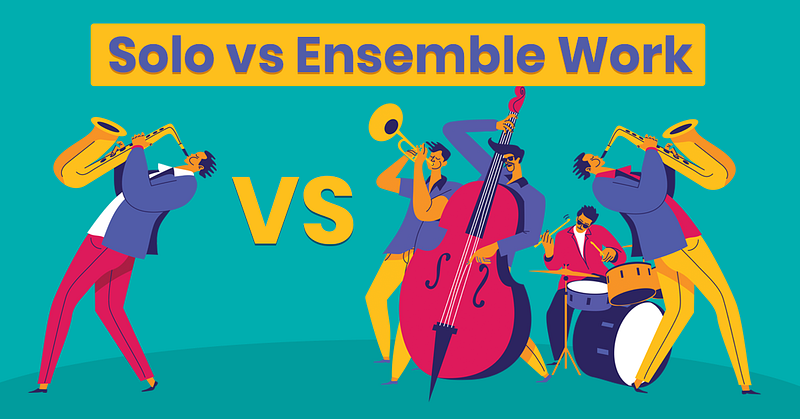
There are some obvious drawbacks of solo work as noted by Ottinger in his post mentioned above. These include the reliance on queues, handoffs, knowledge loss, and rework.
Teams relying on solo work will certainly be hit by those productivity factors. When each team member focuses on moving things from their inbox to their outbox as quickly as possible, those outcomes are predictable. The alternative, as Ottinger says, is to slow down to go fast.
Initially, I thought perhaps that I had stumbled upon a key differentiator — an element of the secret sauce for high-performance teams. Those teams focusing on solo work instead of working as a team in an ensemble fashion MUST perform worse than other teams, right?
Not so fast.
This only applies if people are doing work that can be ensemble. If the goal is to clear discrete tickets then solo is better. You don’t need a team but rather a group.
Tom Cagley, Agile Guide and Host of the Software Process and Measurement Podcast
Ensemble work can include pairing and mob programming. These approaches tend to work best when the work is exploratory or teams need to leverage the expertise of multiple people.
But sorry to say, ensemble work is not an ingredient of the secret sauce for high-performance teams.
Let’s take a look at what experts feel are the important ingredients for the secret sauce for high-performance teams.
What You Actually Need for High-Performance Teams
Here are the ingredients of the secret sauce, based on the book The Wisdom of Teams by Jon Katzenbach and Douglas Smith.
In the book, Katzenback and Smith describe what they called the Team Performance Curve. The Team Performance Curve shows a relationship between Team Maturity and Team Performance.
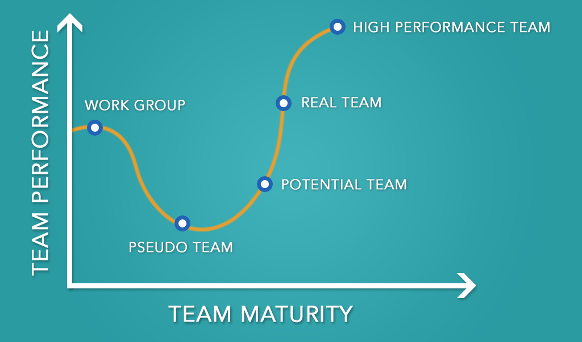
In order to be a high-performance team, they argued that the team had to meet a set of criteria. These criteria are the so-called secret sauce. Here are the criteria with explanations in the sections that follow:
- Shared Vision and Goals
- Shared Agreement on Team Process
- Shared Agreement to Pursue Team Performance
- Holding Each Other Accountable
- Team Members Collectively Owning Team Results
1. Shared Vision and Goals
At the heart of every high-performing team is a shared vision that cohesively binds individuals. Katzenbach and Smith suggest that a common purpose and performance goals should be the magnetic field that aligns individual efforts.
A well-articulated vision statement and SMART goals serve as the North Star for your team.
Regular communications, such as team meetings help ensure alignment and reinforce this shared vision. Team members make decisions, and regulate their behavior in ways that align with the vision and goals of the team.
2. Shared Agreements on Team Process
Effective teams don’t leave their modus operandi to chance; they establish shared processes that serve as the backbone for daily operations.
Team agreements can include defined team processes, meeting protocols, communication tools, and decision-making procedures. Fellow Agile Coach Ben Kopel recommends creating a team agreement as the first step in forming a new team:
Looking back on my career, the highest-performing teams I’ve ever been a part of have had AND RESPECTED their working agreements. The emphasis on respected their working agreements is important because it can be common to create working agreements and then completely ignore them.
Team agreements need to evolve with the team and should be reviewed periodically and updated as the team evolves.
2. Shared agreement to pursue team performance
A high-performing team doesn’t just agree on goals and processes; it also makes a collective commitment to pursue excellence.
This isn’t a passive form of agreement, but rather an active commitment to exceed performance expectations.
Teams should discuss what “high performance” means specifically and how they will measure it. The commitment to regular performance reviews, where strategies are adapted based on results, sets the tone for an ongoing drive toward excellence.
High performance is not a plateau to reach but a mountain to continually scale. Team members should be committed not just to achieving but to elevating team results. A practical approach to fostering this culture of ongoing improvement is to conduct regular retrospectives.
Discuss what worked and what didn’t, then jointly formulate action plans for improvements. This aligns well with Jon Katzenbach’s emphasis on continuous performance drive and Lencioni’s focus on attention to detail.
3. Holding Each other Accountable
High-performing teams hold each other accountable. In fact, lack of accountability is one of the 5 Dysfunctions of a team in Patrick Lencioni’s book by that name.
While leaders may also hold people accountable, in truly effective teams, it is the team members themselves who hold each other accountable. This reinforces Katzenbach’s insights by adding a layer of peer-to-peer accountability.
Open and honest feedback should be encouraged among team members, not just during formal review sessions but as a regular feature of team meetings, especially retrospectives.
4. Team Members Who Collectively Own Team Results
Ownership should not be the realm of a single individual but a collective responsibility. This applies even if the work of the team includes or is largely solo work.
When each team member feels a sense of ownership for the team’s results, there’s an amplified sense of responsibility, leading to enhanced problem-solving and innovation.
Teams can build on this by celebrating wins as a team and viewing losses as collective learning experiences. Each team member has a sense of collective ownership that transcends individual contributions.
In the previously mentioned The Five Dysfunctions of a Team, Patrick Lencioni identified five interrelated issues that can prevent a team from reaching its full potential. We have already mentioned a few of these including commitment and accountability.
The other dysfunctions include trust, fear of conflict, and attention to detail. These dysfunctions can act as obstacles to team performance, and they often feed into one another, creating a cycle of inefficiency and discord.
A Real-world Example of a high-performing Team
This is a pretty simple example from a recent movie that impressed me. The 2023 movie Oppenheimer chronicles the career of physicist J. Robert Oppenheimer.
It is based on the 2005 biography American Prometheus by Kai Bird and Martin J. Sherwin. I am using it here as the example because of its popularity.
A large part of the story focuses on Oppenheimer’s leadership of the development of the atomic bomb at the laboratory in Los Alamos in New Mexico. The Manhattan Project was a fantastic feat of engineering as well as a good example of a high-performing team.
Guided by a clear, shared vision — to build an atomic bomb before Nazi Germany — the team maintained alignment and focus.
Stringent protocols and procedures, rigorously enforced, ensured that everyone knew their roles and responsibilities, creating a harmonious blend of scientific, engineering, and logistical talents.
Accountability was deeply ingrained, reinforced both by the project’s military and civilian leadership.
The Manhattan Project is a good example of how a large, diverse team can become a high-performing unit under challenging circumstances.
It exemplifies how clear vision, strong protocols, collective ownership of results, and a culture of accountability and continuous improvement can align to achieve a singular, immensely challenging objective.
Bottom Line — High-Performing Teams
In a nutshell, high-performance is not only desirable, it may be necessary to compete and survive in todays competitive business landscape.
Knowing the ingredients of the secret sauce that leads to high-performance teams is critical for teams, coaches and leaders.
If your team is working more like a group of individuals than a high-performance team, you might find this article helpful — transforming a work group into a team.
Thanks to the agility experts that offered their insights to this article including Patty Aluskewicz, Michael Dougherty, Thomas Cagley and Ben Kopel.
⭐️Thank you for reading. If you enjoyed this article, feel free to hit that clap button 👏 to help others find it.
Let’s connect on Twitter or find me professionally in Linkedin.
Leave a comment below if you have any questions, and subscribe to receive the latest updates in Agile and Scrum.
Anthony Mersino is the founder of Vitality Chicago, an Agile Training and Coaching firm devoted to helping Teams THRIVE and Organizations TRANSFORM. He is also the author of two books, Agile Project Management, and Emotional Intelligence for Project Managers.


