A Framework for Evaluating High-Performing Teams
Use this framework for high-performing teams as a checklist to evaluate your current team and determine what you need to do to improve the performance.
Are you interested in creating high-performing teams? Would you like to understand why some teams perform better than others, or to objectively evaluate the condition of your current team?
In The Wisdom of Teams; Creating the High-Performance Organization, Jon Katzenbach and Douglas Smith dive deep into team anatomy and paint a vivid picture of what makes a high-performing team. In this previous post, we explored Katzenbach’s findings about the performance of long standing teams.
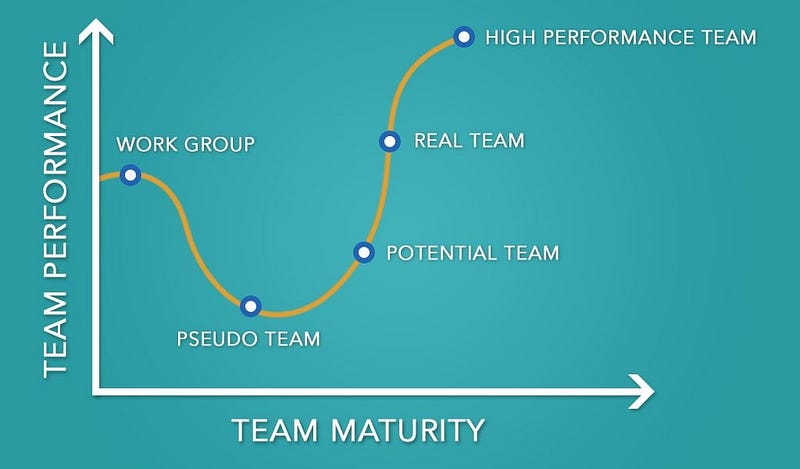
One of the more useful takeaways for me was the framework for understanding team performance relative to maturity. In this framework, Katzenbach and Smith show 5 maturity states for all teams. These states of maturity reflect directly on the performance of the team. Let’s explore each of these.
A Framework for Evaluating High-Performing Teams
Level 1 — Work Group
The Work Group is the lowest in terms of maturity. Workgroups are not so much teams, as collections of individuals formed by natural affinity classes, for example, everyone in the same department or all the students in the same class.
In a Workgroup, there is little need or attempts to perform well together as a team, and little care for the development of others members of the group.
Level 2 — Pseudo Team
Next in terms of maturity is the Pseudo Team. The Pseudo Team is a team in name only. Though set up to look like a team, individuals in the Pseudo Team are not trying to maximize the performance of the team.
If anything, they are trying to maximize their own personal benefit without regard for other team members (and sometimes at the expense of the other team members). Giving these groups a “team” moniker is actually a disservice to all teams.
Pseudo Teams have the lowest collective performance of any other type of team we will explore. They also lack trust of each other. Fans of Patrick Lencioni will recall that lack of trust is one of the 5 Dysfunctions of a Team. Examples of Pseudo Teams include most committees, councils, and nearly all government organizations.
Level 3 — Potential Team
The Potential Team is one that actually has the opportunity to become a real team. Most of our “teams” in the corporate environment would fall into this category of a potential team.
In contrast to the self-serving behavior of Psuedo Teams, Potential Team members are focused on improving the performance of the overall group.
They are called potential teams because they have the potential to be a real team. They are just missing a couple of key attributes: accountability and complementary skills.
Level 4 — Real Team
Real teams are those Potential Teams that have matured to the point where they are holding each other accountable. This relates to another of Lencioni’s team dysfunctions — the Avoidance of Accountability. Real teams also differ from Psuedo Teams in that the team members are diverse and have complementary skills.
Level 5 — High Performing Team
A high-performing team shares all the characteristics of Real Teams. In addition, they have two characteristics that set them apart. With High-Performance Teams, the individuals are deeply committed to the growth and development of their teammates.
They are also committed to the success of each team member and the group as a whole. The implication is that the individuals truly care about each other, and are willing to risk upsetting their teammates to support them.
This relates closely to a third Lencioni’s team dysfunction: fear of conflict. If I am afraid of conflict, I am unlikely to tell the truth about your performance and how it affects me and the team. We will be superficial and kind so that we avoid conflict.
High Performing Team Self-Assessment
Take a moment to think about the Agile or Scrum team or teams that you are currently on or that you currently support. How would you categorize them based on the 5 types above? What would you need to do to move them to a higher level of team performance?
On a related note, Tom Cagley describes the 3 categories of good teams in Teams, the Heart and Soul of work. Also check out how to setup the conditions for high performing teams for specific steps.
⭐️Thank you for reading. If you enjoyed this article, feel free to hit that clap button 👏 to help others find it.
Let’s connect on Twitter or find me professionally in Linkedin.
Leave a comment below if you have any questions, and subscribe to receive the latest updates in Agile and Scrum.
Anthony Mersino is the founder of Vitality Chicago, an Agile Training and Coaching firm devoted to helping Teams THRIVE and Organizations TRANSFORM. He is also the author of two books, Agile Project Management, and Emotional Intelligence for Project Managers.