
The Secret Behind Jews and Food
Every Jewish holiday and major life event is marked with food. Special foods are eaten on different holidays that relate to the specific theme or event the holiday commemorates.
Have you heard the one about the bum who walked up to a Jewish mother on the street and said, “Lady, I haven’t eaten in three days.”
“Force yourself,” she replied.
What’s the short summary of every Jewish holiday? The tried to kill us. We won. Let’s eat.
According to the Hebrew calendar the year is 5779 while according to the Chinese calendar it’s 4717. That means that against all odds the Jews survived for 1062 years without Chinese food.
There are countless other jokes about Jews and food and it’s no wonder. It’s no secret that Jews have a relationship with food. In fact, there is no way that you can practice Judaism religiously or culturally without food. Within the Jewish legal framework there is the idea that Jewish rituals should be celebrated with a special meal. Life cycle events such as a bris and bar or bat mitzvah are followed by an celebratory spread and a wedding is followed by seven days of elaborate meals prepared by family and friends.
Jewish holidays and festivals are also celebrated with large meals. The Sabbath is celebrated with a lavish dinner that includes fish, meat, and noodle pudding and the traditional chicken soup with matzo balls. Many holidays have specific foods that are associated with them such as Passover or potato pancakes on Channukah.
Some of my strongest memories of being Jewish are associated with the comforting smells of chicken soup, gefilte fish with horseradish, brisket cooked in chili sauce, noodle kugel (pudding) with cinnamon, raisin challah (bread), cheese blintzes with sour cream, potato latkes (pancakes) with applesauce and warm brandied fruit compote. Every weekend when I went to synagogue for services, the lengthy service was always followed by a Kiddush, a kind of reception with fish, wine and all kinds of pastries, cakes and cookies.
I can remember coming back from school the first time for Rosh Hashanah. My plane got in late and by the time I got to the house it was close to dinner time. I loved the independence of college but when I walked through the door that first Rosh Hashanah and smelled the aromas of foods that were just out of the oven the feelings of comfort, of home were overwhelming.
I went to my bedroom, sat on the bed and looked around. The feelings and memories those aromas elicited made me feel safe, warm and wanted. It was so different from the food I got at school. I hadn’t even realized how much those aromas had been a part of my childhood or my identity until that moment.
When I eventually moved into my own apartment, my mother gifted me with a lucite box filled with all her recipes which she’d painstakingly copied over from her originals. I have moved that box from place to place ever since then and despite the ease of storing things on the cloud now, I still keep the box and use those cards to cook with.
The foods Jews eat have special significance to a particular holiday or to the general idea of celebrating in a way that is lavish. They also often have personal meaning for us and just provide a sense of home or homecoming which represents our place in Jewish life.
Special Days and Holidays In The Jewish Calendar
Shabbat — The Sabbath
Shabbat traditionally includes three required meals: Friday night dinner, Saturday lunch, and the third meal in late afternoon. Chassidic Jews add another meal call the melave malka which translates into “escorting the queen.” Shabbat is likened to a Royal Queen and this meal is a way of affording honor to the Sabbath as one would to a departing dignitary.
Typical Shabbat foods include challah which is braided bread and wine, both of which are blessed before the meal starts. A meat dish is eaten to elevate the meal since meat was historically considered a luxury that could only be afforded on the Sabbath.
Jews whose ancestors originate from eastern Europe (Ashkenazim) eat gefilte fish which is a mixture of ground fish, chicken soup with matzo balls, kugel (potato or noodle pudding or casserole), cholent which is a hearty meat stew made with beans, onions and potatoes, cooked before the start of Shabbat then left to simmer until lunch the next day (you can’t cook on the Shabbat so this allows you to have a hot dish for Shabbat Day).
For Jews whose families originated in countries they traveled to after being expelled from Spain (Sephardim), Shabbat foods include chreime which is a fish cooked is a spicy tomato sauce, chamin which is the Sephardic version of cholent, bourekas filo pastries stuffed with meat, potatoes or vegetables and dishes made with various types of beans, chickpeas, lentils, burghul (cracked wheat) and rice.
Passover, Chametz and the Seder Plate
Most people are familiar with the Passover seder which occurs on the first two nights of Passover. This is a communal meal that lasts all night (and in some homes into the wee hours of the morning) during which the story of the Exodus from Egypt is retold. The word “Seder” translates into “Order” which refers to the specific order everything is done during these meals. The entire holiday lasts for 8 days in diaspora and 7 days in Israel.
During this holiday, Jews are prohibited from eating what is called Chametz, which is any food containing wheat, barley, rye, oats or spelt that has come into contact with water and been allowed to ferment and “rise.”
In practice, just about anything made from these grains, other than matzah, which is carefully controlled to avoid leavening is prohibited, This includes flour (even before it is mixed with water), cake, cookies, pasta, breads, and items that have chametz as an ingredient, like malt. Yeast is also out.
Due to the seriousness of the prohibition of chametz, in medieval times the Ashkenazic rabbis also forbid Jews in their communities from eating kitniyot (roughly translated as legumes), since they can be confused with the forbidden grains. This includes (but is not limited to): rice, corn, soybeans, stringbeans, peas, lentils, mustard, sesame and poppy seeds. Since Sephardic rabbis at the time didn’t prohibit their communities from eating legumes, Sephardic dishes made on Passover often include these ingredients.
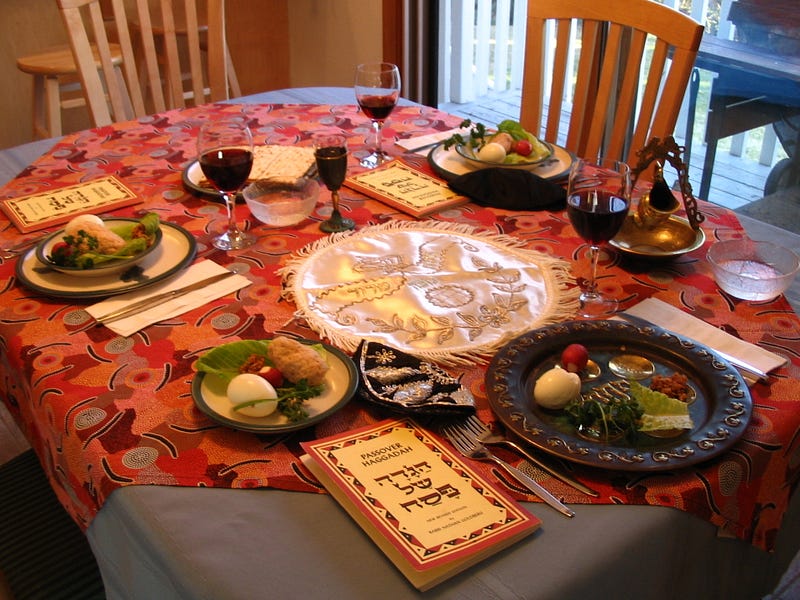
During the two seders, a plate with specific foods is used as part of the retelling of the Exodus. There are six things on the seder plate which include:
- Shank bone - represents the Passover offering
- Haroset — A mixture of apple, nuts and wine that represents the mortar and bricks used by the Jewish slaves.
- Zeroah, a lamb’s shank bone symbolizing the ancient Passover sacrifice
- Beitzah, a roasted egg, which represents the temple sacrifice and the ongoing cycle of life
- Mar’or, a bitter herb (like horseradish), which symbolizes the bitterness of slavery
- Karpas, a green vegetable (usually parsley) representing spring
- Chazeret, more bitter herbs, usually, the heart of romaine lettuce
- A bowl of salt water to dip the karpas which symbolizing the slaves’ tears
- Three matzos representing the Kohanim, Leviim and Yisroel, the three groups that make up the Jewish people. (Others say they represent the three Patriarchs). In my community, our custom was to add a fourth matzoh to show solidarity with the oppressed Soviet Jews. Even after Glasnost, some families have continued the tradition as a way to remain aware of all people, Jews and non-Jews alike, anywhere in the world, who are not yet free.
Everyone adult at the Seder is also required to drink four glasses of wine while children drink grape juice.
Purim
Purim commemorates the story of the Jews in Ancient Persia who were decreed to be killed by the King’s adviser, Haman, but who were saved instead. The main special food that is served on Purim is Hamentashen which are triangular in reference to Haman’s hat or ears. These are pastries filled with poppy seed paste, fruit preserves or other fillings such as chocolate or caramel.
Gifts of food and drink are also given on Purim to friends and family. These must consist of at least two different foods that are ready to eat. In addition to Hamentashen these often include fresh fruit, nuts, chocolate, dried fruit, candies, baked goods and grape juice.
Shavuot
Shavuot is the festival commemorating the giving of the Torah. On the first day of this two day holiday, it is customary to eat a dairy meal. There are several explanations for this. One is that Torah is likened to milk because both are nourishing.
Another is that on the holiday, there was an offering of two loaves of bread. Because of this, two meals are eaten during the day. Since they are eaten close together, a lighter dairy meal is eaten followed by a traditional meat meal. It is done in this order since Jews are allowed to eat milk before meat but not after it.
Some traditional dairy dishes for Shavuot include cheese blintzes, dairy kugel and cheese cake. In my community growing up we also often had lasagna.
The synagogue my family went to always threw an ice cream party for the kids where we got to make our own Sundaes while the adults were still in services. There were at least three flavors of ice cream, caramel, chocolate sauces, whipped cream, and all kinds of other toppings like sprinkles, chocolate chips, candies, cherries, nuts and marshmallows. We waited for this day all year long!
Rosh Hashanah
The traditional foods eaten on Rosh Hashanah, the Jewish New Year all signify positive aspects we want the coming year to be filled with. The Jewish New Year is celebrated by greeting one another with the words shana tovah u’metukah, which translates into wishing each other “a good and sweet new year.” As a result, the table is filled with foods that reflects a happy, prosperous year to come.
Challah, the braided bread always eaten on festivals and on Shabbat, is round on Rosh Hashanah. This commemorates the cyclical nature of the year and of life itself. It is also symbolic of a crown, a reference to the God being crowned as King. As the table is likened to an altar and the bread, an offering, challah is usually dipped in salt as sacrifices once were. On Rosh Hashanah however, we dip it in honey as a prayer for sweet things to come in the year ahead. Apples are also dipped in honey as the apple represents the Garden of Eden. Other foods we eat on Rosh Hashanah include:
- A fish or rams head to represent the idea that we should be “the head and not the tail.” In other words, we should move forward and make progress in the coming year, rather than just lingering in the rear. Since fish swim in schools and sheep are part of a flock it also represents abundance.
- Pomegranate — As this fruit is filled with seeds, eating it represents the hope that our merits will increase in great number over the coming year.
- New Fruits — It is customary for us to eat a fruit we haven’t ever eaten before so we can say a special blessing that is said on new things
- Carrots — The Hebrew word for carrot is similar to the one for decree so eating these is a prayer that God will cancel any negative decrees against us.
- Beets or Spinach — The Hebrew words for beets and spinach is similar to the one for remove so beets are an expression of the hope that God will remove our enemies from among us.
- Black Eyed Peas, Green Beans or Fenugreek — The word for these types of small beans is similar to the word for increase which symbolizes the hope for a year filled with good deeds and merit.
Channukah
On Channukah, the tradition is to eat foods that are fried in oil. This celebrates the miracle that occurred when the Maccabees, the Jewish rebel army, defeated the Syrian-Greeks in 165 BCE. When they went to rededicate the Temple they needed to light the Menorah which was always to remain lit. Regardless of only having enough oil for one day it burned for eight days which gave them the time make more. On Channukah we eat potato pancakes and sufganiyot which are jelly filled donuts both of which are fried.
There is also a tradition to eat dairy meals on Channukah. This is to commemorate the bravery of Yehudit (Judith) who tricked the Syrian-Greek general into believing she would help him to know when to attack. Bringing him cheese and wine, when he became drunk she chopped of his head. Although there are various opinions as to when this story occurred, according to one version, it happened during the time of the Maccabean revolt against Syrian oppression, and ensured the Maccabees victory.
Takeaway
Holiday foods enhance and elevate our Jewish celebrations. The distinctive foods eaten on special days give each holiday meal its own joyous and familiar character. The specific foods eaten on different festivals reinforce the meaning of the day and the celebratory atmosphere.
Every Jewish family also has its favorite holiday foods which are influenced by where their ancestors originated. Through time these foods have become imbued with a sense of comfort and beautiful memories. They have acquired a meaning of their own and special recipes are often handed down from parent to child through the years.
Specific dishes are important in Jewish life because of the feelings they arouse, the memories they call to mind and the historical significance they entail. These characteristics make food an important part of Jewish cultural identity and Jewish life.

If you enjoyed reading this article, you might also like these:
You can find links to my other work on Medium and follow me here. Thanks for reading!


