
The Seasons of Creativity Like the Seasons of a Garden
Writing Goals, Seeds, & the Harvest
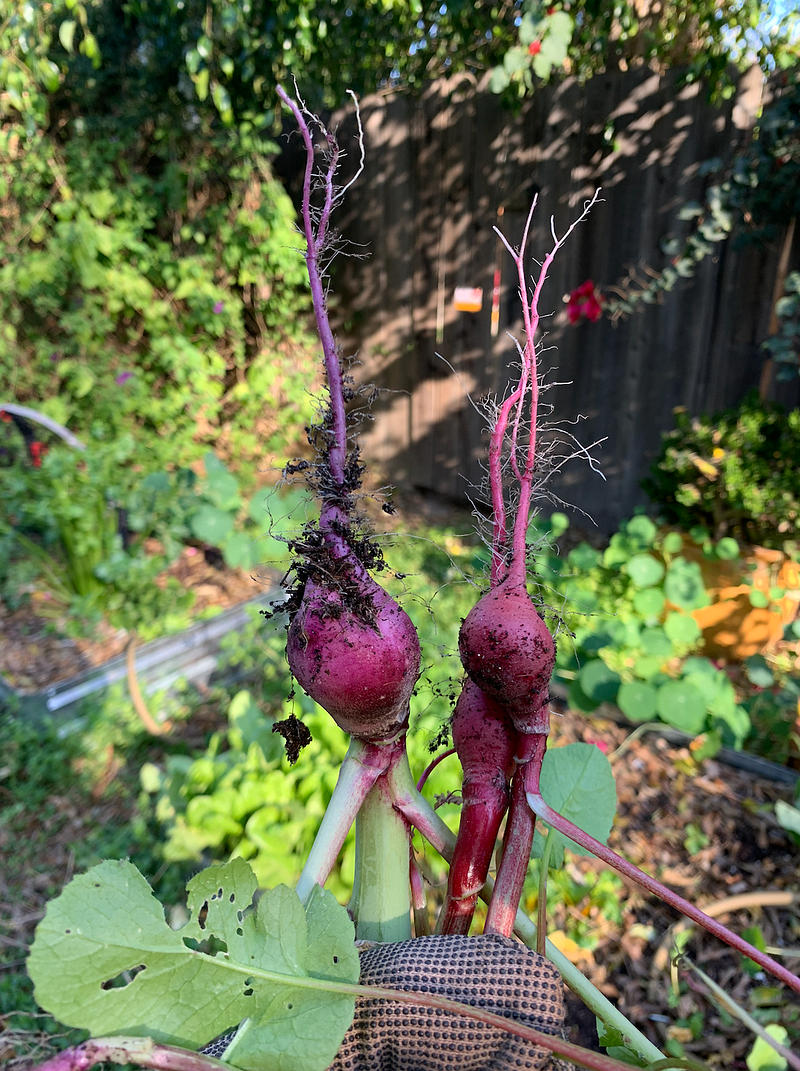
Thanks to Ellie Jacobson for the invitation to reflect on my writing goals:
Over the past six years, I’ve come to observe my writing as akin to that of my work in the garden. I must preface, before I continue any further, with the truth:
I am a mediocre gardener, at best.
I am lucky to live in southern California, where succulents grow easily and make it look like I labor daily for their survival. Also, nasturtium and poppies and daisies, which populate every available inch of space, especially during the winter and spring months. I like to think that I am good at growing vegetables — and I am moderately successful — but I never am able to harvest the abundance of other local gardeners. Or — and I’ll explore this more a bit later — I just plain forget to harvest what I’ve grown.
Even so, there is so much about writing — and the creative process in general — that I’ve learned from working in the garden. Please note the difference, though: gardening is not farming.
I am not planting for sustenance. I am experimenting and exploring; I am delighting in and allowing for both the hope of certainty and the possibility of surprises.
I have learned that, in order to keep my writing life healthy and the flow steady, (whether I am writing for sustenance or not), I have to apply this mindset of experimentation, exploration, delight, and allowance, to my creative life.
In more simple terms: I plant seeds. A lot of seeds.
(Like, maybe it’s a problem.)
But I’ve learned that you never quite know what will take. You can try your best to control the quality of the soil, the placement of the hose, the choice of planting space, the fertilizer, the compost, the angle of light — but you just never know. A pest could come, or a heatwave, or a frost. Or a volunteer pumpkin will sprout out of the compost harvesting two humongous squash. Or the celery stump will grow through more than four seasons, and you’ll have salad for years. Or the grapevine will return from the dead.
In a garden, anything is possible.
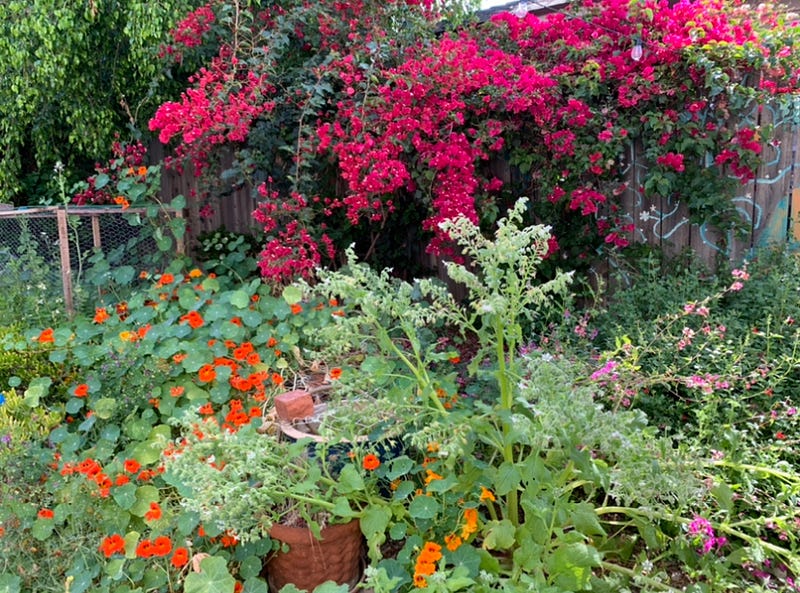
We can learn more about the seasons of creativity from the growing cycle of gardening, which involves “preparing and planting, followed by care and harvest,” according to Grown By You.
In writing, anything is possible as well — you just never know what your writing will reveal to yourself or how it will impact others — but it’s only possible as long as you are taking that first step in the gardening cycle to prepare and plant. a.k.a. get words on the page and WRITE.
I can’t tell you how many people I’ve met who have said that they wish they could write, but either
- a) they are scared
- or b) they don’t know how to start.
When I hear this, I understand — for I was a secret writer until I was 32 years old. I wrote in my journal throughout my childhood and teens, but I rarely shared my work, and I did not have the courage to take a creative writing class until I was 25. I kept writing — poems, essays, and then suddenly, novels — and when I shared on the social medias that I had signed with an agent, the response from friends and family revealed a theme: “I didn’t know you wrote.”
So yes, I understand the fear and the confusion. And I love E.B. White’s witty take on the alleged terrors of the garden:
“We find a useful parable in one of the farm journals, whither we turned, hoping to escape for a few moments the ominous headlines of suspicion in the papers. It was a vain hope. The first headline we encountered was ‘Danger in the Flower Garden.’ There is enough poison in a single castor bean to kill a person. The seeds of pinks cause vomiting. Sweet-pea seeds contain a poison that can keep a person bedridden for months. The nightblooming jimson has enough power it its leaves to produce delirium. Daffodil bulbs when eaten cause stomach cramps. And in the lily of the valley is a subtle substance that makes the heart slow down. But the conclusion drawn by the writer of the article, chewing absently on a daffodil bulb, was a good one.
We must plant this garden anyway. Even in the face of such terrors, we must plant this garden.”
E.B. White 4/24/54 The New Yorker
If you want to be a writer, you have to plant the seeds — in other words, you have to start writing.
And I recommend that you write A LOT.
- Freewrite in your journal a little bit every day.
- Use the notes function on your phone.
- Use voice to text as you’re walking.
- Write down actual things people say during meetings.
- Text yourself plot ideas.
- Write descriptions of characters on the back of receipts while you’re standing in line at the post office.
In other words, prepare your creative garden by getting into the mindset of collecting seeds of ideas, wherever you go.
And then, if and when you are ready to share, plant those seeds — broadcast them into the soil.
- Maybe you start with one small bed. (Email a poem to a friend.)
- Maybe later, you expand your planting space. (Take a class —in fact, I have a new one starting next week! I’d love for you to join!)
- Find a writing group. As you take this step, focus on the care here — you will need nutrients and water and sunlight. (You will need supportive people who can tend to your fragile young seedlings of ideas or character descriptions or first chapters or poems.)
- If anyone is a stinker in their criticism of you, pull them out of your life like you would uninvited weeds. (Or at very least, stop sending them your drafts and asking for their opinions. )
Your creative seeds are precious; take good care of them, and of yourself.
I am not going to offer a deep analysis of my own psychological issues here, but let’s just say that my weakness, when it comes to gardening, is the harvest.
I will see the tomatoes, plump and ready, juicy and delicious, and yet I will walk right past them until they’ve been cooked by the hot sun of summer. I will let the arugula bolt. I will forget to pick the cucumbers.
My eye towards the harvest has improved greatly over the past few years.
It’s partly my ADHD. But I also see it as fear of success or fear of failure or just fear of facing the unknown and/or end of cycles due to my own experiences with grief and loss.
(Okay, I lied — it’s a deep analysis.)
Brene Brown has certainly helped me face the fear over the years:
It feels dangerous to show up. But it’s not as terrifying as thinking, at the end of our lives, ‘What if I had shown up? What would have been different?’
It’s definitely something I’ve been working on, in both my garden and in my writing.
So then: My 2022 summer writing goal is to FINISH THE UNFINISHED PROJECTS. They include:
- the middle grade novel I started in 2019
- the cookbook I started in 2021
- the at least 100 posts on Medium that I promised myself I would write (this is #81!)
- the next series of ELEVEN Yoga with Eleonora videos that I was recently invited to write and record (So exciting!)
- More meditation videos on YouTube and Instagram
- A few other secret projects that I have in the works ;)
But also, I’m going to try not to overwhelm myself.
Ha!
As a parallel 2022 goal in the garden, I urged myself to harvest my winter vegetables before the heat came last month. I had grown:
- green lettuce
- sugar snap peas
- cilantro (was getting ready to bolt)
- dill (was already turning brown)
- celery (busting out of it’s skunk-protective cage)
- nasturtium…lots of nasturtium…
But I did it! I harvested a whole salad! And it was delicious!
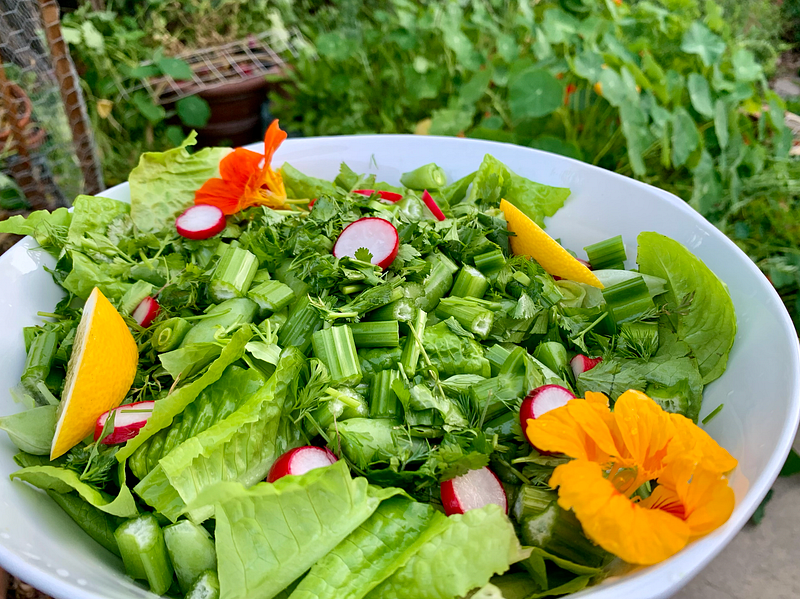
Indeed, as E.B. White wrote: We must plant this garden.
And I’ll add, we must harvest it, too.
E. Katherine Kottaras the writer, voice, and co-creator of Yoga with Eleonora on PillowFortTV and the co-writer with Vanitha Swaminathan of the forthcoming picture book, A RAINBOW INSIDE MY BODY, illustrated by Holly Hatam (Viking 2024). She holds an M.A. in English and an M.S. in Kinesiology with a focus on Integrative Wellness, and she is a contemplative writer and holistic teacher, having worked at the K-12 and community college levels for over two decades. She is a yoga teacher, personal trainer, and health coach while also living with invisible illnesses and neurodivergence, and as such, she is passionate about mindfulness, bodily self-determination, and health equity. As the queer daughter of an immigrant, Katherine believes that holistic and inclusive approaches to expression, healing, and growth should be accessible to all.
Connect with Katherine on all the social medias: IG, YouTube, FB, LinkedIn, Twitter, or at katherinekottaras.com.
Check out Katherine’s new series, Yoga with Eleonora on YouTube, which helps kids of all ages calm their minds and bodies so they can respond to and communicate their feelings in healthy ways.
Read every story from Katherine (& thousands of other writers) by signing up for Medium. Your $5/month membership directly supports writers (ad free!).


