
The Scientific Reason Some People Have Creepy Smiles
A smile might make someone more likable, but research shows it doesn’t make them genuine.
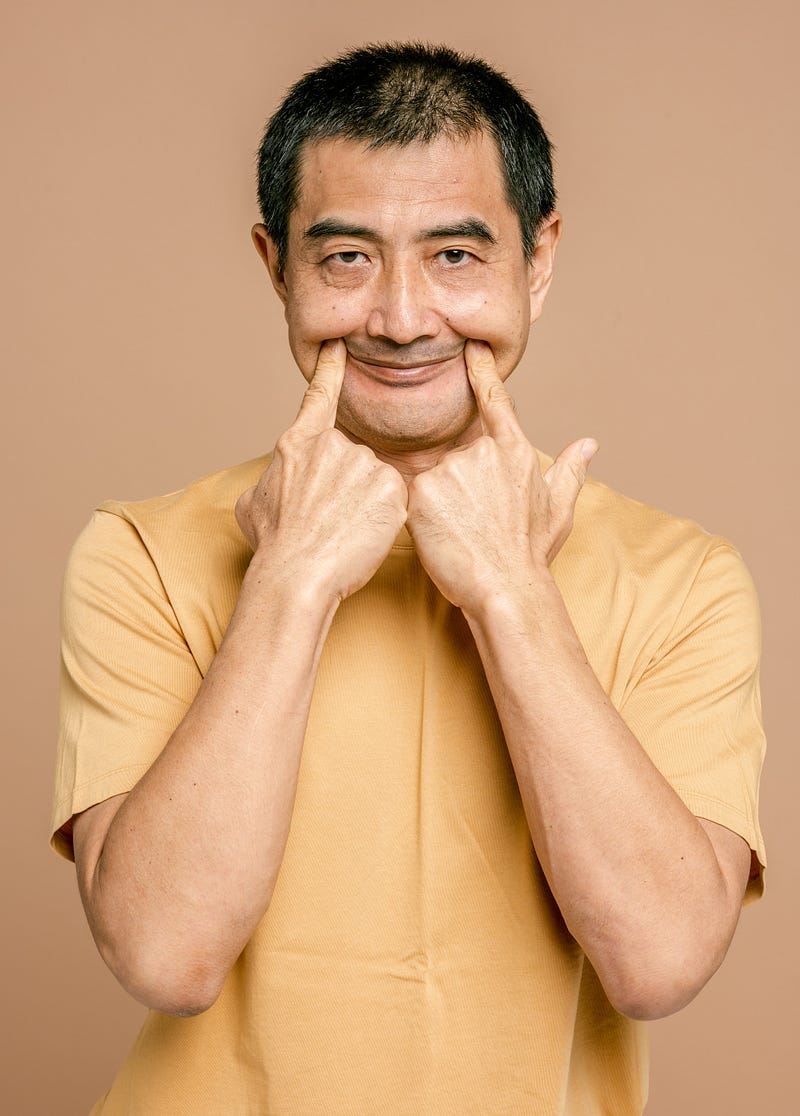
My Grandma Ella used to say you can tell the difference between a crook and an honest man in the same way you tell the difference between a crocodile and an alligator. The crocodile and the crook have a toothier grin.
I remembered her words recently while watching the Republican debates.
During closing remarks, Gov. Ron DeSantis stared unflinchingly into the camera and promised, “I pledge to you as your President, we will get the job done, and I will not let you down.”
If only he had stopped there. Unfortunately, he punctuated his promise with a smile that could only be described as a horned melon’s attempt to appear human. Apparently, whoever was pulling the automaton strings only yanked the ones at the corners of his mouth, not his eyes.
Naturally, the pundits, comedians, and Lizard People conspiracists had plenty to say about DeSantis’ smarmy, sphincter-clenching grin. And, of course, the unwashed masses from the meme brigade took their cheap shots.
First, I do not support Ron DeSantis’ “the cruelty is the point” thuggish politics. DeSantis has about as much human compassion as a three-day-old turd. It is really hard not to mock him.
But…the comments were a tad mean-spirited. To start, smiling isn’t as easy as it looks. While scientists are still divided on how many facial muscles are engaged when smiling, an authentic, joyful smile can use as many as 43 facial muscles. And if you are not experiencing true happiness (who would while listening to Mike Pence sermonize), those 43 muscles don’t always cooperate.
De Santis was either nervous or proved my Grandma Ella right — insincere people have insincere smiles.
Either way, throughout history, most strong leaders never smiled.
“One may smile, and smile, and be a villain.” — William Shakespeare
The real reason people throughout history didn’t smile. And no, it was not only because of tooth decay.
Today, we think a smile makes someone appear more affable and approachable, but smiles have not always made someone likable. There isn’t a Latin word for “smile” because the Romans did not smile.
Nor will you find any gap-toothed grins in medieval or Renaissance portraiture. While it’s true that tooth decay was rampant, that’s not the reason people didn’t smile. (Oral hygiene was so poor that anyone with all their teeth was just weird.)
This closed-mouth seriousness was due to cultural norms. Only drunks, fools, babies, and satyrs smiled. Simply put, a smile was emasculating because it represented losing control over your body and emotions.
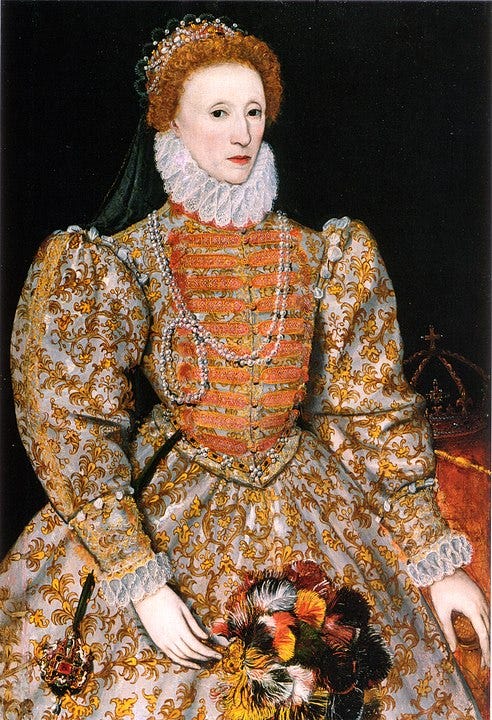

For this reason, you won’t find any smiling portraits of Queen Elizabeth I. When she sat for the Darnley Portrait (above), she had so few teeth that her breath became fetid, and she could barely speak. But a toothache is not why she looks so glum. A smile was seen as weak. Strong leaders never showed mirth.
At the turn of the eighteenth century, Europeans regarded smiling as a sign of someone who lacked self-regulation. And as sugar was traded throughout the continent, tooth decay got worse. Consequently, conduct and civility books advised a closed-mouth smile to hide joy and rotting teeth.
However, dentistry changed in the late eighteenth century and focused on preserving instead of extracting teeth. Dentists were no longer barber-surgeons and tooth pullers of yore. In 1787, Nicholas Dubois de Chemant invented porcelain dentures. Suddenly, it became fashionable to flash your pearly whites.
The Duchenne vs. the Pan Am smile
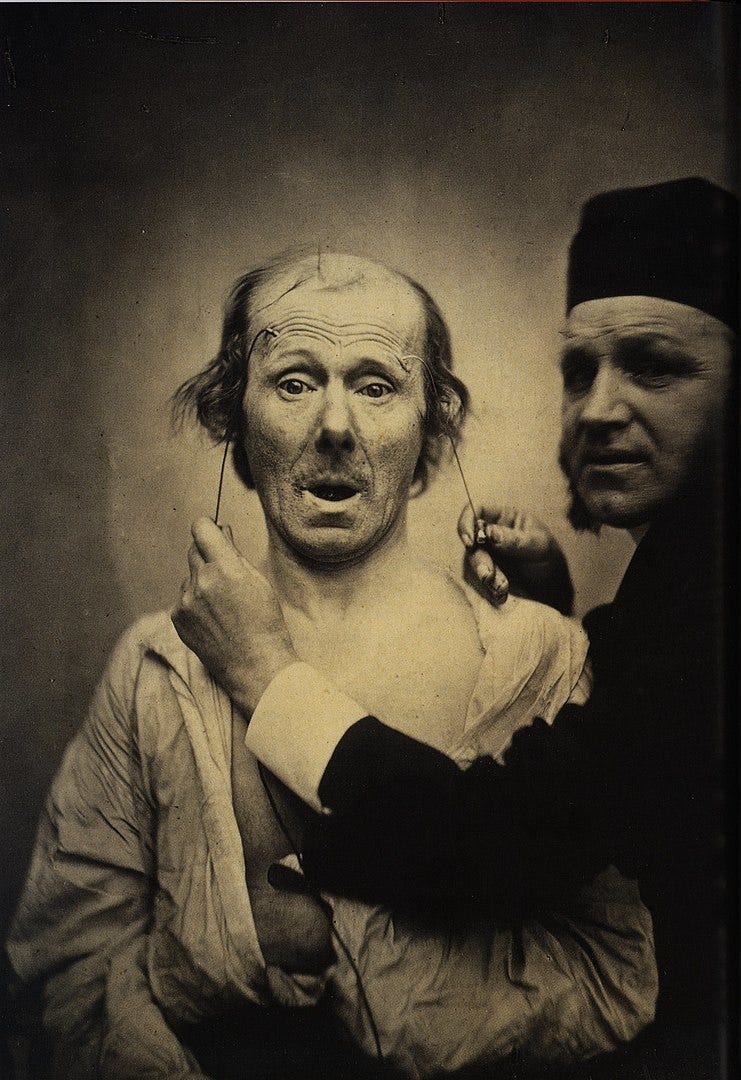
By the nineteenth century, scientists had classified an authentic smile as one that engages the orbicularis oculi — the muscles that wrap around the eyes. This full smile is called a Duchenne smile, named after the French anatomist Duchenne de Boulogne.
In 1862, Duchenne stimulated various facial muscles with electrical currents. From his experiments, he produced more than 60 photographic plates of his subjects demonstrating common emotions such as happiness, fear, sadness, and surprise. From these unethical experiments that would never get funding today, Duchenne theorized that a real smile activates the upper cheek and eye muscles.
.jpg)
Today, when someone says you have a Duchenne smile, it means your smile is warm, infectious, and, most importantly, authentic.

Conversely, a fake smile never reaches the eyes but only engages the zygomatic major muscles — the muscles that lift the corners of the mouth. Smiling with your mouth only is referred to as the Pan Am smile, named after the polite, forced smiles required of airline flight attendants in the 1960s.

One older study found that the Duchenne smile activated the left frontal cortex of the brain — the portion of the brain responsible for experiencing joy. The Pan Am smile did not activate these brain regions.
Charles Darwin’s dinner guests become his test subjects
From March to November 1868, Charles Darwin hosted a series of dinner parties in his country home in Kent, outside of London. Darwin had become pen pals with Duchenne and collected his photographic plates, showing various facial expressions.
Darwin wanted to test one theory — do people accurately read other’s emotions on their faces? And, more importantly, can a smile be faked?
So Darwin showed roughly 20 guests Duchenne’s photographs and asked them to identify the emotion in each photo. Darwin’s test subjects unanimously agreed on happiness, fear, sadness, and surprise but were divided on other emotions.
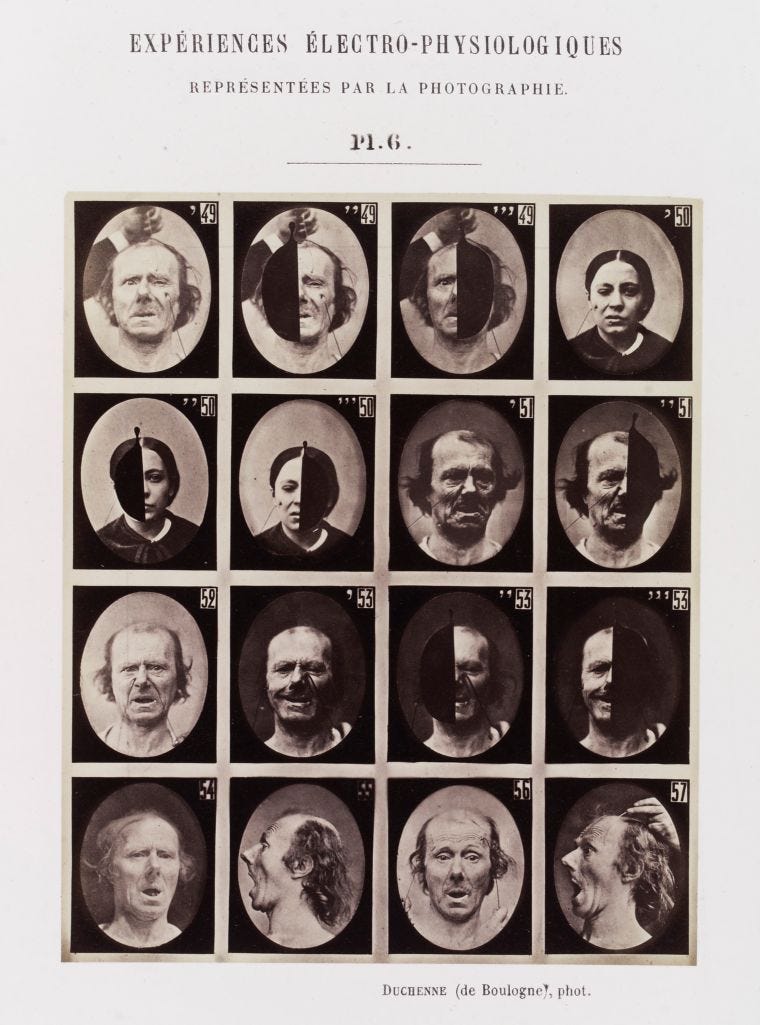
Darwin’s research supports current research. Study after study has found the average person cannot identify nuanced emotions in someone’s face. We tend to get the big emotions right but not the small ones — i.e., subtle contempt, cautious optimism, or nervous diffidence.
Still, body language experts claim to teach people how to read microexpressions — the facial expressions that occur within a fraction of a second.
I call bullshit on the body language woohoo. Most people can’t even tell the difference between a fake and a real smile. In one study, 83 percent of participants could feign a Duchenne smile that others mistook for real joy.
So, even if DeSantis learns to smile, it doesn’t mean his sincerity is genuine. But it might convince the populace that he is.
What Darwin knew about a monkey’s smile
In 1872, a year after Darwin published The Descent of Man, he wrote The Expression of the Emotions in Man and Animals. Darwin concluded that facial expressions are universal in apes and humans.
The science community lost their collective minds.
Aristotle taught that smiling is what separates humans from animals. Creationist Sir Charles Bell (1774–1842) supported ancient philosophy and taught that human emotions were a divine creation from God. Animals were not included in that divinity.
Duchenne, Darwin, and any dog owner would disagree. Duchenne even kept a pet monkey and observed its facial expressions. He noticed that the corners of the monkey’s mouth turned upward when his pet was given delicious delicacies.
But Darwin also observed that a primate’s smile was not always a sign of contentment or joy. For example, apes frequently bare their teeth to show submission to another alpha male. It’s the primate equivalent of “You are the boss. Now, please don’t hurt me.”
But if monkeys and apes smile when placating a rival, do humans do the same? Researchers sought to answer that question.
Why DeSantis and U.F.C. fighters shouldn’t smile
When two U.F.C. fighters face off before a fight, most people are not looking for smiles. But one research team decided to do just that. The researchers hypothesized that humans were not any different from apes in combat situations. And since apes smile as a sign of submission, humans would do the same.
To test their hypothesis, researchers took photographs of fighters during the standoff. Then, they had four independent judges, ignorant of the test's purpose, code the smiles for intensity.
The researchers found the fighters who had bigger smiles lost more fights.
It makes sense. People who smile more have lower testosterone and are consequently less aggressive. Even more interesting, research has found that low-status people smile more than high-status people.
In other words, a smile allows the weaker opponent to appease the stronger opponent and quietly admit defeat.
So perhaps DeSantis campaign managers should stop nagging him to smile more. If history and science are correct, he would have a better chance of winning if he smiled less.
“An evil soul producing holy witness is like a villain with a smiling cheek.” — William Shakespeare