avatarCarlyn Beccia

Free AI web copilot to create summaries, insights and extended knowledge, download it at here

5356

Abstract

<img src="https://cdn-images-1.readmedium.com/v2/resize:fit:800/1*Jj8B62khDJi0n2CyHIkrAg.jpeg"><figcaption>A Satyr, Jacob Jordaens, 1630–1645 | <a href="https://commons.wikimedia.org/wiki/File:Jacob_Jordaens_-_Een_satyr.JPG">Public Domain</a></figcaption></figure><p id="ebbb">But even the first stately portraits captured more than just a ruler’s likeness. When Elizabeth I posed for the Darnley portrait, it was not just her rotting teeth that made her keep her mouth shut. She kept her mouth closed because her portrait was a propaganda vehicle to convey her authority.</p><figure id="c0dc"><img src="https://cdn-images-1.readmedium.com/v2/resize:fit:800/1*o2IkmiCKG9u0zEOZjIIL-Q.jpeg"><figcaption>Left: The “Darnley Portrait” of Elizabeth I of England, 1575, <a href="https://en.wikipedia.org/wiki/Elizabeth_I#/media/File:Darnley_stage_3.jpg">Public Domain</a> | Right: ©<a href="http://www.carlynbeccia.com/">Carlyn Beccia</a></figcaption></figure><p id="f79c">In the smiling version, Elizabeth is suddenly not as threatening. To our modern eyes, her smile makes her more approachable. But for a queen, being approachable would get you booted off your throne.</p><p id="81a5">Not much has changed since Elizabeth’s day. <a href="https://www.reuters.com/article/us-smiles-sex/brooding-men-smiling-women-seen-as-sexy-study-idUSTRE74N7CJ20110525">Studies show </a>that women who smile in photos are perceived as more attractive but less capable, while men who smile are perceived as less attractive and less capable. Researchers think this is because smiling communicates passivity. (And passivity is less of a turn-off in women.) Even our closest ape and monkey relatives only smile as a sign of submission.</p><p id="7bbf">So now you know the real reason why Elizabeth is not flashing those Tudor dimples — no one would take her seriously.</p><p id="ea03">Her dad, Henry VIII, crafted the same omnipotent image of absolute power.</p><figure id="f446"><img src="https://cdn-images-1.readmedium.com/v2/resize:fit:800/1*ywWE6JbqKWxlY9FIm-FShw.jpeg"><figcaption>Left: After Hans Holbein the Younger — Portrait of Henry VIII, 1537, <a href="https://en.wikipedia.org/wiki/Henry_VIII#/media/File:After_Hans_Holbein_the_Younger_-_Portrait_of_Henry_VIII_-_Google_Art_Project.jpg">Public Domain</a> | Right: ©<a href="http://www.carlynbeccia.com/">Carlyn Beccia</a></figcaption></figure><p id="89bd">It’s hard to take Henry VIII seriously with his affable grin. He certainly doesn’t look like a man who would make a couple of wives a head shorter.</p><p id="8b79">There are cases when smiling would have seemed absurd since the sitter didn’t have any teeth. By the time Gilbert Stuart painted George Washington’s portrait, Washington had one remaining tooth and his dentures kept springing out of his mouth when he spoke.</p><p id="b23b">The loss of teeth had another unfortunate side effect — his cheeks caved in. So Washingon had to stuff cotton in his mouth when he sat for his portrait. Naturally, this made him especially grumpy.</p><p id="866d">Grumpy until I performed a little cosmetic dentistry…</p><figure id="beda"><img src="https://cdn-images-1.readmedium.com/v2/resize:fit:800/1*2_YI_7Xqje2ctpoOFE-h2A.jpeg"><figcaption>Left: George Washington, Gibert Portrait, 1803, <a href="https://en.wikipedia.org/wiki/George_Washington#/media/File:Gilbert_Stuart_Williamstown_Portrait_of_George_Washington.jpg">Public Domain</a> | Right: ©<a href="http://www.carlynbeccia.com/">Carlyn Beccia</a></figcaption></figure><p id="79f6">Fortunately, the nineteenth-century ushered in modern dentistry. The first dental college, the first dental journal, and the first dental society were established two decades before the Civil War. Dental fillings became more accessible with gold and tin as the primary materials (depending on your budget). These improvements made smiling less of a freak show.</p><p id="a3d7">And still…people did not smile in their portraits.</p><figure id="f1b7"><img src="https://cdn-images-1.readmedium.com/v2/resize:fit:800/1*KFDcLvkeDO__H6KElygRsw.jpeg"><figcaption>Left: Abraham Lincoln, 1863, <a href="https://en.wikipedia.org/wiki/Abraham_Lincoln#/media/File:Abraham_Lincoln_O-77_matte_collodion_print.jpg">Public Domain</a> | Right: ©<a href="http://www.carlynbeccia.com/">Carlyn Beccia</a></figcaption></figure><p id="b368">It’s often been assumed that people didn’t smile in photos due to the long exposure times, but that theory does not hold up. By the time photographers took Lincoln’s photo, photography was advanced enough to capture an image in less than five seconds — plenty enough time to flash your pearly whites.</p><p id="4b7d">The real reason why people didn’t smile in photos was that it was not instinctual to do so. Think of the last time you went through an airport screening device. When you stand with your hands above your head, what expression do you have on your face while the machine scans your body? If you want to get past the TSA folks, I am guessing it is neutral.</p><p id="3261">Taking a photograph was as solemn of an event as an airport screening. Flashing that thousand-watt smile would make you seem a tad affected.</p><p id="829d">For example, when Queen Victoria smiles, she looks like she has swigged a little too much morphine.</p><figure id="48ee"><img src="https://cdn-images-1.readmedium.com/v

Options

2/resize:fit:800/1*3YQVY-diTh9zcIALRSfUQw.jpeg"><figcaption>Left: Queen Victoria, 1882, <a href="https://en.wikipedia.org/wiki/Queen_Victoria#/media/File:Queen_Victoria_by_Bassano.jpg">Public Domain</a> | Right: ©<a href="http://www.carlynbeccia.com/">Carlyn Beccia</a></figcaption></figure><p id="e686">Eventually, smiles would creep their way into portraits. According to Angus Trumble, author of <a href="https://www.google.com/books/edition/A_Brief_History_of_the_Smile/XKJkswEACAAJ?hl=en"><i>A Brief History of the Smile</i></a>, photographers started telling their subjects to “say cheese” around 1920. (The tradition began with British schoolchildren.)</p><p id="5ba2">But today, not every country uses the word “cheese” to get a relaxed smile. Australians say “money.” Spaniards say “patata” (potato), the Japanese use the English word “whiskey,” and the Czechs say “fax.”</p><p id="2d9e">Other countries do not smile at the camera. In many countries, smiling makes you appear stupid. For example, in Japan, South Korea, India, and Russia smiling people are viewed as less competent than those with sober expressions.</p><p id="a56f">We tend to think Americans are exempt from being viewed as incompetent if we smile, but research says differently. Behavioral scientist Vanessa Van Edward’s found that <a href="https://www.scienceofpeople.com/leadership/">leaders smile less than non-leaders</a>. Another study found that <a href="https://www.diversityinc.com/study-women-who-smile-less-could-be-promoted-more/">women who smile less are more likely to be promoted</a>. Personally, I saw a dramatic increase in followers when I changed my smiling headshot to an unsmiling one. Go figure.</p><p id="4248">I have also wondered if Trump had scowled less, would people have seen him as an impotent failed businessman? In Che Guevara’s famous portrait, he certainly seems less commanding when he smiles. And dare I say…his smile makes him seem a tad maniacal.</p><figure id="4019"><img src="https://cdn-images-1.readmedium.com/v2/resize:fit:800/1*adas6Y38d9OuFHE7l17ryA.jpeg"><figcaption>Left: Che Guevara, 1960, <a href="https://en.wikipedia.org/wiki/Che_Guevara#/media/File:CheHigh.jpg">Public Domain</a> | Right: ©<a href="http://www.carlynbeccia.com/">Carlyn Beccia</a></figcaption></figure><p id="e6ee">Harriet Tubman looks especially badass in her unsmiling photo. Tubman did not even let infected teeth slow her down. When she was on the run, she knocked her decaying front tooth out with a pistol.</p><p id="ab24">But when I force a softer half-grin on her face, she loses some of her rugged determination. The left clearly captures Tubman’s grit. The right makes her appear caricatured.</p><figure id="9f47"><img src="https://cdn-images-1.readmedium.com/v2/resize:fit:800/1*pMvvJW8BCcIlHTMOr5z3PA.jpeg"><figcaption>Left: Harriet Tubman, 1895, <a href="https://en.wikipedia.org/wiki/Harriet_Tubman#/media/File:Harriet_Tubman_1895.jpg">Public Domain</a> | Right: ©<a href="http://www.carlynbeccia.com/">Carlyn Beccia</a></figcaption></figure><p id="4ac4">Some people appear more mischievous when they smile. Frida Kahlo played many pranks on her friends and her husband, Diego Rivera. Her playfulness comes through in her smiling photo. But again, this might only work on a woman.</p><figure id="6ebf"><img src="https://cdn-images-1.readmedium.com/v2/resize:fit:800/1*GiNmG3Py_5L7ePxrhV1YAg.jpeg"><figcaption>Left: Frida Kahlo, 1932, <a href="https://en.wikipedia.org/wiki/Frida_Kahlo#/media/File:Frida_Kahlo,_by_Guillermo_Kahlo.jpg">Public Domain</a> | Right: ©<a href="http://www.carlynbeccia.com/">Carlyn Beccia</a></figcaption></figure><p id="d68d">Today, when a smartphone takes our picture, we instinctually smile. But are these forced smiles the best way to capture our soul in pixels?</p><p id="65ef">A smile should be as natural and as involuntary as a sneeze. Yet, we are constantly being told to smile more. The logic follows that if you force the corners of your mouth upward…you feel happier. But when someone asks you to smile, they ask you to adapt <i>your</i> emotions to accommodate <i>them</i>. We smile to make others feel more comfortable.</p><p id="24a3">So perhaps our great-great-grandparents had the right idea. When we smile at the camera, it does not capture our likeness. It captures how much we want others to like us.</p><figure id="d2eb"><img src="https://cdn-images-1.readmedium.com/v2/resize:fit:800/1*mY4gQHlgANjOHHc-NfJ3qw.jpeg"><figcaption></figcaption></figure><p id="fb08"><b>To read more and support The Grim Historian, please visit my affiliate link and become a Medium Member. A portion of your subscription supports my writing.</b></p><div id="74cc" class="link-block"> <a href="https://carlynbeccia.medium.com/membership"> <div> <div> <h2>Join Medium with my referral link - Carlyn Beccia</h2> <div><h3>Read every story from Carlyn Beccia (and thousands of other writers on Medium). Carlyn Beccia is an award-winning…</h3></div> <div><p>carlynbeccia.medium.com</p></div> </div> <div> <div style="background-image: url(https://miro.readmedium.com/v2/resize:fit:320/0*5JcNbextyJI8s7si)"></div> </div> </div> </a> </div></article></body>

Say Cheese! — I Photoshopped a Smile onto my Favorite Historical Figures

How does a smile change how we view someone?
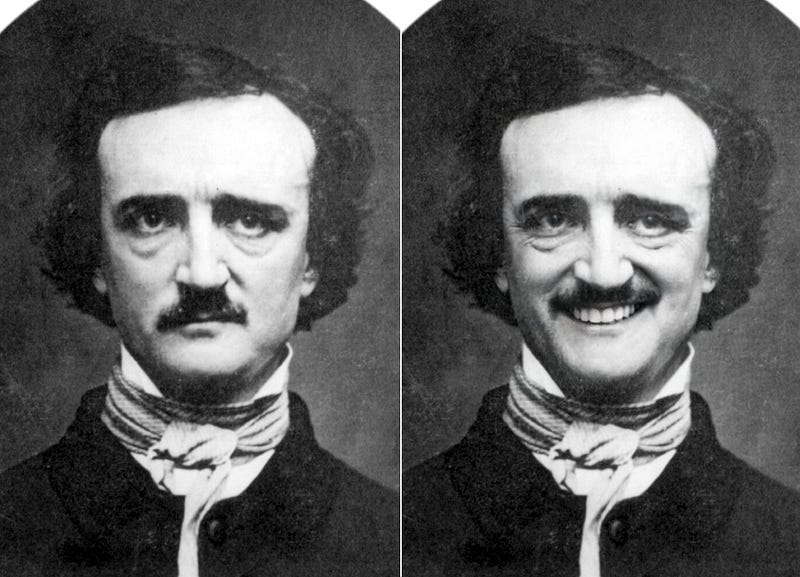
Left: 1848 “Ultima Thule” daguerreotype of Edgar Allan Poe, Public Domain | Right: ©Carlyn Beccia

On a cold November morning in 1848, Edgar Allan Poe made his way through Providence, Rhode Island’s dusty streets, crowded with horse-drawn buggies and city trolleys. He arrived at Samuel Masury and S. W. Hartshorn's daguerreotype studio, where he sat for the above portrait — known today as the “Ultima Thule” daguerreotype.

In this photo, Poe appears haunted by melancholy. Just four days earlier, he had attempted suicide by overdosing on laudanum. The previous year, the death of Poe’s beloved wife had unhinged him. He was not in a good place.

Months after this photograph was taken, Poe died under mysterious circumstances that have baffled historians.

What is certain is that when Edgar Allan Poe sat in the darkened studio, the photographer did not ask him to smile.

But what if Poe had smiled for his portrait? Or even worse, what if the photographer had applied filters to smooth over his lined face or erase the sleepless nights beneath his eyes?

When you contrast the brooding original photograph with my doctored smiling Poe, the difference is unsettling. Instead of imagining a complex man tortured by demons, we see the usual saccharine headshot that could be slapped on any resume (minus the Victorian clothing).

A smile often conceals more than it reveals. When we smile, it is not always because we are happy. We smile to make those around us happy. A smile is the first cloying plea to a fellow human —please like me.

This is part of the reason why people never smiled in old photos. In the nineteenth century, only drunks, naughty children, and insane people smiled for photos. A photo was serious business, and many people could only afford one or two portraits throughout their life. (Or in death…if your only photo was a post-mortem picture.) You certainly didn’t want to be remembered as a grinning buffoon.

Mark Twain found it utterly uncouth to smile for a photo. He said, “A photograph is a most important document, and there is nothing more damning to go down to posterity than a silly, foolish smile caught and fixed forever.”

Well, Mr. Twain. My apologies. I couldn’t resist…
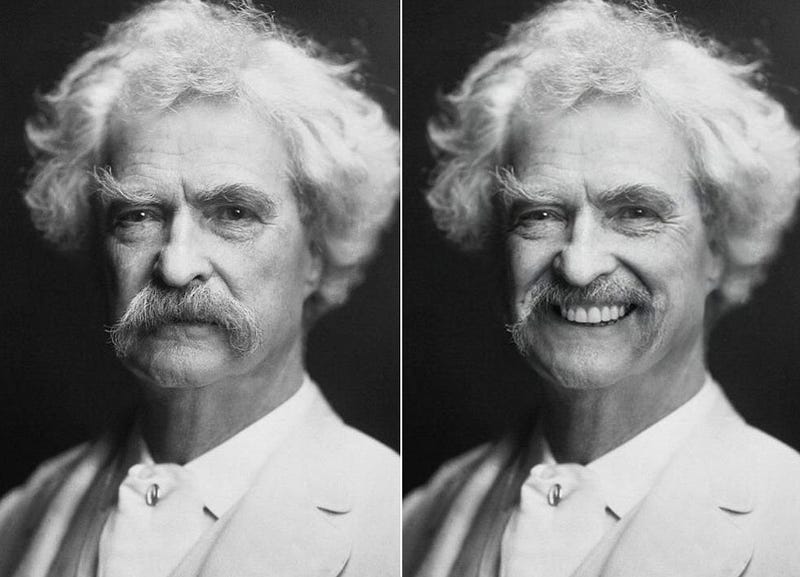
Left: Mark Twain, 1907, Public Domain | Right: ©Carlyn Beccia

Now, Twain is just another creepy man with a devilish grin. But if he posed today, the left side would be considered odd, not the right. Everyone knows you must smile for the camera.

So how did smiling for your portrait go from ridiculous to de rigueur?

The History of Smiling in Portraits

The first reference to the word “smile” is dated from the 1300s from the Old Norse smíla (“to smile”). There isn’t any Latin word for smile because the Romans didn’t smile. (Or they didn’t record themselves smiling.) It was considered rude to expose rotting gums and teeth with putrid breath. You won’t find any roman busts of leaders with toothy grins.

Until now…
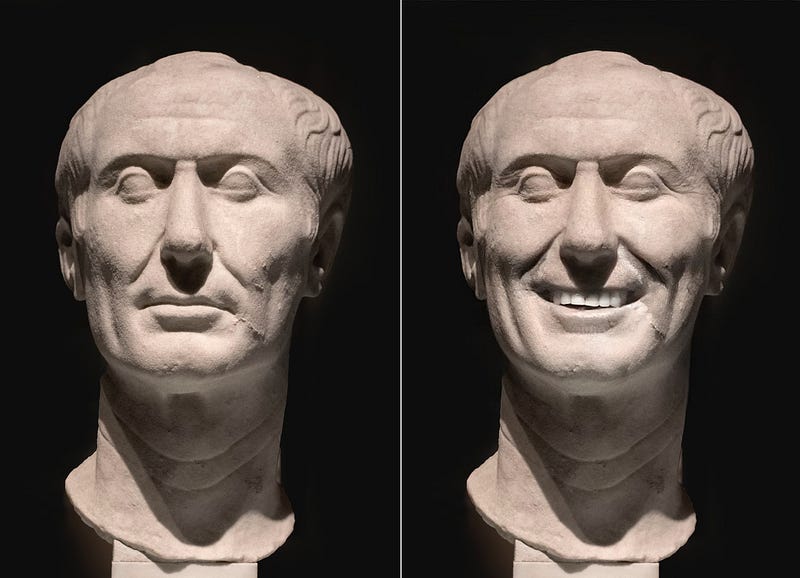
Left: The Tusculum portrait — Julius Caesar, 50–40 BC, Public Domain | Right: ©Carlyn Beccia

The above bust is the only portrait made during Caesar’s lifetime. Most historians believe his bulging forehead was caused by his head being squashed in the birth canal. And despite the long-cherished myth, it is doubtful Caesar was born by the procedure named after him — the Cesarean birth. Personally, I think his smile balances out his misshapen head.

After the fall of the Roman empire, artists mainly created paintings of religious figures — Jesus, Mary, and far too many rambunctious cupids. But by the fifteenth century, portraits returned to secular subjects and became the most popular way to capture someone’s likeness.

Their likeness did not include smiling unless you were a fool, demon, or cloven-hooved satyr. Give a man a goat and a flute, and you will get a smile out of him.
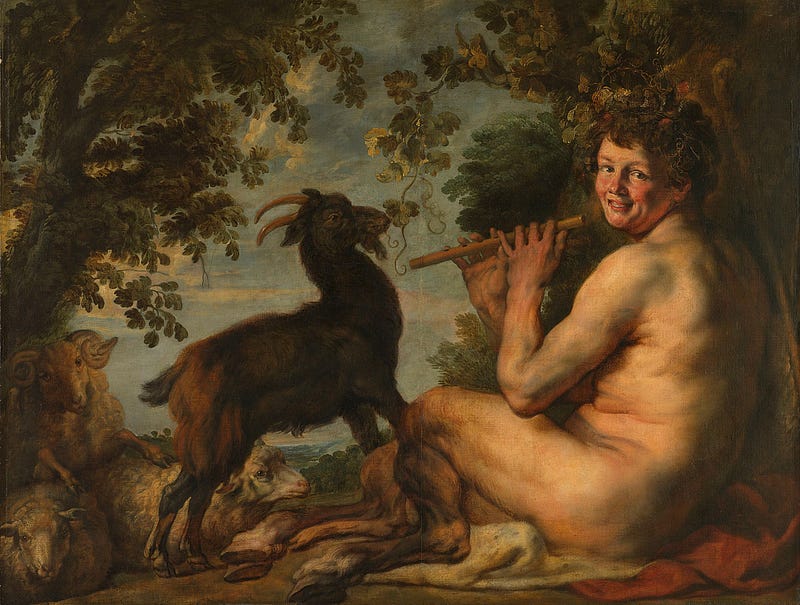
A Satyr, Jacob Jordaens, 1630–1645 | Public Domain

But even the first stately portraits captured more than just a ruler’s likeness. When Elizabeth I posed for the Darnley portrait, it was not just her rotting teeth that made her keep her mouth shut. She kept her mouth closed because her portrait was a propaganda vehicle to convey her authority.
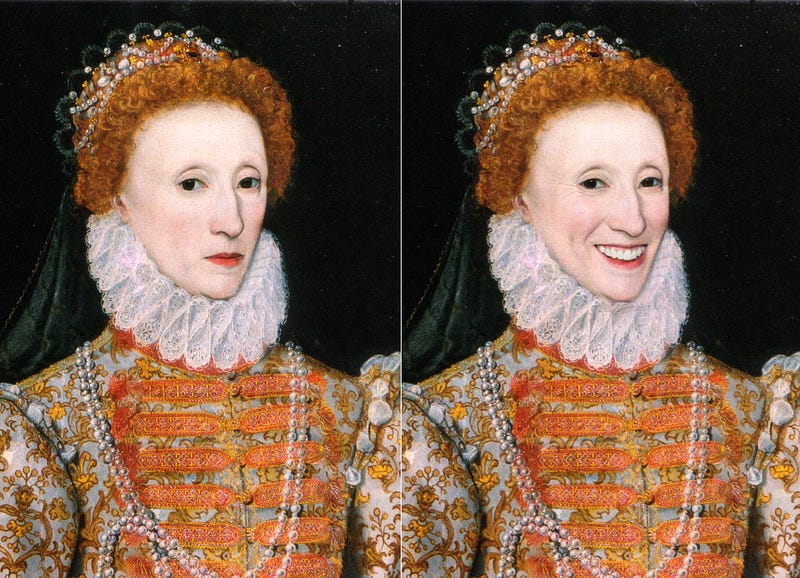
Left: The “Darnley Portrait” of Elizabeth I of England, 1575, Public Domain | Right: ©Carlyn Beccia

In the smiling version, Elizabeth is suddenly not as threatening. To our modern eyes, her smile makes her more approachable. But for a queen, being approachable would get you booted off your throne.

Not much has changed since Elizabeth’s day. Studies show that women who smile in photos are perceived as more attractive but less capable, while men who smile are perceived as less attractive and less capable. Researchers think this is because smiling communicates passivity. (And passivity is less of a turn-off in women.) Even our closest ape and monkey relatives only smile as a sign of submission.

So now you know the real reason why Elizabeth is not flashing those Tudor dimples — no one would take her seriously.

Her dad, Henry VIII, crafted the same omnipotent image of absolute power.
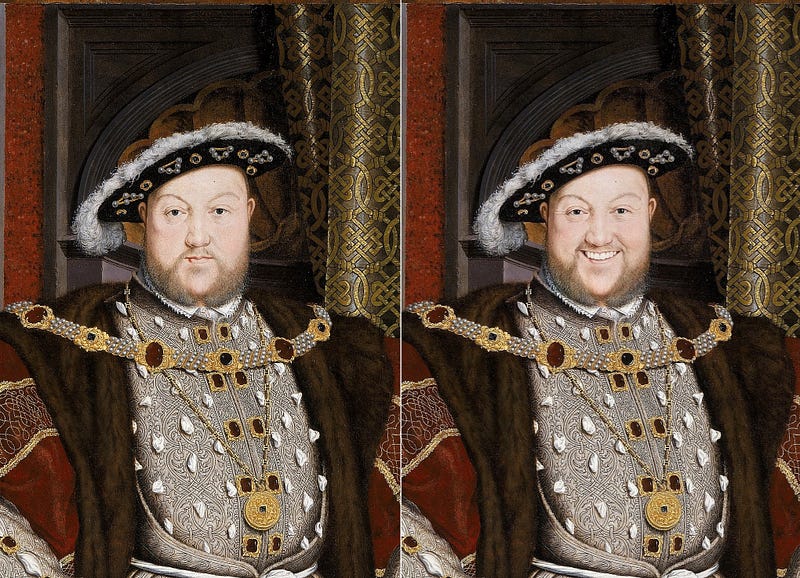
Left: After Hans Holbein the Younger — Portrait of Henry VIII, 1537, Public Domain | Right: ©Carlyn Beccia

It’s hard to take Henry VIII seriously with his affable grin. He certainly doesn’t look like a man who would make a couple of wives a head shorter.

There are cases when smiling would have seemed absurd since the sitter didn’t have any teeth. By the time Gilbert Stuart painted George Washington’s portrait, Washington had one remaining tooth and his dentures kept springing out of his mouth when he spoke.

The loss of teeth had another unfortunate side effect — his cheeks caved in. So Washingon had to stuff cotton in his mouth when he sat for his portrait. Naturally, this made him especially grumpy.

Grumpy until I performed a little cosmetic dentistry…
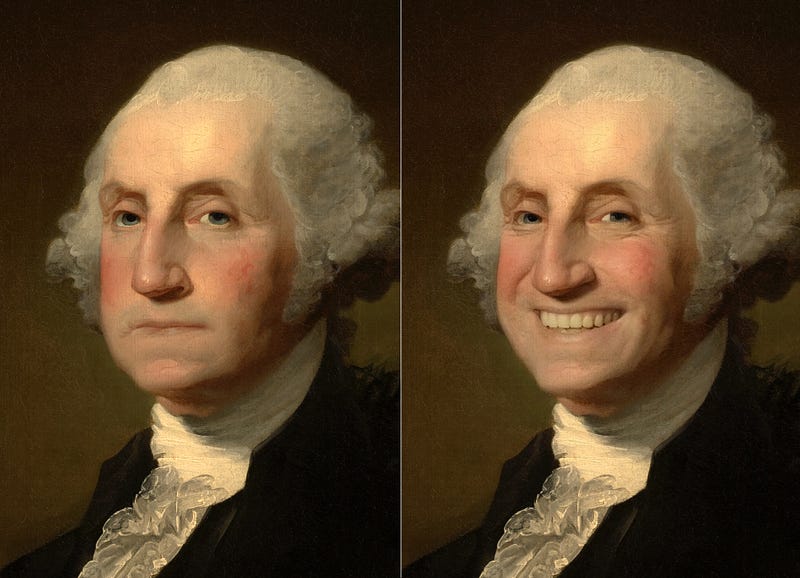
Left: George Washington, Gibert Portrait, 1803, Public Domain | Right: ©Carlyn Beccia

Fortunately, the nineteenth-century ushered in modern dentistry. The first dental college, the first dental journal, and the first dental society were established two decades before the Civil War. Dental fillings became more accessible with gold and tin as the primary materials (depending on your budget). These improvements made smiling less of a freak show.

And still…people did not smile in their portraits.
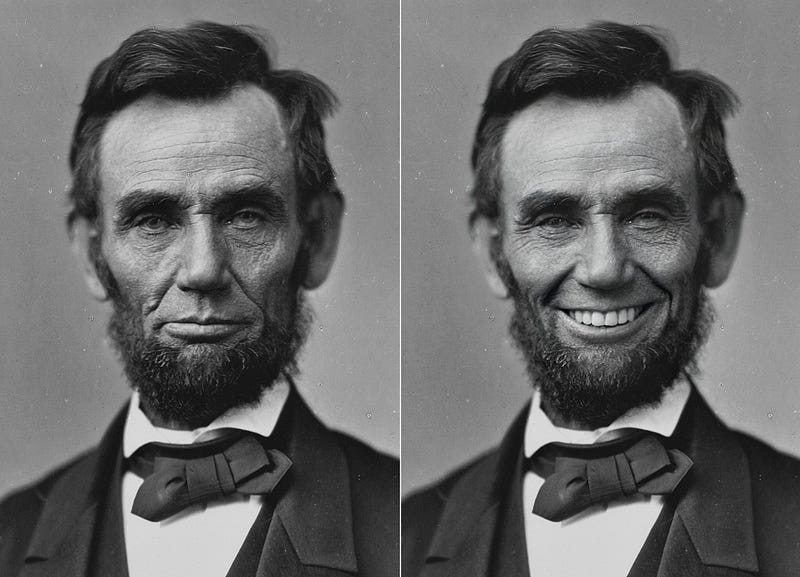
Left: Abraham Lincoln, 1863, Public Domain | Right: ©Carlyn Beccia

It’s often been assumed that people didn’t smile in photos due to the long exposure times, but that theory does not hold up. By the time photographers took Lincoln’s photo, photography was advanced enough to capture an image in less than five seconds — plenty enough time to flash your pearly whites.

The real reason why people didn’t smile in photos was that it was not instinctual to do so. Think of the last time you went through an airport screening device. When you stand with your hands above your head, what expression do you have on your face while the machine scans your body? If you want to get past the TSA folks, I am guessing it is neutral.

Taking a photograph was as solemn of an event as an airport screening. Flashing that thousand-watt smile would make you seem a tad affected.

For example, when Queen Victoria smiles, she looks like she has swigged a little too much morphine.
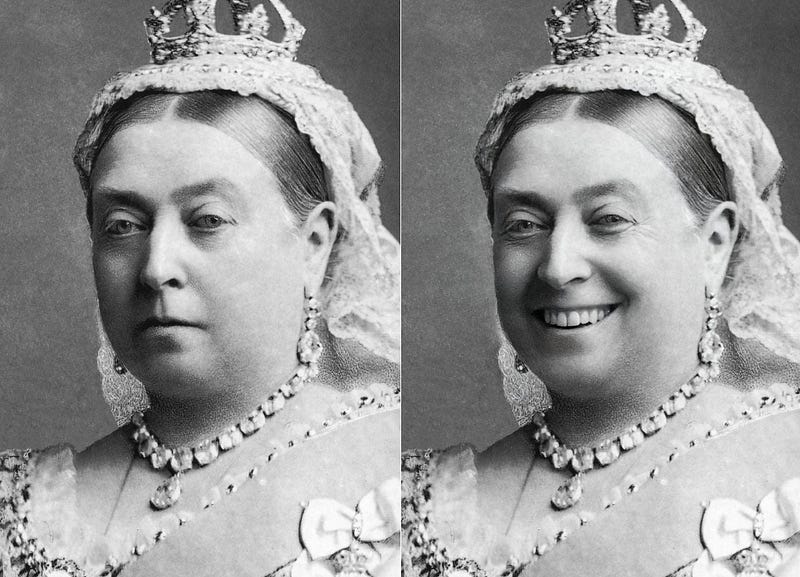
Left: Queen Victoria, 1882, Public Domain | Right: ©Carlyn Beccia

Eventually, smiles would creep their way into portraits. According to Angus Trumble, author of A Brief History of the Smile, photographers started telling their subjects to “say cheese” around 1920. (The tradition began with British schoolchildren.)

But today, not every country uses the word “cheese” to get a relaxed smile. Australians say “money.” Spaniards say “patata” (potato), the Japanese use the English word “whiskey,” and the Czechs say “fax.”

Other countries do not smile at the camera. In many countries, smiling makes you appear stupid. For example, in Japan, South Korea, India, and Russia smiling people are viewed as less competent than those with sober expressions.

We tend to think Americans are exempt from being viewed as incompetent if we smile, but research says differently. Behavioral scientist Vanessa Van Edward’s found that leaders smile less than non-leaders. Another study found that women who smile less are more likely to be promoted. Personally, I saw a dramatic increase in followers when I changed my smiling headshot to an unsmiling one. Go figure.

I have also wondered if Trump had scowled less, would people have seen him as an impotent failed businessman? In Che Guevara’s famous portrait, he certainly seems less commanding when he smiles. And dare I say…his smile makes him seem a tad maniacal.
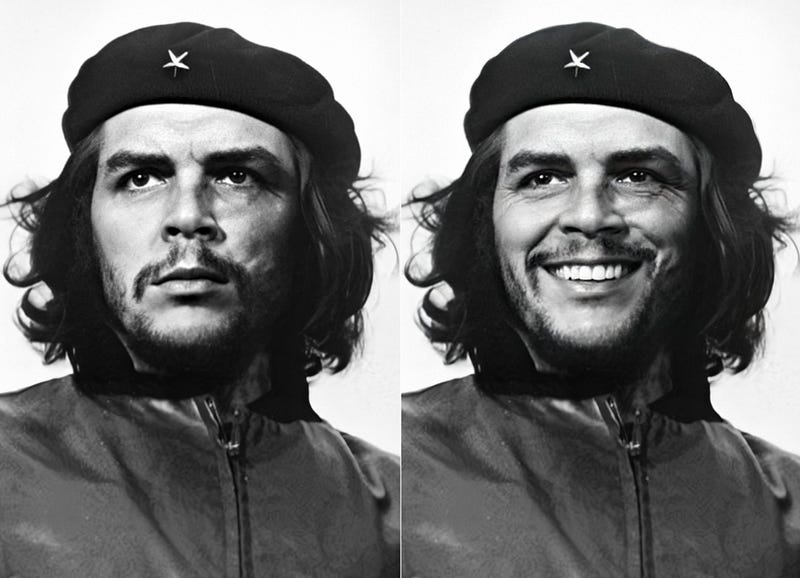
Left: Che Guevara, 1960, Public Domain | Right: ©Carlyn Beccia

Harriet Tubman looks especially badass in her unsmiling photo. Tubman did not even let infected teeth slow her down. When she was on the run, she knocked her decaying front tooth out with a pistol.

But when I force a softer half-grin on her face, she loses some of her rugged determination. The left clearly captures Tubman’s grit. The right makes her appear caricatured.
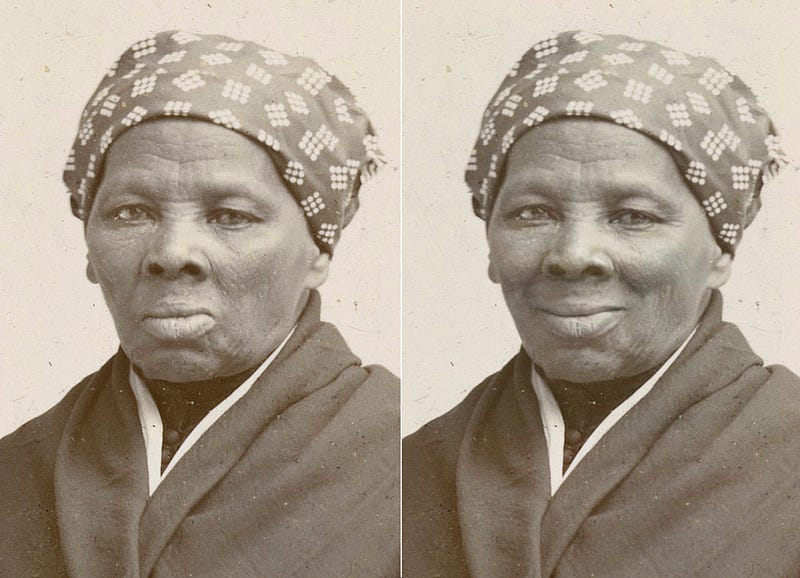
Left: Harriet Tubman, 1895, Public Domain | Right: ©Carlyn Beccia

Some people appear more mischievous when they smile. Frida Kahlo played many pranks on her friends and her husband, Diego Rivera. Her playfulness comes through in her smiling photo. But again, this might only work on a woman.
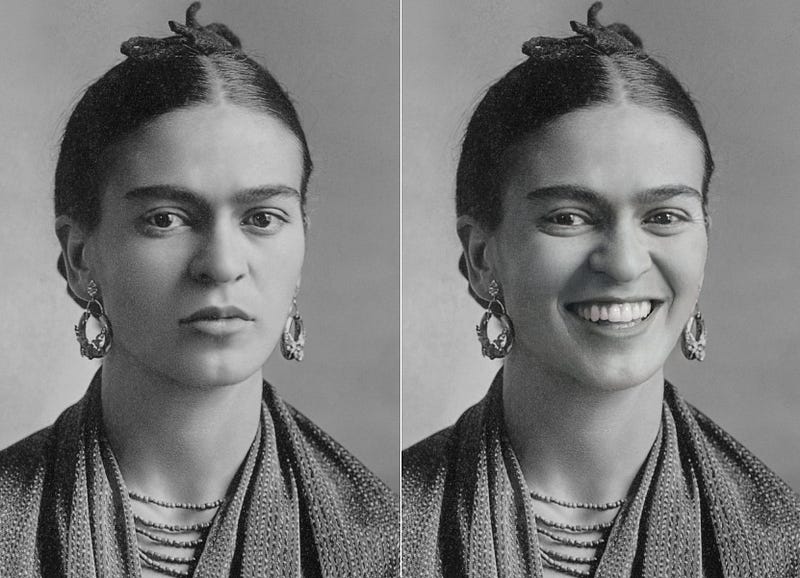
Left: Frida Kahlo, 1932, Public Domain | Right: ©Carlyn Beccia

Today, when a smartphone takes our picture, we instinctually smile. But are these forced smiles the best way to capture our soul in pixels?

A smile should be as natural and as involuntary as a sneeze. Yet, we are constantly being told to smile more. The logic follows that if you force the corners of your mouth upward…you feel happier. But when someone asks you to smile, they ask you to adapt your emotions to accommodate them. We smile to make others feel more comfortable.

So perhaps our great-great-grandparents had the right idea. When we smile at the camera, it does not capture our likeness. It captures how much we want others to like us.

To read more and support The Grim Historian, please visit my affiliate link and become a Medium Member. A portion of your subscription supports my writing.

History
Humor
Art
Culture
Photography
Recommended from ReadMedium