
The Science Behind What Writing Does to the Brain
A scientific study reveals what’s happening to your brain while you write

Imagine it’s a dark and stormy night. The tree branches are whipping back and forth as the wind has its way with them. The rain is coming down hard, starting to pelt you in the face.
You duck your head so the water doesn’t get in your eyes.
Even without the rain, it’s getting hard to see. The light from the moon and stars is not strong enough to cut through the darkness. You know if you don’t find shelter soon you’re in real trouble.
It’s so cold out you’re starting to see your breath. Your hands are beginning to ache. You blow into them trying to regain some of the lost heat but it makes no difference whatsoever.
You glance around nervously, looking for somewhere — anywhere — you can take shelter to escape the cold. And then you see it.
Off in the distance. You can barely make it out. You squint and lean forward slightly as you try to determine what it is…
“A controversial question in creativity research concerns the phenomenon of cognitive control: our capacity to regulate the contents of our minds. Does creative thinking happen spontaneously, or can we deliberately direct the process?” — National Library of Medicine
What did you envision?
A house? A barn? An approaching car? Did any of those things pop into your mind as you imagined what the fictional character saw in the distance?
Maybe it was something else but whatever you were imagining, you fired up the parts of your brain that respond to your imagination and creative thinking — your creative brain.
Over the past several decades a lot of research has been conducted on what is happening in the brain when someone is reading or writing, but not a lot of concrete data has been captured.
That’s because it’s extremely difficult to capture anything conclusive.
What was necessary for the study?
To properly conduct the study, 3 things were needed:
- A group of scientists qualified to lead the study
- A group or groups of writers to be studied
- A way to measure and capture the brain scans during the writing process
Once those 3 criteria were determined, the leaders of the study faced two critical challenges. First, how would they watch the brain activity of the writers as they were writing? And second, how would they connect the dots once the data was captured?
Although there are devices designed to watch live brain scans, they’re only designed to capture images of the brain useful for medical purposes. They’re not designed to study the brain activity generated while a writer is writing.
For starters, if you’ve ever had a MRI scan of the brain you know that laying on your back inside a metal tube is not the most comfortable position to be in.
Secondly, if you’ve ever tried to write while lying down, it’s just not very feasible. Believe me, I’ve tried. I was forced to try to get creative because of severe medical issues in the past 3 years.
The setup needed to capture data
Under normal circumstances, the magnetic field generated by a scanner would launch a standard keyboard across the room. This challenge was overcome by giving the writers a special keyboard they could use.
The writers also had a special “writing desk” that allowed them to write while in the reclined position. They were able to rest their writing arm while writing, and a special set of mirrors was positioned to allow them to see what they were writing while within the scanner.
The team of researchers was led by Dr. Martin Lotze of the University of Greifswald in Germany. The main parameter of the testing was to see exactly how the brain reacts while a writer is researching or writing a work of fiction.
They observed two different groups of writers to see if there were differences between the way the brains of professional writers responded versus that of a group of novice writers.
Conducting the study
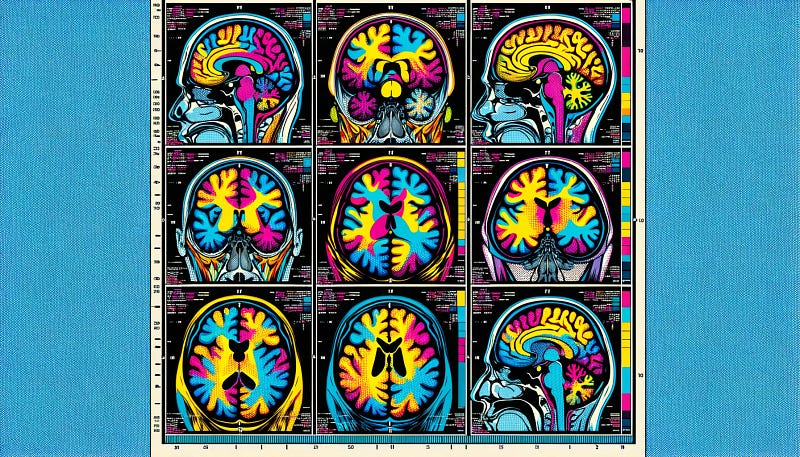
As the scientists used a fMRI (functional magnetic resonance imaging) scan to observe the regions of the brain they found the two groups used different regions of the brain as they were brainstorming and developing the details of their stories.
For instance, the scientists gave the novice writers the beginning of a story and asked them to continue from there. They found the writers activated their visual centers during brainstorming sessions.
By contrast however — when asked to do the same — the expert writer’s brains showed more activity in the regions of the brain that are involved with speech.
This is thought to be because the novice writers were visualizing the story as they were developing it. Their more experienced counterparts however were not visualizing what they were writing as much as they were thinking in terms of the actual wording needed to capture the story.
Deep within the brains of the expert writers, a region called the caudate nucleus was firing on all cylinders. But in the novices the same area of the brain was quiet.
The caudate nucleus is an area of the brain familiar to scientists like Dr. Lotze who have spent a great deal of time studying that area of the brain.
What is happening
When we first start to learn a new skill — such as playing a sport or the piano —it takes a strong conscious effort. But as we practice those actions it becomes more automatic as the caudate nucleus and nearby regions of the brain begin to coordinate the brain’s activity.
According to the study, the professional writers “showed some similarities to people who are skilled at other complex actions, like music or sports.” (Zimmer, 2014).
The Key Takeaways
There is still a big mystery to the human brain and there probably always will be.
One thing is certain, there is a long way to go in making sense of what’s going on between our ears.
If we’re ever going to fully understand the brain, it’s probably going to take several more studies, techniques, and the development of new technologies to make significant advances.
However, with experts such as Dr. Lotze and other scientists, the timeline for breakthroughs in this field may be on the horizon.
Like rays of sunshine beginning to penetrate the deep darkness, breakthrough studies are beginning to illuminate the field of brain science.
References
Cerebrum. Beatty, R. (2020). National Library of Medicine. https://www.ncbi.nlm.nih.gov/pmc/articles/PMC7075500/
Neuroanatomy, Nucleus Caudate. Driscoll, M., Pradeep, C.B., Prassana, T. (2023). National Library of Medicine. https://pubmed.ncbi.nlm.nih.gov/32491339/
The Science Behind What Writing Does to Your Brain. Rasso, E. (2017). Craft Your Content. https://www.craftyourcontent.com/science-behind-writing-brain/
This is Your Brain on Writing. Zimmer, C. (2014). New York Times. https://www.nytimes.com/2014/06/19/science/researching-the-brain-of-writers.html
Cipher Max suggestions for improvement?


