
The Roman leaders harmed the state and played a significant role in the downfall of the Roman Republic.
The large conquests posed significant challenges to the Roman Republic. Ambitious Roman leaders, such as Marius, Sulla, Pompey, and Caesar, attempted to address these challenges but quickly transformed into tyrants. In their attempt to “save” the republic, they ultimately contributed to its downfall.
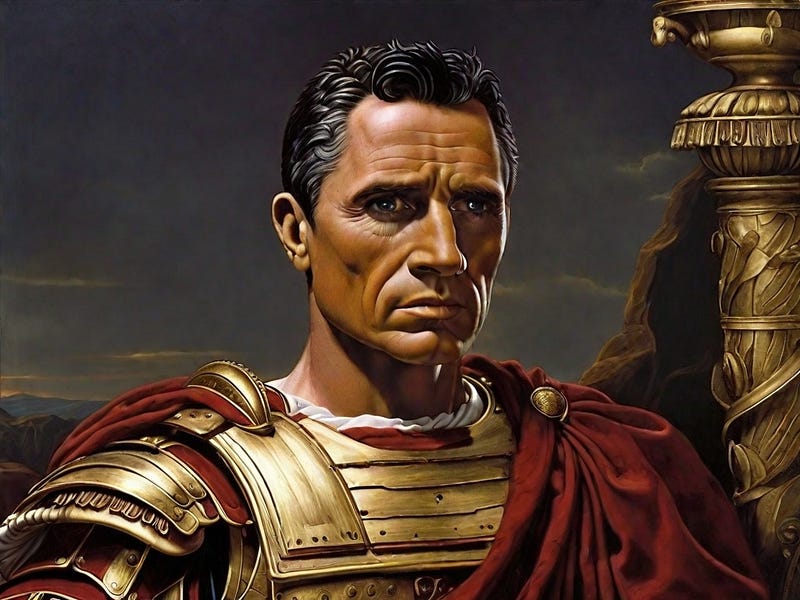
Honesty was considered a vice. The elders spent their days sleeping. The youth influenced by the Luxuria movement turned to a life of crime to fund their extravagance. This is how Salustius, a contemporary Roman historian of Caesar, described the last decades of the republic. However, the real problems of the republican system looked quite different. What did the Roman leaders have to do with them?
The Brutal Politics of Roman Leaders
The worst thing that happened to the Romans in the late 2nd century BC was the loss of the ability to peacefully resolve internal disputes. Two political factions emerged. The Populares argued that the will of the people was the highest law and focused on land redistribution through agrarian laws. Their opponents, known as the Boni or Optimates, advocated for the supremacy of the republic’s well-being. They understood this well-being as the rule of the oligarchs and the restriction of legislative activity by their opponents to preserve the “customs of the ancestors.” The Optimates believed they had the right to remove anyone who threatened their position. They discovered that violence and murder could be effectively employed against political opponents, even if they were fellow citizens.
In the years 133–121 BC, the attempts at land reforms by the Gracchus brothers ended in a massacre of their faction. The symptoms of the disease that began to plague the once-efficient republican system became evident during the war with Jugurtha (111–106 BC), the King of Numidia. As an ally dependent on Rome, he dared to ignore the order to share the country with his brother Adherbal. A blatant insult to Rome was the killing of Italian merchants from Cirta who had provided shelter to Adherbal. The commander of the army sent to Numidia chose to make peace instead of seeking revenge. To make matters worse, Jugurtha, upon his visit to Rome with a sealed letter, used the opportunity to assassinate one of his cousins and defeated a consular army when the war resumed.
Rome was disgraced and paralyzed
Tribunes, instead of acting in unity, vetoed their resolutions, and in an atmosphere of witch hunt, supposedly responsible for the defeat were hunted down. To break the deadlock, the Romans had to bypass the law. The impatient people granted Gaius Marius the power to rule the province in Africa, even though only senators were allowed to lead there! Marius was known as an efficient soldier. As Salustius wrote, “his mind was not tainted by the twisted teachings of rhetoric or politeness.” He quickly ended the embarrassing war.
“Incidentally,” he did something far more important: he allowed the so-called proletarii (people who had only one thing — offspring: proles) to serve in the military and later secured land for them in colonies. For the first time, settlement action only applied to the soldiers of one commander, who automatically became a better class of citizens. They felt bound to the leader for life and put their common interests above the state’s interests. The path to the rebellion of an ambitious individual was wide open.
Citizens under the rule of Roman leaders
As if that were not enough, Marius began to hold the consulship year after year, although the law strictly prohibited serial holding of this office. The threat posed by the Cimbri invasions helped him secure successive consulships. After invading Gaul, they gathered related tribes and crushed successive armies, relentlessly pushing towards northern Italy. They were only defeated in the Battle of Vercellae. And although historians still debate who deserves more credit in this battle — Marius or the second consul Catulus — the former gained immense popularity.
The war with the Cimbri also revealed that the limited, almost “parochial” mentality was unable to keep up with the lightning-fast expansion of dependent territories. The Romans seemed oblivious to the fact that their city was no longer a tiny polis. In repelling the Cimbri, many Italian allied peoples played a significant role. Many of their leaders believed that their support for the Romans should be rewarded with citizenship. However, when the greatest threat since Hannibal had passed, the consuls established a tribunal to control self-proclaimed “citizens.” Under the blows of the murderers, tribune Livius Drusus, who supported the arguments of the allies, fell.
Allies decided to incite a rebellion. This marked the beginning of an entirely unnecessary war with the allies of Italy (90–88 BC). Although the confederation of tribes was broken, the Romans did not maintain the elite status of citizenship. Initially, it was granted to those who refrained from fighting or voluntarily switched to the side of Rome, and eventually, it was extended to most of the peoples of the peninsula.
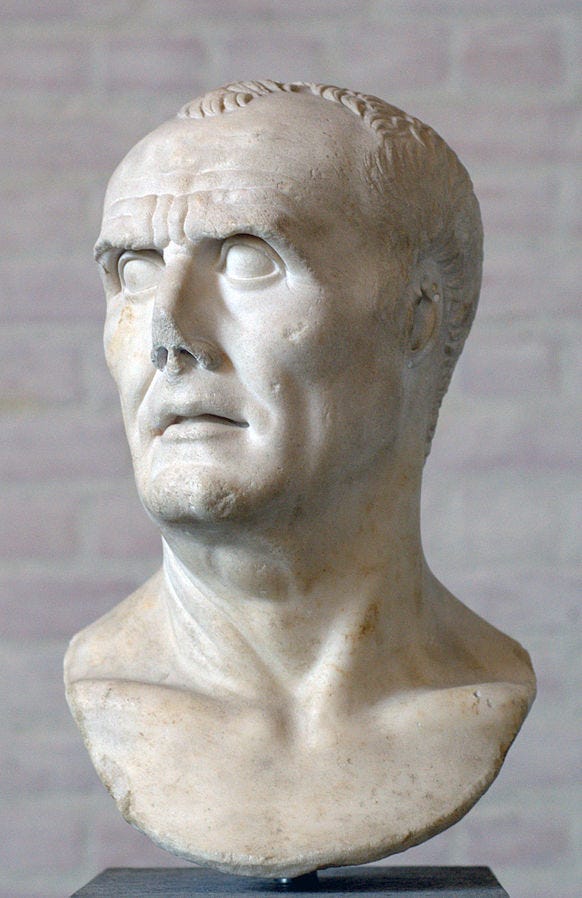

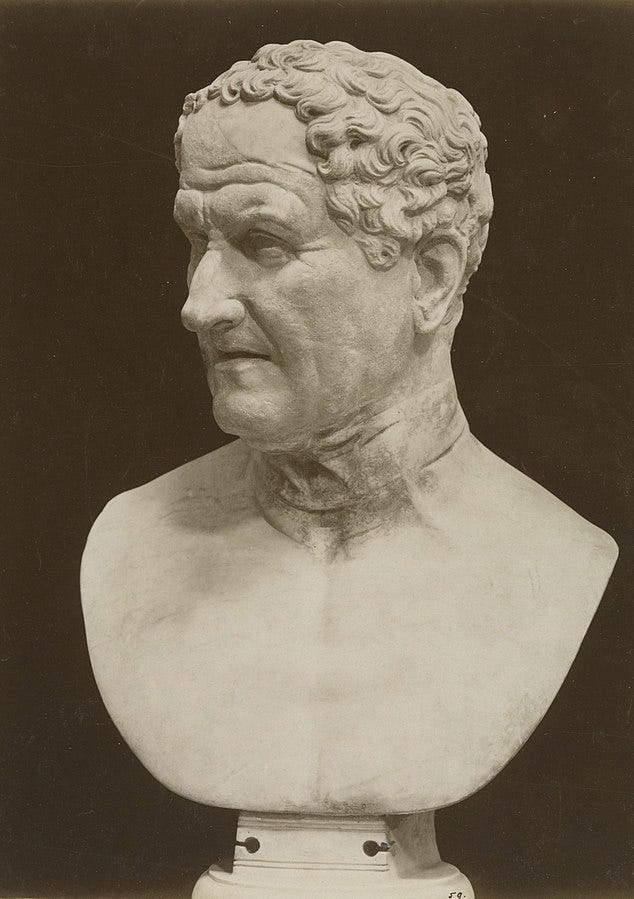
Lucius Cornelius Sulla
The war with the allies unexpectedly led to a much more serious First Civil War (88–81 BC). The plebeian tribune Publius Sulpicius Rufus demanded the recall from exile of the supporters of Drusus. Of course, not without self-interest. He offered to entrust the war against Mithridates Eupator in Asia to Marius. Another political bargain was struck — the allocation was given to the consul Lucius Cornelius Sulla, but he had to settle for less. Sulla, however, was not afraid of risky undertakings, and a certain Chaldean magus allegedly promised him greatness. So, he had the audacity to attempt something Rome had never seen before. He marched into the city but did not allow mass killings. Even Marius managed to escape from the Esquiline Hill. After consolidating his position, Sulla moved to the east. Then, the second coup occurred. When the Senate stripped the consul Lucius Cornelius Cinna, who was trying to recall the supporters of Drusus from exile, of his office, he followed in Sulla’s footsteps and marched on Rome. He seized power with the support of Marius, among others. According to the account of Appian of Alexandria (2nd century AD), the soldiers of Cinna and Marius slaughtered the entire families of Sulla’s supporters and threw their heads onto the Forum. Marius died shortly after these horrific events, and as a result, Cinna ruled in the West. However, he too unexpectedly perished at the hands of his own soldiers, and Sulla quickly transferred his army to Brundisium.
The elites, who had been tormented by Marius, saw Sulla as their savior, and people came out to meet him — even Cinna’s friend Gnaeus Pompeius. The consul’s armies deserted him. The year-and-a-half war ended with Sulla’s victorious Battle of the Colline Gate, one of the gates of Rome, after which he ordered the killing of 4,000 captured countrymen and instructed the interrex to appoint him as an indefinite dictator “for the compilation of laws and the strengthening of the republic.” He understood these actions very specifically as proscriptions, which meant creating lists of his enemies. From then on, they could be killed with impunity (or even rewarded). Their property was confiscated, and entire families were deprived of political rights. Salustius writes that during Sulla’s time, “everyone started to plunder and rob. One wanted a house, another wanted land. The victors knew no end or limit and committed terrible violence.”
.jpg)
Within a few months, entirely new elites emerged. The Sullan system also fulfilled the dreams of the Optimates. The people could only vote for laws preliminarily approved by the Senate; the veto power of the plebeian tribunes was limited, and, furthermore, after their tribunate, they had to end their political careers. When in 79 BC, tormented by old age and aware of emerging conspiracies, Sulla relinquished dictatorial power, it turned out that the Senate could not effectively use the broad prerogatives granted to it! Divided senators looked at each other suspiciously, fearing the emergence of a “new tyrant” among them.
Gnaeus Pompeius seized the opportunity created by the atmosphere of mutual distrust. This talented young man played an increasingly important role, but his arrogance knew no bounds. The Roman historian Velleius Paterculus ironically wrote about him in the early 1st century AD: “He had almost no faults, except that in a republic that ruled the world, where all citizens are equal by law, he was offended when he saw that someone equaled him in dignity.”
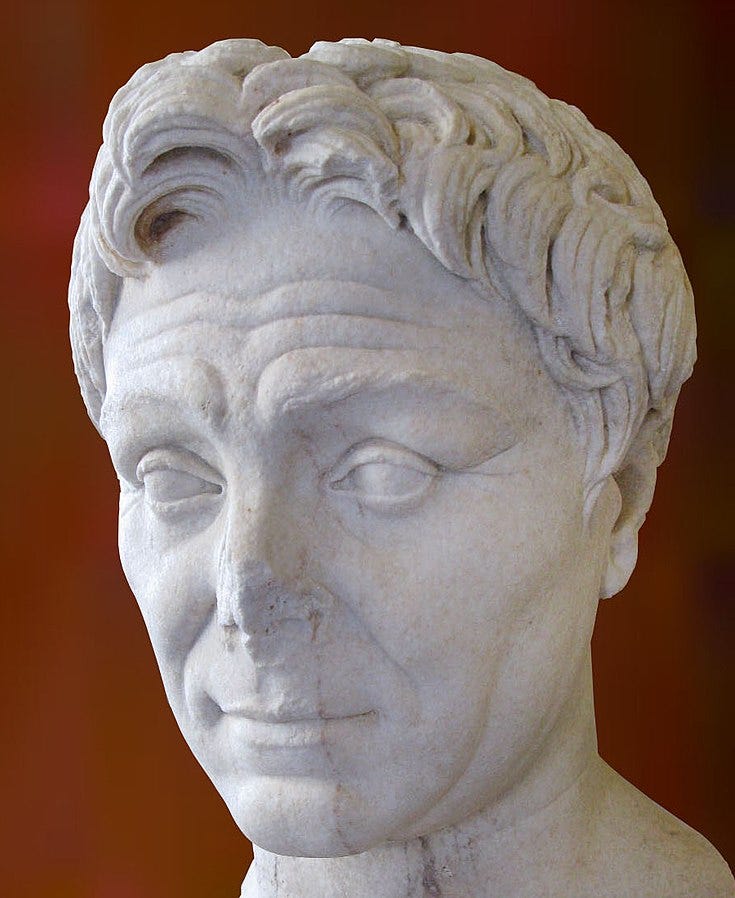
Gnaeus Pompeius
Pompey, renowned for his victories in Spain over the last supporters of Marius, reached an agreement with Crassus, the conqueror of Spartacus. Although the Senate refused to support their candidacy for the consulship, they forcibly obtained these offices with the support of the people, thanks to their armies and the backing of the Populares. Pompey, hungry for glory, did not stay in the capital. In 67 BC, he set out to the East to combat the pirates, and a year later, against the Senate’s and consuls’ wishes, he obtained indefinite power in the province of Asia, the first time in history with the authority to decide on war and peace.
Now, one man was to make decisions affecting the entire state. Upon his return to Italy, Pompey acted in a surprising way. He discharged all his soldiers, believing that his fame and the recently acquired wealth equivalent to the annual income of the state would ensure his influence. After all, he had the kings of the East as his clients. Why should Roman officials resist him? However, according to Plutarch, his incredible successes only aroused envy. Pompey found himself isolated, and he was only rescued from this isolation by Julius Caesar, the nephew of Marius’s wife and the son-in-law of Cinna.
In 60 BC, Caesar, out of sheer cynicism (simply aligning himself with the strongest), brought about the formation of a secret agreement between Pompey and Crassus, which historians called the First Triumvirate. They were to secure the consulship for Caesar, and in return, he promised land for Pompey’s veterans and the confirmation of his authority in the East, and Crassus would get a reduction in the leasing fees for the revenues from Asia. Within a year, Caesar received the governance of the provinces of Cisalpine Gaul, Transalpine Gaul, and Illyricum for a five-year term!

Caesar hoped that besides political benefits, the plunder of Gaul would help him escape his debts. Wanting to enter the political stage, he distributed money to the people and even borrowed a sum many times greater than his wealth. When the creditors realized that he was simply giving away their funds instead of investing them, they temporarily blocked his departure to Spain, where he was to become a governor. When he finally set out, the money was within his reach.
According to Suetonius, he “did not miss any opportunity to start a war, even if it was the most unjust and dangerous, attacking both the nations allied with Rome and those that were hostile and wild.” The Senate was so concerned about the reports coming from Gaul that they sent a commission to investigate what was really happening there. Of course, it achieved nothing, and Caesar began making bolder plans. His victorious march was only interrupted by the uprising of Vercingetorix and defeats beyond the Rhine.
Divided Roman leaders
Changes came in 53 BC. Driven by the desire for military victories, Crassus went to Syria and soon perished there along with his son at the hands of the Parthians. He had no shortage of military talent, as he demonstrated, for example, at the Porta Collina, but he often faced opponents much more skilled than himself in Parthia. The physical Triumvirate ceased to exist. Pompey also distanced himself from Caesar. After pacifying the capital, which was in turmoil after the murder of Clodius and drawing closer to the Optimates, he believed he could become an independent hegemon.
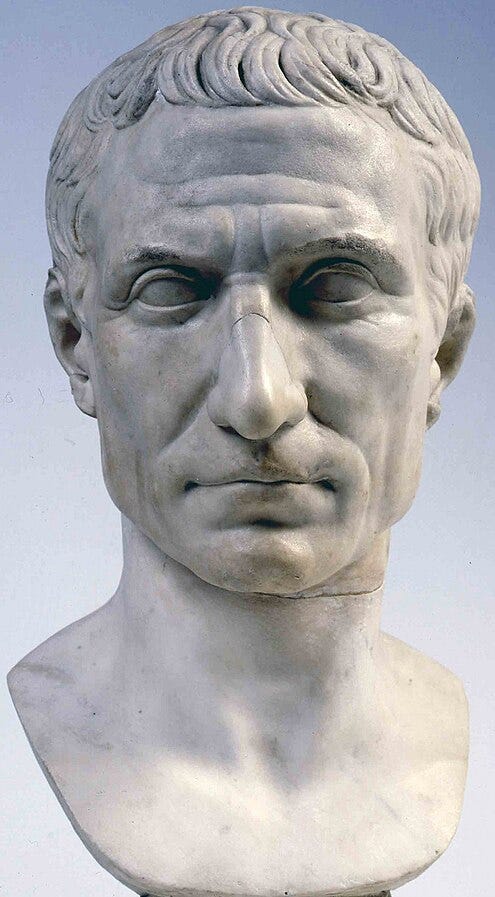
The nail in the coffin for the conqueror of Gaul was a law regarding the election procedure — anyone who wanted to become consul had to appear in the capital. This was a clear sentence for Caesar — having given up his command, he would undoubtedly be put on trial. The height of Optimate provocation was depriving Caesar of power in Gaul and issuing the famous senatus consultum ultimum, to which he responded on January 10, 49 BC, by crossing the Rubicon River. It was a symbolic gesture. He entered the boundaries of Italy, where it was forbidden to station legions, positioning himself as a usurper.
.jpg)
The Civil War Between Caesar and Pompey
The second Civil War (49–45 BC) became a reality. Pompey quickly left Italy (he felt safer in the East), which Caesar immediately seized. The decisive battle of the war took place at Pharsalus in Greece. Pompey had twice the numerical advantage, and yet he succumbed to Julius’s battle-hardened veterans. After winning the battle, Caesar, standing among the dead, reportedly said, “They asked for it themselves: despite such great deeds, I, Gaius Caesar, would have been condemned if I had not sought help in the army.”
The defeated Pompey fled for his life. Unfortunately, he chose Egypt. It is said that Theodotus of Chios, the tutor of King Ptolemy XIII, concocted a plot. To meet Pompey, Sempronius, a man who had fought in Pompey’s legions in the past, was sent as an escort. However, when they found themselves on a boat, he delivered a fatal blow. The cunning Greek, watching from the shore, said briefly, “The dead do not bite.”
After Pompey’s Death
After conquering Egypt, even though Pompey was no longer alive, Caesar continued to pursue the Optimates across the entire Mediterranean. Supported by the King of Numidia, they were defeated in the Battle of Thapsus. Considered one of the most important commanders, Metellus Scipio took his own life. One of Pompey’s sons fled to Spain, where Caesar’s forces eventually caught up with him. However, the most memorable event in history was the death of Cato the Younger in Utica, North Africa. The unwavering embodiment of civic virtues refused to accept mediation with Caesar. When Caesar approached his estate, Cato ordered his family and friends to save themselves, while he took his own life by sword at dawn. His servants tried to dress his wounds, but Cato, regaining consciousness, tore off the bandages and ripped out his own entrails with his hands. From that point on, Caesar no longer had any serious opponents.
The intimidated Senate “celebrated” the defeat of their own defenders. Nevertheless, there were certain limits he did not cross. Instead of titles for disgraceful civil victories, Caesar was awarded substitute triumphs: over the Gauls, Egyptians, or Juba. The new “tyrant” also turned out to be more lenient than Sulla — he only confiscated the property of a few. Even Cicero survived, only to be executed later by Mark Antony with the silent consent of Octavian. His executioners severed his head and hands, which they then displayed in the Forum.
,_1st_cent._B.C.jpg)
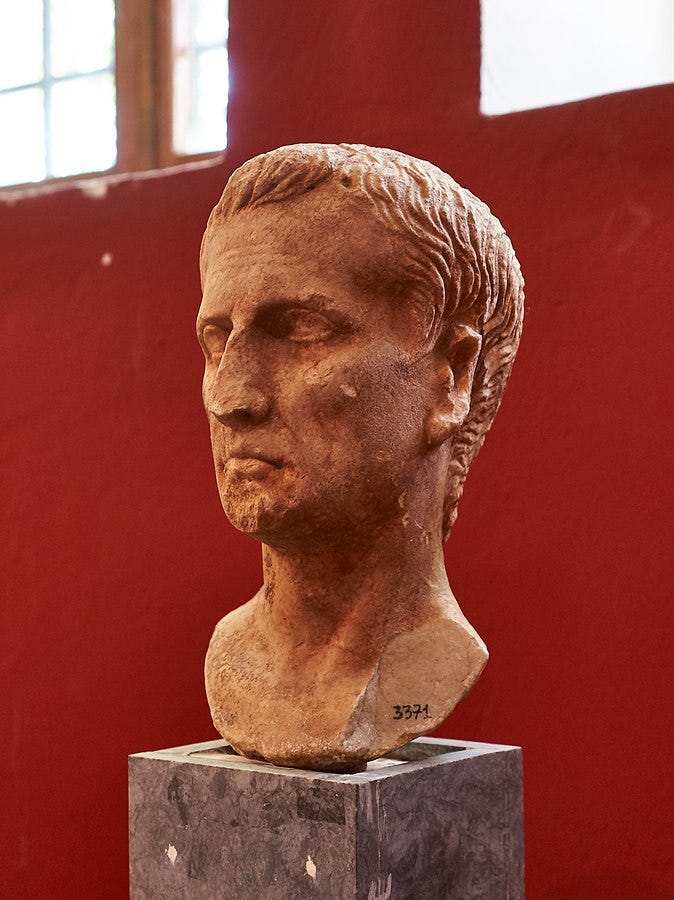
Julius Caesar
Caesar obtained the right to appoint officials. However, he did not officially assume this power, limiting himself to proposing candidates who were to be elected. Only he had control over the army and the treasury. He ambitiously settled Corinth and Carthage with veterans. He generously granted citizenship to other peoples, including the entire Gaul. Initiating the expansion of Latin culture in this direction is undoubtedly his merit. Caesar realized that Rome was becoming a powerful empire encompassing the entire civilized world of that time, and the city-state needed to adapt to the new conditions.
One issue remained unresolved — Caesar’s personal status. In 48 BC, he received an indefinite dictatorship, in 46 BC, a ten-year one, and in 44 BC, a lifetime one. However, a dictatorship was not a “normal” republican office, and what’s more, no one had ever held it for so long. The Republic was too narrow for his powers, and a monarchy was still too offensive for the citizens.
In 44 BC, Mark Antony attempted to force a diadem onto his head, but Caesar removed it and threw it into the crowd. They tried to stage an acclamation on the way from Alba to Rome, but it didn’t sway those present. A flustered Julius was reported to have said that his name was not “Rex” (king), only “Caesar” (this is a subtle play on words — both Rex and Caesar are Roman names). By a Senate resolution, Caesar was allowed to attend all official ceremonies dressed as a triumphing general with a wreath and to ride in a gilded chariot. He also received the title “Liberator.” Social hysteria went so far that the month of Quinctilis was named after him: Julius. In the East, whispers began that he was a god.
.jpg)
The Assassination of Caesar
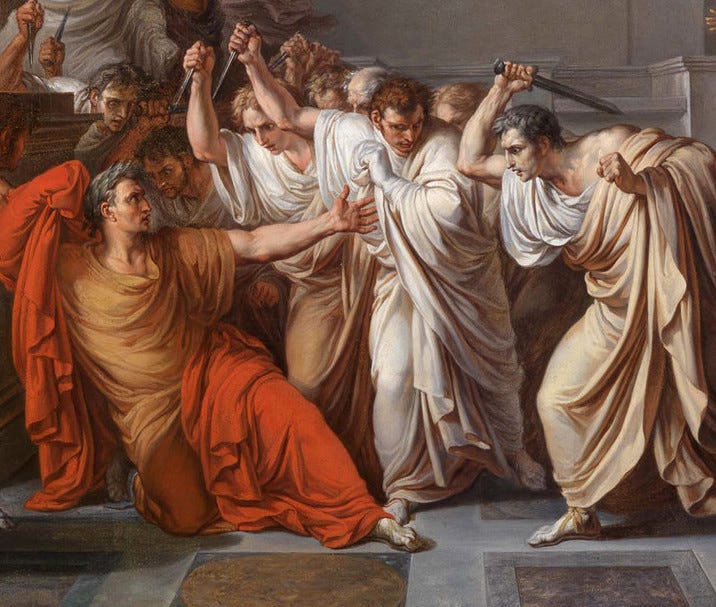
Caesar’s life suddenly ended on the famous Ides of March in 44 BC. The leading conspirators, Brutus and Cassius Longinus, were former Pompeians who had begged him for forgiveness a few years earlier. This is how they repaid him for the favor he granted them. The last straw, a few days before Caesar’s departure for a new Parthian war, was the “discovery” of a prophecy from the Sibylline Books, which stated that only a Roman king could defeat the Parthians. Now, not only the Optimates knew what was brewing. Caesar had to die because, in the eyes of the elite, he had become a damned autocrat.
Among the conspirators were even some of his confidants, such as the consul Gaius Trebonius, who had been a trusted legate, sharing the hardships of conquering Gaul and Britain. Overthrown monarchy sent shivers down everyone’s spine. After killing Caesar, the conspirators did not know what to do next. They had seriously miscalculated, expecting that the common people would be on their side. The city’s residents were seething with a thirst for vengeance because they had lost their benefactor.
Isolated Optimates locked themselves in the Capitol, and negotiations with them were initiated by Antony. He agreed to lift the dictatorship and forgive them the crime in exchange for confirmation of Caesar’s legislative acts. Many of Caesar’s supporters remembered him for negotiating with the conspirators. His situation was further exacerbated by the reading of Caesar’s will. Caesar distributed huge sums of money to the city’s population through his will, and he named the son of his niece, young Octavian, as the heir. Octavian did not hesitate to accept the burden of the inheritance, and within a few weeks, he arrived in Italy, heralding new wars and completely new times.
Attention all readers!
As content creators on Medium.com, we face minimal compensation for our hard work. If you find value in my articles, please consider supporting me on my “Buy Me a Coffee” page. Your small contributions can make a big difference in fueling my passion for creating quality content. Thank you for your support!

