
The Imperfections of Greek Deities: Foundations of Western Culture
Greek mythology is undoubtedly one of the most important relics of antiquity. Like the Bible, it has inspired subsequent cultures and, in a way, created the foundation upon which all of Western civilization is built. What do we know about Greek myths? Which gods did the Hellenes worship? What are the differences between Greek and Roman mythology? I will answer these and other questions below.
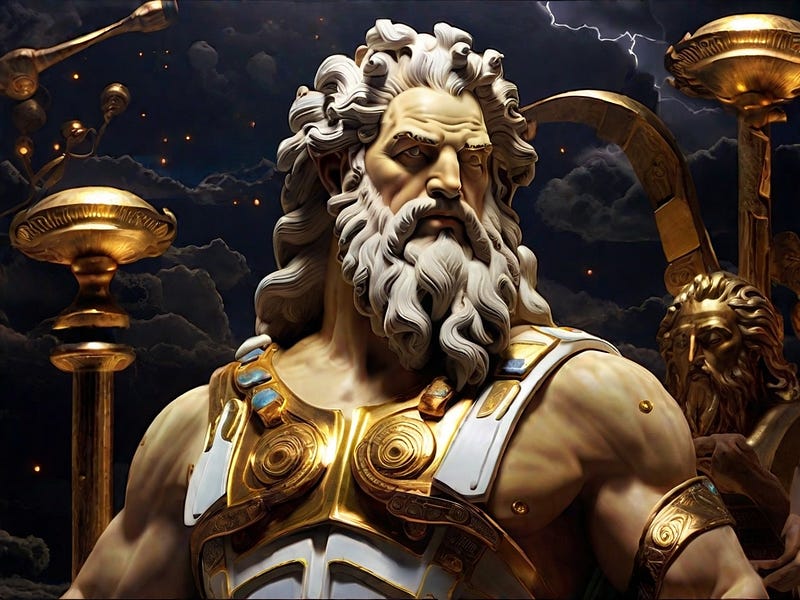
The need to explain phenomena that cannot be comprehended by the mind has accompanied people throughout history. Today, science provides answers to many questions, but in antiquity, abstract concepts were often perceived as the will of a higher power. The desire to understand the unexplainable emerged at the dawn of civilization, leading to the formation of belief systems.
Each subsequent culture created its own gods, often alongside preexisting ones, and assigned them individual attributes. Simultaneously, among the tales of deities, the stories of ordinary people were recorded. The myths of ancient Greeks reflect the consciousness of the Hellenes and the relationships that existed in their society. Over time, their religious function faded, but today, they remain one of the most valuable sources of knowledge about life in antiquity.
Characteristics of Greek mythology
When speaking of Greek mythology, one must refer to a collection of myths about the creation of the world, gods, heroes, and their connections to humans. These stories were initially passed down orally and later took on a literary form.
Ancients drew their knowledge about the world and its governing principles from these myths. Through mythology, the Hellenes attempted to understand the origin and history of the world. Myths contained a set of ethical and social norms that defined an individual’s role. The stories in question primarily contained fictional narratives, although they often intertwined with historical events.
Greek mythology, as an integral part of ancient Greek culture and religion, was polytheistic in nature. Greek tales expressed belief in numerous gods. Each element of nature had its divine guardian, just as every natural phenomenon did. However, it’s important to emphasize that, unlike many other ancient cultures, Greek belief did not have orthodoxy. While there were certain uniform practices and rituals, there was considerable freedom in interpreting stories of gods and heroes, and debate and criticism were not uncommon. This was primarily due to the decentralized organization of the country.
In antiquity, Greece did not have a centralized state apparatus. The country was composed of independent city-states, each venerating different gods. Individual deities were perceived differently, and unique attributes were ascribed to them. This diversity is evident in the myths, with various versions often being inconsistent or even contradictory.

Gods of Greek mythology
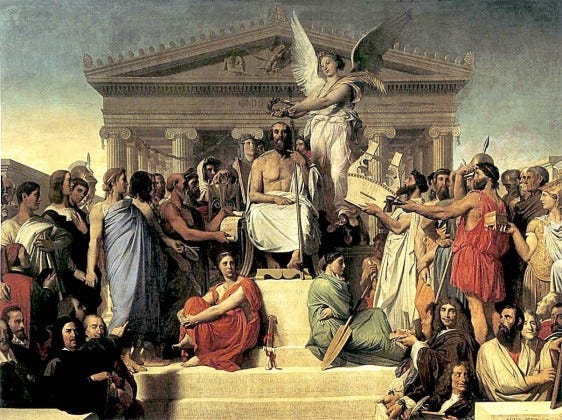
Norse mythology portrays gods as mortal beings, but the Greeks had a different conception. In Hellenic beliefs, the gods were immortal, transcendent entities, yet many of them displayed certain characteristics typical of ordinary mortals. However, it should be noted that the Greek perception of gods evolved over time.
In the oldest stories, describing a time when there were no humans in the world, gods were depicted as bloodthirsty beings locked in a struggle for power. After them, the world was populated by non-human entities, such as Cyclopes, Titans, and giants.
Only when the Olympians came to power did the gods become more relatable to mortals. At that time, the Greeks worshipped anthropomorphic gods — omnipotent and eternal beings, but similar to humans and possessing human flaws. On one hand, they had supernatural powers, but on the other, they often succumbed to common weaknesses.
In Greek beliefs, the gods coexisted with humans for a long time. They not only descended to the realm of mortals and revealed themselves but also established close relationships with them. In ancient tales, gods often had romantic affairs with mortals, just as goddesses did.
All power over humans was held by the Olympian gods. They decided their existence, life, and death. Temples were erected in their honor, where they were worshiped. In Greek mythology, there were twelve Olympian gods, although it should be noted that different names are mentioned in various myths (as mentioned earlier, the ambiguity in Greek mythology).
In each source, ten gods appear: Zeus, Hera, Poseidon, Hermes, Apollo, Hephaestus, Aphrodite, Athena, Apollo, and Artemis. The occupants of the remaining two positions remain unclear, and depending on the source, they could be Hades, Hestia, Demeter, or Dionysus.

How many Greek myths are there?
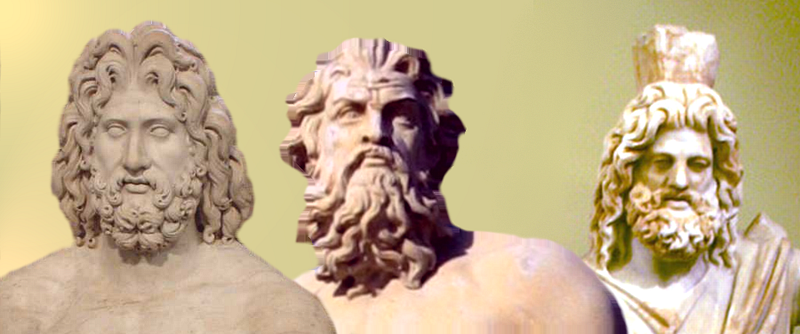
Myths were initially passed down orally and only later took on a literary form. The most important sources of knowledge about mythology are the works of Homer and Hesiod. Besides the “Iliad,” “Odyssey,” “Homeric Hymns,” and the “Theogony,” non-religious works by poets from Greece and Rome (including Apollonius of Rhodes, Callimachus, Ovid, and Hyginus), mythographers’ treatises, and historical works also touch on mythology.
Today, it is impossible to definitively state how many myths exist. Robert Graves’ monograph published in 1955 contains descriptions of 171 stories.
Key Greek Myths
Greek myths cover a wide range of themes, from the creation of the world and the first gods to bloody wars and the stories of individual deities, heroes, and other beings. Below, we present a few of the most important ones.
The Myth of the Birth of the World
According to Greek mythology, the world emerged from Chaos. But what was Chaos? Some saw it as a shapeless god, while others perceived it as an abyss filled with creative force and divine seed. From Chaos, two powerful deities emerged: Uranus (the sky) and Gaea (the earth). Their union gave birth to the Titans, Cyclopes, and Hecatonchires.
The monstrous offspring terrified Uranus, and he decided to cast them into the depths of Tartarus. Gaea resented him for this and, along with the youngest Titan, Cronus, conspired against him. Armed with a sickle, Cronus shamefully mutilated his father, and from his blood, the goddesses of vengeance were born.
The world was born alongside the gods. Sunrays and raindrops fell on solid land, and forests emerged, populated by animals. The rule remained in the hands of Cronus, alongside his consort, Rhea. Unable to forget his father’s curse, which predicted that he would be overthrown just as he had overthrown Uranus, he swallowed each of his children born to Rhea. Thanks to the cunning of the mother, only Zeus (Dzeus) survived. In the future, he would engage in a battle for power with his father, after dealing with an entire generation of giants.
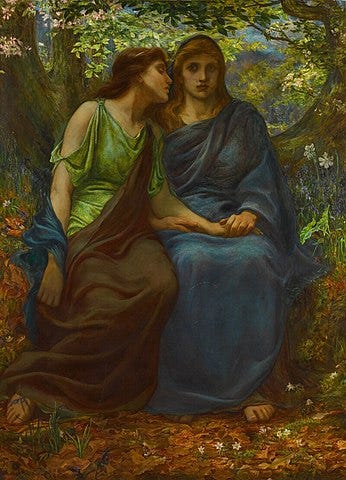
The Myth of Demeter and Persephone
This story explains how the seasons were perceived in antiquity. Demeter, the goddess of fields and fertility, strolled through a meadow with her daughter Persephone. She warned her not to pluck the narcissus flowers, sacred to the underworld gods, but Persephone succumbed to temptation.
Intoxicated by the fragrance of the flowers, she lost her vigilance. Hades took advantage of this and abducted Persephone to the underworld. Eventually, Zeus ordered him to release Demeter’s daughter. However, through a cunning trick, he ensured that every year, Persephone had to return to the underworld for three months. During this time, winter fell on the earth, and all of nature became dormant. When Persephone returned to her mother, the world came back to life. This marked the arrival of spring. Their time of happiness ushered in the summer, and when the separation came, the world wept with autumn rain.
The Myth of Prometheus
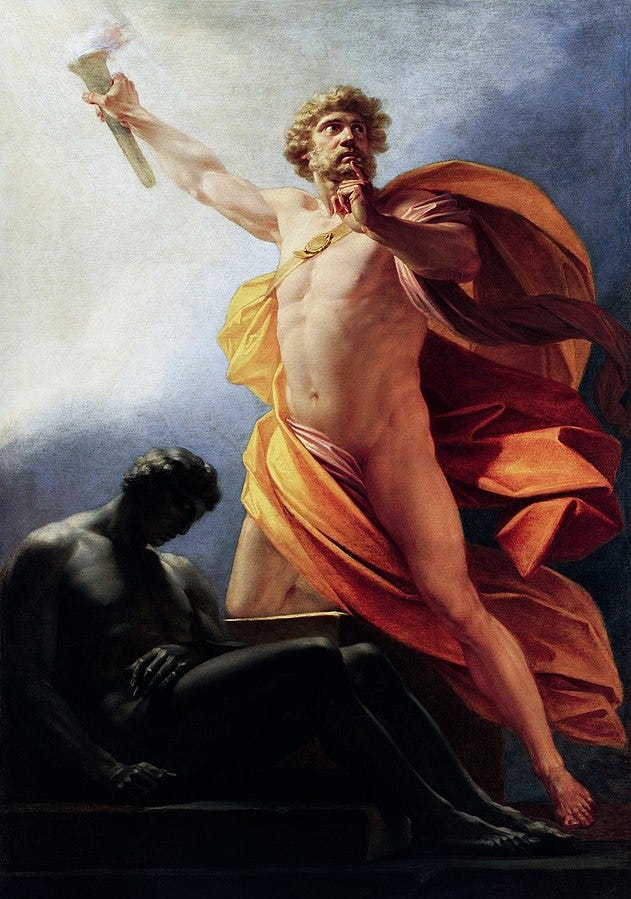
Another important myth revolves around the creation of humanity and explains how diseases and worries came into existence. The Titan Prometheus was the father of all humans. He molded the first human from clay, mixed with tears, and gave him a soul with sparks stolen from Helios’ chariot. Humans were beings similar to the gods but weak and naked. To help them survive, Prometheus gave them the fire that rightfully belonged to the gods.
Annoyed Zeus ordered Hephaestus to create a woman resembling the goddesses. Thus, Pandora was created, and she descended to the earth with a mysterious box from which diseases, worries, sadness, and suffering were released into the world.
Prometheus decided to take revenge on the ruler of Olympus. He killed a bull and divided it into two parts. In one part, he hid all the meat under the skin, and in the other, he concealed the bones and fat. One of the parts was meant as an offering for Zeus. The Supreme God chose the one that appeared more magnificent. When he discovered that it contained only bones and fat under the skin, he decided to punish the Titan severely. He ordered him to be chained to the Caucasus Mountains, where a hungry vulture tore out his regenerating liver continually.

What is the difference between Greek and Roman mythology?
Roman mythology is largely based on Greek myths. However, it cannot be said to be a faithful copy of them. Romans gave gods their names and often attributed them different attributes and characteristics. Roman gods did not descend to the realm of mortals or form close relationships with humans, unlike Greek gods. Compared to the Greek deities, Roman gods were more warlike. It’s worth mentioning that Roman mythology is, to a considerable extent, based on local legends specific to Roman culture (foundation myths, etiological myths).
Fascinating Facts about Greek Mythology
Above, we presented the most important information about Greek mythology. Here are a few interesting facts about the beliefs of the Hellenes:
- The well-known symbol of pharmacy — the chalice entwined by a serpent — has its origins in Greek mythology. Ancient Greeks believed that the cup and the serpent were attributes of Hygieia, the goddess of health.
- Pandora, the first woman in human history, was sent by Zeus as a punishment for Prometheus’s actions when he stole fire from Olympus.
- Greek gods had almost absolute power over humans. Almost, because they did not have control over fate and destiny.
- The Greeks did not idealize their gods. In Greek stories, there is no shortage of descriptions of divine weaknesses. Some gods could not accept defeat, others exhibited jealousy, and some easily succumbed to desire.
Attention all readers!
As content creators on Medium.com, we face minimal compensation for our hard work. If you find value in my articles, please consider supporting me on my “Buy Me a Coffee” page. Your small contributions can make a big difference in fueling my passion for creating quality content. Thank you for your support!

