
Roleplaying Games | Money
The Rich Want You To Stay Poor | Hard Wired Island
“Anyone who has ever struggled with poverty knows how extremely expensive it is to be poor; and if one is a member of a captive population, economically speaking, one’s feet have simply been placed on the treadmill forever.” — James Baldwin
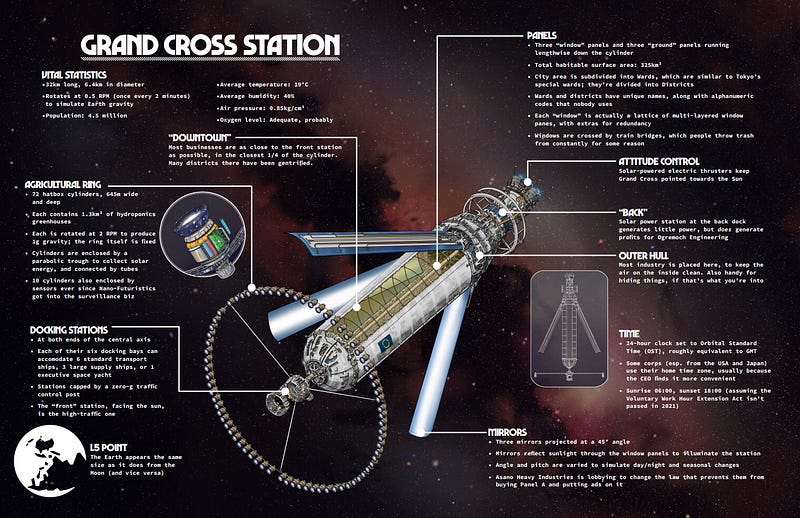
“According to the station’s website, the purpose of Grand Cross is to be “a sustainable orbital habitat that acts as a gateway to the stars for greater humanity, lighting the way forward into eternity.” According to experts, it’s to “prove that people can live in space without dying instantly or whatever.” It’s both a proof-of-concept and a hub for future efforts.” — Hard Wired Island, page 101.
Hard Wired Island is set in an alternate now. The year is 2020, but it’s a 2020 in which humanity got serious about space exploration in the 90s due to a freak meteor strike. This world didn’t privatize space travel until the creation of the first major launch point for REAL exploration: Grand Cross.
But now, the corporations have finally gotten their ducks in a row. The Offworld Cartel is in the process of liberalizing and privatizing Grand Cross. By doing so, they will become the gatekeepers of space exploration and colonization. And they’ll make a lot of money.
Hard Wired Island’s setting isn’t quite an economic dystopia, but it’s on the verge of becoming one. Up until this point, mankind didn’t produce a Bezos or a Musk or a Branson until it was well on its way to being a multi-planet species. Only now has Big Business caught up.
“The capitalist system of Grand Cross is designed to trap people in poverty so the ruling classes can exploit them. There’s little upward mobility, but it’s easy for emergencies, sudden bills, or the station’s shifting economic situation to knock you further down.” — Hard Wired Island, page 54
To hammer home how hard life is becoming on Grand Cross, the designers went out of their way to model a character’s financial situation with more granularity than in most RPGs. Hard Wired Island abstracts characters’ economic condition with a Burden stat.
- 0 = comfortable
- 1 = getting by
- 2 = precarious
- 3 = struggling
- 4 = destitute
The default is 1
Burden isn’t only about what comforts you have to do without. It’s also a measure of your economic stability. Before every game, everyone with a Burden over 0 rolls to check for an economic shock. That shock can be “a delayed paycheck, rising rent, an unforeseen emergency, a theft, or just general hard times.” It’s totally out of an individual’s control. The roll a isn’t skill check. It’s a luck check.
The economic shock can lead to one or more consequences. Examples include:
- “You get kicked out of your current living space and must find a new one.”
- “You lose an Asset (gear or property) permanently.”
- “You have to skip meals/recharging (for android characters). Mark your first damage box; you can’t recover it until after your next mission.”
- “One cybernetic augment stops functioning properly until the next session. It still works, but bonus Specialties and anything beyond normal human function does not.”
- “Your Burdens exhaust your mental energy. You suffer Disadvantage on all Clever rolls until after your next mission.”
- “Your Burdens make it hard to be social. You suffer Disadvantage on all Cool rolls until after your next mission.”
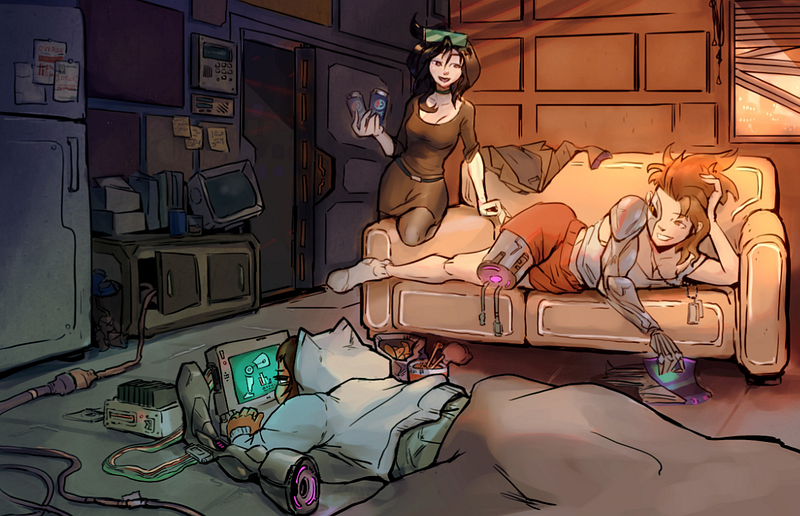
Again, these shocks have nothing to do with the character’s personal decisions. The landlord can evict you so they can turn your apartment into a condo. Your augment, which you might need for work, could give out for no reason other than planned obsolescence. Your financial obligations could worry you to the point of distraction.
The wrong economic consequence can send you spiraling downward. And if you REALLY miss your Burden roll, you get TWO consequences.
Of course, some people would still say these are your fault because you “failed” to become more financially secure. Those people are assholes.
Characters in HWI also have liquid Cash. Cash can be spent to:
- “…Boost a roll.”
- “…acquire Assets.”
- “…mitigate economic shock.”
- “…reduce your Burden.”
But as in real life, Cash is fleeting. If you have unspent Cash at the end of a game, you roll 1d6 and lose that much Cash to unexpected costs, old bills, maintenance, and whatnot.
Note that it’s not the same as “dollars”. 1 Cash equals a few bucks. This game refuses to quantify money precisely.
Hard Wired Island’s representation of brutal hypercapitalism doesn’t stop there. It also has mechanics for gig work apps. Each app helps a character nab Cash in its own way, but there’s always a trade-off.
- Headpattr is a cat-themed maid service. It scores you +1 Cash before every session, but because you have to buy your own supplies AND you’re overworked, it’s harder to improve your Burden score. Normally you can buy your way to a better Burden with 10 Cash, but Headpattr workers have to spend 12.
- Huntr is a bounty-hunting app, because of course that’s a thing. If someone involved in your mission just happens to also be wanted, you can bag them for an extra 2 Cash. But because it rarely pays off, you roll with “Advantage”, which is a bad thing in this case, when you roll for Cash loss each session.
- Roofdash is a delivery service. You can make up to +3 Cash but at the expense of being able to Prep for a mission. Basically you risk failing to make the station’s future any better in exchange for Cash now.
That last one is especially insidious.
Prepping for a mission is a central part of gameplay. It’s downtime legwork the characters do before taking on The Man. The Prep mechanics abstract away actually thinking up everything the characters might need. The better the Prep roll, the more Prep you can “spend” during the mission. Prep is spent to let you do stuff as if you planned for it. You can activate a distraction as if you set it on a timer, or “flash back” to your character planting a parachute so you can escape from a skyscraper.
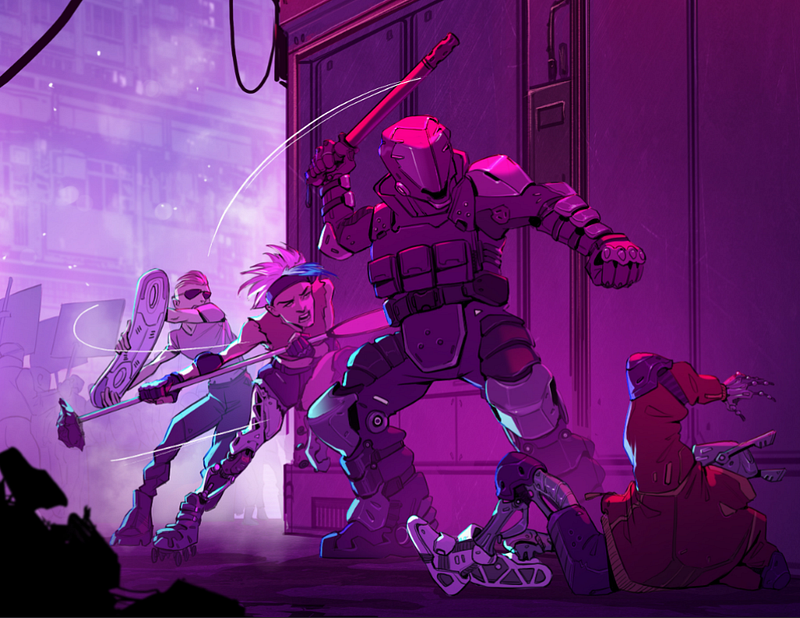
But if you’re doing work for Roofdash, you can’t do that. You’re too busy just trying to make ends meet, so you can’t effectively fight The Man.
WHICH IS EXACTLY WHY THE RICH DON’T WANT YOU TO HAVE FREE TIME.
All of this economic madness might seem a tad over-the-top. That just means you don’t remember, or never experienced, what living paycheck-to-paycheck is like.
This level of hypercapitalism is right around the corner in the real world. Few rules. Few consumer protections. Few worker’s rights. It’s just the market, and it’s barely a “free” market. Instead, it’s a captured market with a few big players that are impossible to dislodge by anyone that isn’t already rich.
A lack of cushioning from economic shocks, plus tempting the desperate into doing extra work keeps people from protesting. The fear that things can always get worse keeps workers from striking. Poverty is something you always have to fend off. It’s always coming for you. Every hour you spend ensuring the next generation doesn’t have to endure this is an hour you’re not stashing away a few more bucks, just in case. This might not have been planned, but it’s how it’s working out.
Hard Wired Island is one of a few RPGs with interesting money mechanics.
- Shadowrun: Anarchy bundles wealth and experience together as Karma.
- Apocalypse World has characters spend money, abstracted as Barter, every day just to eat.
- Spire treats wealth, or Silver, the same as physical health, or Blood.
Hard Wired Island takes this all a step further by mechanically demonstrating how much bad luck can fuck you. This is a big departure from D&D’s focus on merely counting currency. Hard Wired Island demonstrates how expensive being poor can be.