
The Revolutionary Themes of “Frozen II”
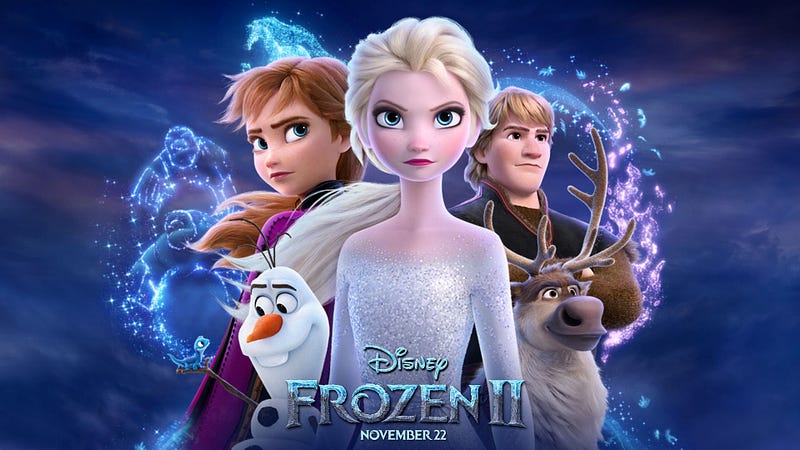
As was the case for many Americans, the early arrival of Frozen II on streaming prompted me to visit the smash sequel, which opened to huge box office last November. Once again, I was struck by just how progressive and bold the film’s themes are.
A Very Brief History of Frozen
Following their critical and commercial resurgence in 1989 with The Little Mermaid, Walt Disney Animation Studios managed to churn out a decade of fare that was (mostly) enthusiastically received by both critics and audiences. But after 1999’s Tarzan, the studio churned out a number of uninspired duds and a few just-fine films that were not even close to enough to reverse the slump. Things started looking up with 2010’s Tangled and 2012’s Wreck-it-Ralph, which grossed over $1 billion and received strong notices from critics. But by this point, the studio was so strongly overshadowed at the box office and awards ceremonies by Pixar that it was not really even a competition anymore.
Then came Frozen.
Released on November 27, 2013, Frozen grossed an astonishing $1.28 billion worldwide, won two Oscars (Best Animated Feature and Best Original Song), instantly became an indelible piece of popular culture, and had critics and audiences making comparisons to the studio’s Golden Age.
After Frozen’s astonishing success, a sequel was inevitable. But what kind of sequel would it be? Would it be a sequel typical of Disney Animation Studios, which historically have gravitated toward direct-to-home market cash grabs? Or would it be a sequel typical of Pixar, which expanded the franchises of Finding Nemo, Monsters Inc., The Incredibles, and especially Toy Story with true commitment to artistry? (Yes, I omitted Cars and, yes, this was intentional.) Many hoped for the latter but feared the former.
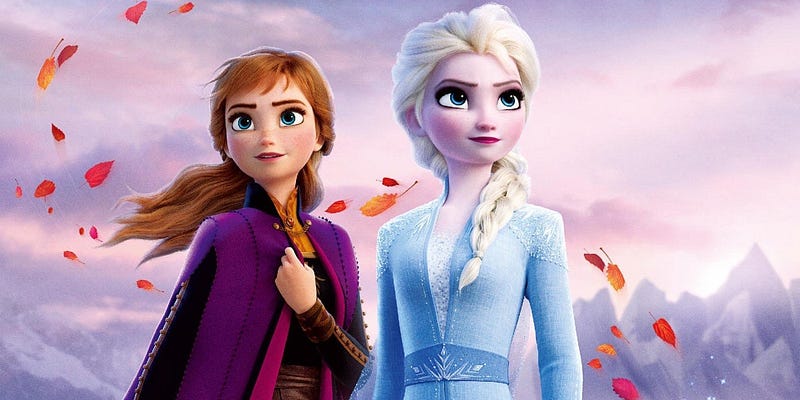
Frozen II was released on November 22, 2019 — just a few days shy of the 6 year anniversary of the original’s release. Despite still having positive reviews, the sequel impressed critics a bit less than its predecessor (its Rotten Tomatoes approval rating of 77% was a step down from the 90% rating of its predecessor, just as its Metacritic score of 64 was a step down from its predecessor’s score of 74). But filmgoers didn’t appear to notice (or care) as the sequel exceeded the original’s box office performance with an astonishing tally of $1.45 billion in ticket sales.
But while everyone was talking about the relative merits of the two films on metrics such as the quality of the original scores, how grating vs. humorous Olaf the magical snowman is, and how compelling the sisters’ journey is, I found myself simply astonished that a mainstream animated film with such progressive themes got the green light from Disney.
[Author’s Note: The following two sections contain SPOILERS of Frozen II. If you have not seen the film and wish to, I recommend that you read the remainder of this article after you have seen the film.]
Frozen II: Film Review
One of the oldest and lamest movie jokes is that “sequels suck.” This belief persists because even though Hollywood has churned out some truly brilliant follow-ups and franchises, they have turned out a far larger number of duds. The modal Hollywood sequel is an uninspired retread of the original film in terms of themes and plot that does not justify its existence as anything other than a cash grab.
But Frozen II mostly avoids retreading the first film. The story is a remarkably complex one that progresses and deepens the story. It takes on a decidedly darker tone, doubles down on some of the magical elements of the first, and explores several fascinating themes related to the atrocities committed against indigenous people by the White people and the upending of gender stereotypes.
Taking place three years after the first film, Frozen II begins with a prologue in which we learn that Arendelle Queen Elsa and her sister Anna’s grandfather forged a treaty with a neighboring Northuldra tribe only to be brutally betrayed by them. The result is that the Enchanted Forest in which the Northuldra lived is locked away by the enraged elements of Water, Air, Earth, and Fire. Back in the present, Elsa hears a mysterious voice calling out to her. She follows it to the Enchanted Forest, with her crew in tow.
What follows is a magic-fueled adventure that is marked by consistently breathtaking animation, thrilling action sequences, occasionally effective comic relief, and a number of terrific original songs by Emmy-, Grammy-, Oscar-, and Tony-winning composers Robert Lopez and Kristen Anderson-Lopez. Like the original, it benefits enormously from the vocal performances of its exquisitely cast main quartet — Idina Menzel (Elsa), Kristen Bell (Anna), Jonathan Groff (Kristoff), and Josh Gad (Olaf).
The film is not perfect, however. Although they are beautifully produced and performed, many of the songs adhere a bit too closely to the blueprints of the original film’s soundtrack. Some of Anna and Olaf’s shtick that was adorable and endearing in the first film becomes grating at times in the sequel. And there are certain elements of the film’s plot mechanics and magical world that defy logic.
Ultimately, this is a sequel that mostly retains the spectacle and artistry of the original, while having far more depth and originality than it needed to in order to become a hit.
Rating for Frozen II: 4/5 Stars
The Revolutionary Themes of Frozen II
The original film was praised for its portrayal of female protagonists that were not only both brave and sensitive but had each other’s backs. They did not always get along, but they were both fearlessly committed to one another and the betterment of the kingdom they reined over. This was in stark contrast to the majority of animated films, which focus on male protagonists and find substantive female characters rarely interacting in a positive way.
The film also generated a lot of discussion over whether Elsa was intended to be a closeted lesbian and whether the first film’s anthem “Let It Go” was intended as a coming out anthem. When asked about this Jennifer Lee, the sole writer and co-director of both films, said: “We know what we made. But at the same time I feel like once we hand the film over, it belongs to the world, so I don’t like to say anything, and let the fans talk. I think it’s up to them.”
Suffice it to say that the revolutionary themes apparent in Frozen II were not shoehorned in to advance someone’s agenda, nor are they out of sync with the spirit of the original film. Progressive themes have been baked into the franchise since its very inception. With that said, the themes of Frozen II go leaps and bounds beyond its predecessor.
The Erasure and Subjugation of Indigenous People
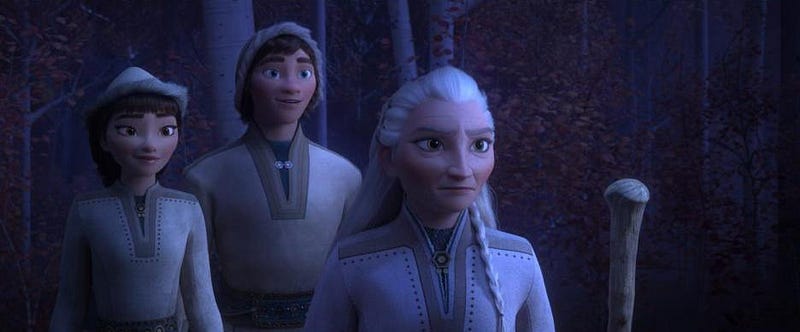
The introduction of the neighboring kingdom of Northundra provides the springboard for an exploration of themes related to indigenous culture. And the film does an impressive job of running with those themes.
The climax of the film reveals that Anna and Elsa’s grandfather had lied to them. The Northundra people did not massacre the envoy from Arendelle, but rather the melee was caused by her grandfather murdering the chief of their tribe. It turns out that their grandfather was the embodiment of an imperialist. He loathed and feared the indigenous people for their connection to magic and nature and cruelly worked to subjugate them through manipulation and force. This discovery and Anna’s subsequently daring act of rectification finally brings peace to the adjacent kingdoms and pleases the spirits.
Elsa and Anna appeared to implicitly respect the Northundra, which is consistent with their wise, mature, and benevolent natures. But the plot twist described above forces Elsa and Anna to realize several things. First, they learned that their revered grandfather was a murderer at best, orchestrator of genocide at worst. Second, they learned that their kingdom’s peace and prosperity was gained at the expense of betraying and subjugating their neighbors. Third, they learned that the people they loved and respected taught them a version of their own history that was horrifically whitewashed at the detriment of indigenous people.
These are big themes. Dark themes. Morally complex themes. Timely themes. And these are remarkably progressive themes, at least by the standards of a family-friendly animation studio.
Disappointingly, none of the individual Northundra people become particularly well drawn out or plot-essential characters. However, they are portrayed as dignified, intelligent, moral, spiritual, and harmonious people. No matter how you look at it, this is a far cry from the cringe-inducting “What Made the Red Man Red” sequence in the 1953 classic Peter Pan.
The Upending of Gender Norms
The complex and powerful bond between Anna and Elsa is the main focus of the sequel just as it was in the original. And, mercifully, the filmmakers did not throw in a contrived conflict or new love interests that undermine that bond in cheap and predictable ways. Rather than undermine the progressive gender norms depicted in the first film, the sequel underscores them. Anna and Elsa have each other back’s always and make some truly remarkable sacrifices for one another in the film.
Nowhere is the film’s upending of traditional gender norms more apparent than in the relationship of Anna and Kristoff. In contrast to the vast majority of studio films throughout history (animated or live action), the woman is concocting and enacting a heroic plan to save everyone while the man is wandering aimlessly and preoccupied by his romantic feelings. The filmmakers resist the urge to turn Anna frigid and Kristoff impotent, a pitfall lesser screenwriters would not have been able to avoid. They are both immensely likable characters with valid points of view.
In one of the film’s climactic scenes, Kristoff arrives at just the right time to aid Anna. Rather than sweep her off her feet and save the day he says, “What do you need?” It’s a seemingly innocuous statement, but one loaded with meaning for viewers living in a society that constantly denies women roles of autonomy and power and forces them to be at the whim of men in their lives.
Although the LGBT-relevant themes are less obvious than those pertaining to indigenous people and gender roles in Lee’s screenplay, they nevertheless persist and expand in the sequel. Elsa’s journey is one where she is living a life of domesticity, but feels unfulfilled and like she doesn’t belong. Something deep inside of her brings her on a journey that allows her to discover the truth about herself and abandon her traditional role and join a new and affirming community that shares her identity. We’re talking about magic, of course, but the parallels to the process of coming out are too strong to be dismissed.
Frozen II is not a perfect film, but it is a great one. And, thanks to Lee’s screenplay, it is one that is not only spectacularly entertaining for children and adults, but also one portrays urgent and progressive themes about equality. Historically, the films that hail from animated studios — especially those involving princesses — tend to gravitate toward outdated gender roles and a xenophobia-compatible narrative that uses outsiders as villains. Frozen II doesn’t just reject those tendencies, it upends them. And it does so while not being overly preachy. In some ways, it provides a beautiful blue print for how we can maintain the magic of family-oriented fare without peddling the same harmful tropes of their predecessors.
Follow the author of this article on Medium and Twitter.
See other articles about Disney/Pixar here:


