
“Luca,” Queer Allegories, and the Future of Pixar
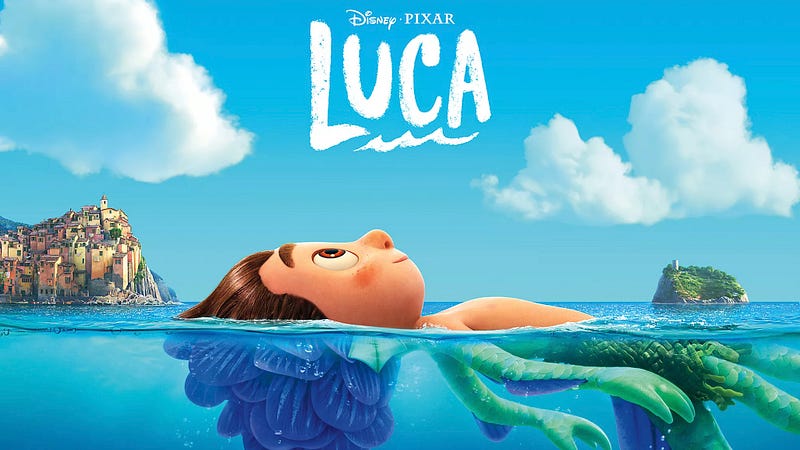
On June 18, Pixar Animation Studios released its 24th feature film on Disney+. “Luca” is a coming-of-age tale set on the Italian Riviera that is charming and refreshingly “low stakes.” Immediately upon its release, however, two problematic discourses erupted on social media — one about the queer themes many saw embedded in the film and another about whether Pixar films are as good as they used to be. Here, I review the film and comment on these discourses.
Luca: Film Review
After receiving an Oscar nomination for the 2012 Pixar short La Luna and spending several years as part of Pixar’s senior creative team, director Enrico Casarosa made his feature film debut with Luca. The film marks Pixar Animation Studios’ 24th feature film and second to be released directly to Disney’s streaming service (Disney+). Originally intended for a theatrical release, Luca is one of many high-profile films redirected to streaming services as the movie theater industry slowly recovers from the havoc wrought by COVID-19.
Many were frustrated that unlike many other high-profile films sent to streaming, Luca did not get a concurrent theatrical release. And I understand the frustration. It is a visually stunning, utterly charming, family friendly film that evokes the youthful joy of summer better than just about any film in recent memory. I imagine that millions of families would have enjoyed the communal experience of watching it together on the big screen. Nevertheless, I understand Disney’s release strategy given that theaters are still struggling and the stakes are high for their streaming service to succeed.
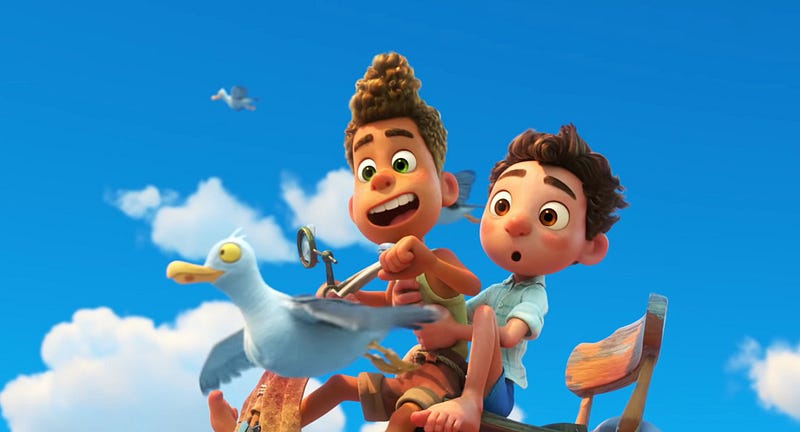
In contrast to recent Pixar originals like Coco, Onward, and Soul, Luca tells a significantly smaller story. It’s not about death, grief, or the meaning of life. Rather, it’s a fable about a couple of boys coming of age. Unsurprisingly, the story centers on the title character of Luca. He is a shy sea monster living off the coast of the Italian port city of Portorossa who is forbidden by his parents to go to the surface due to the fear that they will be hunted by humans (a classic animated film setup following in the footsteps of Disney’s The Little Mermaid and Pixar’s Finding Nemo). He meets a fellow young sea monster named Alberto who shows him what happens when sea monsters go above the surface — they take on a human form.
Luca and Alberto become inseparable as they bond over their dreams of traveling dry land in a Vespa. When Luca’s parents find out he has been spending time above the surface, they order him to go off for the summer with his uncle in one of the deepest parts of the ocean. Luca subsequently runs away with Alberto to the mainland, where they make some local friends and decide to enter in a triathlon (naturally involving swimming, bike riding and pasta eating) in order to obtain the money to buy their Vespa. Their efforts are challenged by Luca’s distraught parents who come searching for them on the mainland, jealously that develops between the boys regarding their new female friend Giulia, and local bully Ercole Viscanti.
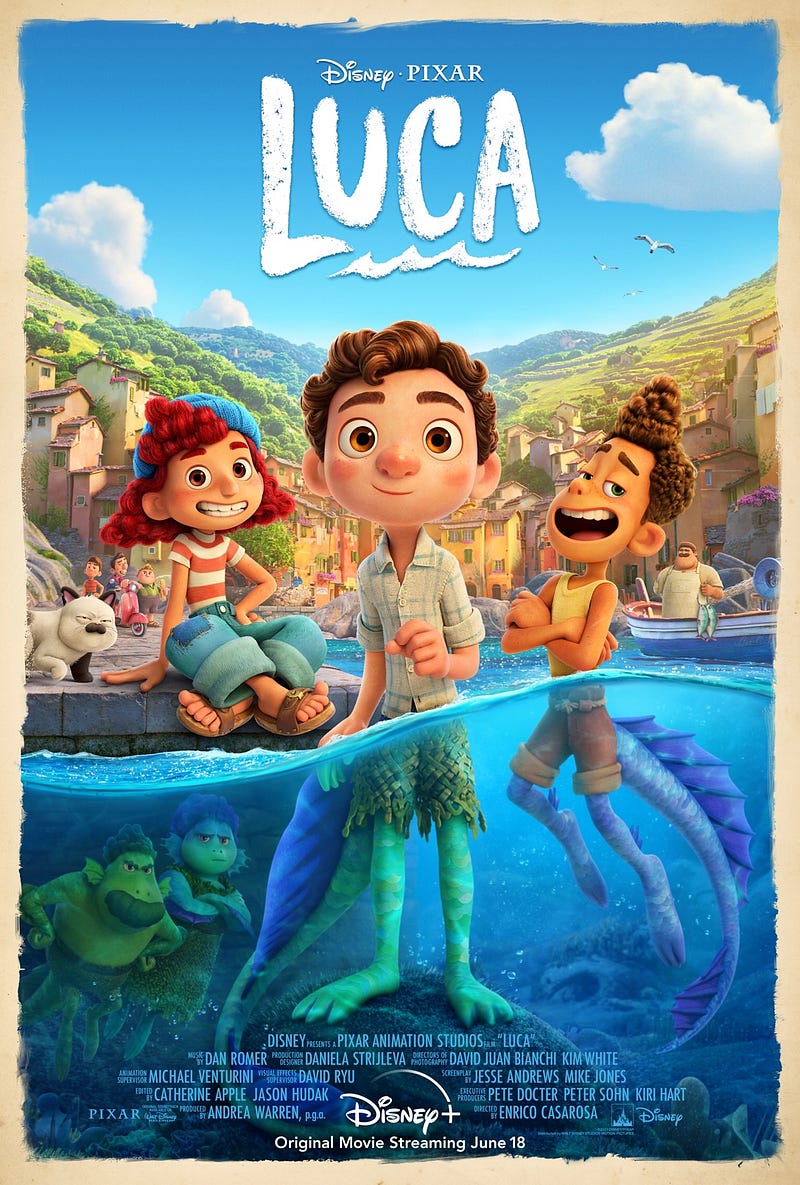
In comparison to many Pixar films, the stakes are low here. The risks of death and abandonment do not loom over the film and the main antagonist is an annoyance more than a terror. It does not strive to break new ground visually, but rather evokes the timeless feel that the director describes as Italian auteur Frederico Fellini meets Japanese animation genius Hayao Miyazaki. And coming in at a lean 95 minutes it largely bucks the trend of bloated running times that are undermining so many films.
Consistent with the “low stakes” theme, the voice cast does not feature any A-listers whose uber-recognizable voices distract from the proceedings. Luca is charmingly voiced by Jacob Tremblay (most famous for playing a captive young boy in the Oscar-winning film Room) and his mother is voiced by gifted comedienne Maya Rudolph (best known for Saturday Night Live, Bridesmaids, and The Good Place). Most of the rest of the main cast are virtual unknowns.
Luca does not break new ground thematically or technologically but for me that is more than okay. It is an entertaining, funny, and surprisingly moving film that represents the type of simple, charming family film that are all-too-rare nowadays.
Grade for Luca: 4.5/5 stars
Luca’s Queer Allegories
The idea that Luca might have LGBTQIA-friendly themes began as soon as the trailer was released. This was largely due to the fact that it centered on the bond between two boys trying to hide their identities and an aesthetic that evoked the iconic gay romance Call Me By Your Name, a coming-of-age film also set in Italy in the second half of the 20th century.
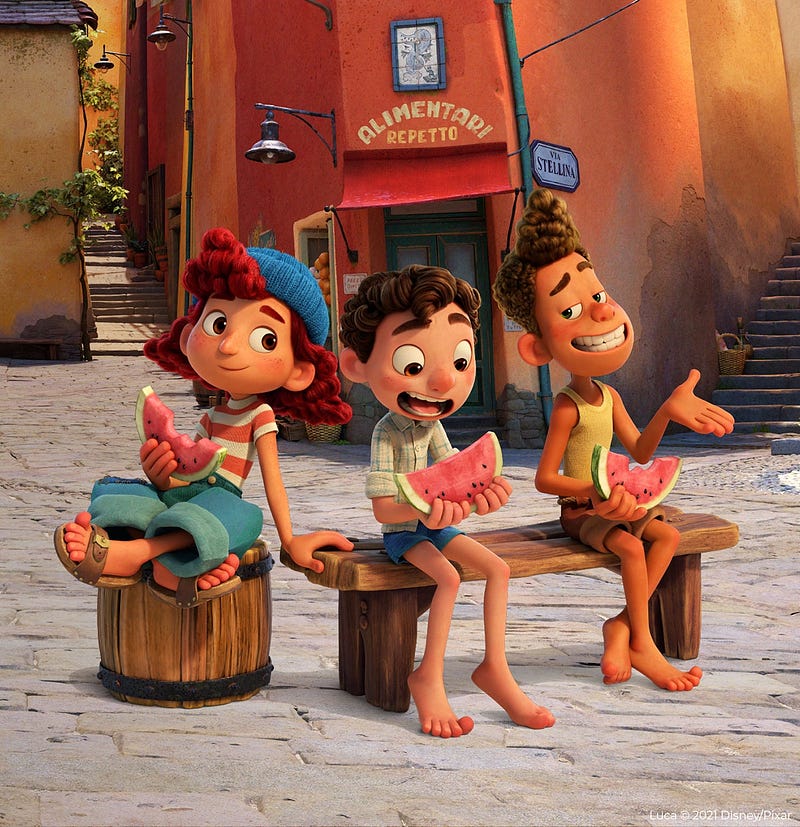
The idea that we might get a queer-themed Pixar film was exciting for many in the community. Despite the extraordinary strides in queer representation on television and in film that have been taken in the past 25 years, there is enormous room for improvement. There has never been an animated or action film made by a major studio that has a major queer character.
The frustration of this for the community has only been compounded in recent years, as many major franchises have experimented with queer representation in laughably benign ways. Marvel had an unnamed bit character reference his male partner in Avengers: Endgame, a female pilot kissed her female partner for a split second at the end of Star Wars: The Rise of Skywalker, Gaston’s right hand man LeFou briefly danced with a man at the end of the live action Beauty and the Beast, and a lesbian cop popped up for one scene in Pixar’s Onward. Combined these scenes accounted for under five minutes of screen time. The goal seemed to be to see how much backlash the filmmakers and studios would get in order to see if it was worth the risk to try for more representation, showing that it was much more of a business-based decision than an artistic- or values-based one.
The director has tactfully but assertively stated that no queer allegories were intentionally built into Luca. However, that does not mean they are not there. This is a story about a sheltered boy who learns that there is another aspect of his identity that comes with exciting possibilities but also great risk. He only considers exploring this identity when he meets another boy who shares the same conflict. They cautiously develop a deeply emotional bond and begin exploring this identity. The boys decide to leave their isolation and integrate into mainstream society, but live in constant fear of being found out. Along the way, a girl unaware of their identity develops a complex relationship with the two and Luca’s confused and concerned parents try to “protect” him by discouraging this new identity and bringing him home.
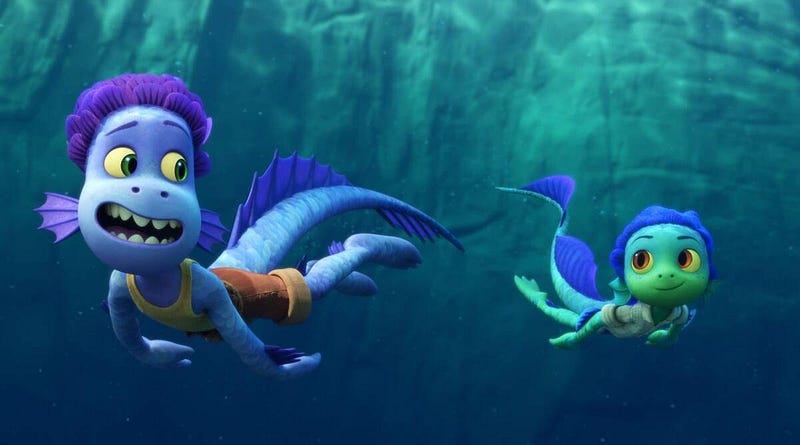
Intentional or not, the character arc and themes in Luca undoubtedly resonate with the experience of countless sexual and gender minorities. Those who do not identify as queer may not see these themes and may see completely different allegories at the root of Luca. And that is okay. But that does not mean that what the queer community is seeing does not exist.
Lately, a toxic discourse has re-emerged in the media about whether the search for queer subtext in same-sex relationships that are depicted as platonic is harmful. In recent weeks, actor Anthony Mackie lamented this when fans questioned the Falcon’s relationship with the Winter Soldier in the Disney+ Marvel series and a reprehensible Twitter thread lamenting how fear of being labeled as gay has ruined the ability of straight men to be friends went viral. What this discourse willfully and problematically overlooks is that it is all rooted in the idea that romantic or sexual connection between two people of the gender is something to be feared and avoided at all costs. You simply do not see social media discourse about whether commenting on perceived sexual tension between two opposite sex characters is problematic for the art itself and society as a whole.
The reality is that until LGBTQIA representation significantly improves, there will be a large and underserved audience thirsting for it and — hopefully — filmmakers and creatives finding clever ways of delivering it subtly and indirectly.
What Luca Does — and Doesn’t — Mean for the Future of Pixar
Luca is unlikely to enter the upper echelon of Pixar classics. In terms of quality, I rank it squarely in the middle of Pixar’s filmography. It cannot compete with top-tier masterpieces like Finding Nemo, Inside Out, Up, The Incredibles, Coco, and — of course — the remarkably consistent Toy Story franchise. However, I found it to be significantly better than films like Brave, The Good Dinosaur, A Bug’s Life, Onward, and a host of the lackluster sequels and prequels the studio has turned out in recent years (e.g., Cars 2 and 3, Monsters University, Finding Dory).
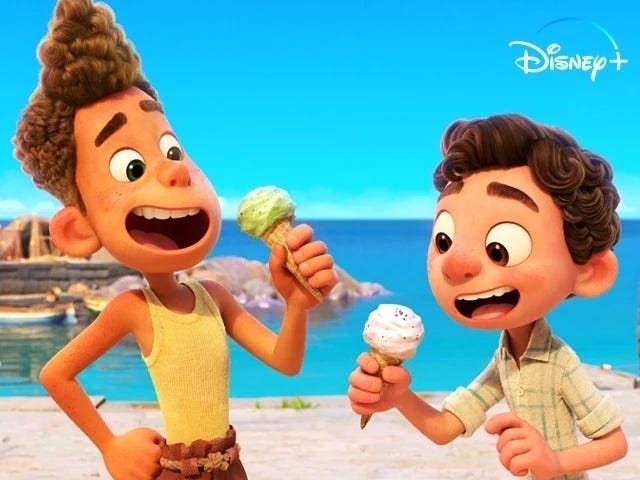
When ranking all of Pixar’s movies or simply comparing new Pixar movies against the ones that came before, it is important to bear in mind that Pixar has churned out so many classics in a relatively short period of time that such efforts are bound to be futile. After all, what does it really mean to be below average when the average is so high? Of the 24 films Pixar has released, 11 have won the Oscar for Best Animated Feature (and the first three were released before the category existed, meaning that more than half of the eligible Pixar films took the Oscar.) And with the exception of Cars 2 and 3, every single release has overall favorable reviews on critical consensus sites like Rotten Tomatoes and Metacritic. (Luca currently has a 90% critical approval rating on Rotten Tomatoes and a 71/100 average critical rating on Metacritic).
I simply don’t buy into the idea that Pixar isn’t as good as it used to be. Since 2015, Pixar has given us classics like Inside Out, Coco, Toy Story 4, and Soul (all four of which picked up the Oscar). If there has been a decline in the quality of Pixar films over the years, this decline is largely — if not entirely — due to Pixar’s increasing reliance on franchises. As is the case with every major studio in Hollywood, established intellectual property is getting the majority of money and attention from Pixar nowadays. And for every great sequel like Toy Story 2, 3, and 4, there seems to be two underwhelming ones that fail to live up to their predecessors.
To me, Luca isn’t a sign that Pixar is faltering. Rather, Luca is a sign that Pixar still has fresh ideas and a willingness to invest in original ideas. I found the fact that it is comparatively small relative to most of the Pixar canon in terms of technical ambition, heavy themes, high-profile vocal talent, and even running time to be a breath of fresh air. It serves as a reminder that first and foremost Pixar is about telling charming and emotionally complex stories that have wide appeal across all ages, genders, races, and cultures. In that respect, it is not representative of a decline, but rather a return to form.
Follow the author of this article on Medium and Twitter and check out his other articles about Disney-related projects


