
The Real Reason Witch Hunters Accused Women of Witchcraft
Let this be a lesson to ladies who hide penises in trees.
If you think modern relationship advice is ridiculous, you should have read the malarky in the fifteenth-century self-help books. If a medieval man chose the wrong girl, his penis could end up dangling from a tree. Or so it was believed.
The myth of the “phallic tree” was popularized in the weirdest and undeniably most hateful book ever written — the Malleus Maleficarum or Hammer of Witches (1486). Its authors were Heinrich Kramer and Johann Sprenger, but most historians credit Kramer as the progenitor of this witch-hunting nonsense.
Before its printing, witchcraft was not solely connected to women. In Iceland and other areas, the witch hunts targeted men (warlocks) and women (witches) with equal ferocity.
But Kramer needed an outlet for his unbridled misogyny, so the Malleus became the female extermination manual that validated centuries of fear and superstition.
Like most women haters, Kramer didn’t have much luck with the ladies. He especially botched a trial where he tried to convince a judge that some local women were practicing witchcraft. The women were all released, and the judge thought that Kramer was a tad daffy.
The judge was right about his daffiness. After Kramer lost the trial, he wrote the Malleus as his “I hate women” burn book. Unfortunately, he was so passionate about his convictions that many used his guide as a way to detect and torture witches.
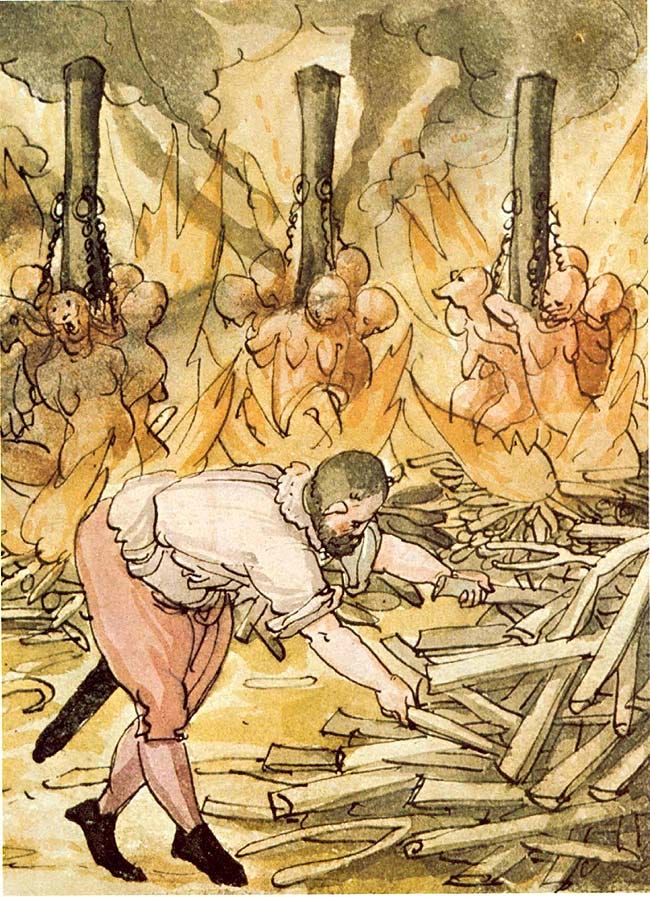
Some men used witchcraft accusations to punish young women who sexually rejected them. Other witches were independent women with economic resources or midwives who crossed into the male-dominated realm of medicine.
Single menopausal women were especially terrifying. To live that long without a man had to be sorcery. Consequently, many accused witches were older women who dared to buck the patriarchy and never marry.
One thing is certain…witchy women had a lot of sex. Kramer referred to women as duplicitous “pythons” who became witches because of their overabundant sexual energy.¹ He writes, “All witchcraft comes from carnal lust, which in women is insatiable.”²
At the time, women were perceived as more libidinous than men. And part of being all lusty pants is that women couldn’t control their sexual urges. Inevitably, this uncontrollable lust led to some really kinky sex with Satan.
Most of the book’s accusations are so fantastical it seems like satire. But it’s not. Witches stole semen from men and inseminated themselves. They dined on babies and then smeared the baby juice onto flying chairs and brooms. They hexed people with sterility and stillbirths. And most terrifying, they made a pact with the devil that caused men to lose their erections.
In other words, Kramer launched a terrorist campaign that cleverly played upon men’s greatest fear — impotence.
Not only did wicked women make men impotent, but these Femme Fatales could also make their penis shrivel up and disappear. Some women even stole penises from their suitors, kept them as pets, and fed them oats and other nutritious grains.
Now, I know what you are thinking. Penis pets seem like way too much work. Why not just keep the penis pet on the man? Then you only have to feed the man. Steal his penis, and you have two mouths to feed. Duh.
But it made perfect sense to Kramer. In Malleus, he cites three examples of penis theft. In all three accusations, witches didn’t just chop off dicks. Oh no, that might leave some forensic evidence. No, these women castrated men by “concealing it with some glamour.” One minute the poor guy had his manhood, and the next minute — hocus pocus glitter glamour…gonads gone.
Fortunately, Kramer offered some solutions (because medieval men were problem solvers too). He assured his readers that their dicks were not really gone. They are just hanging out in the elusive penis tree.
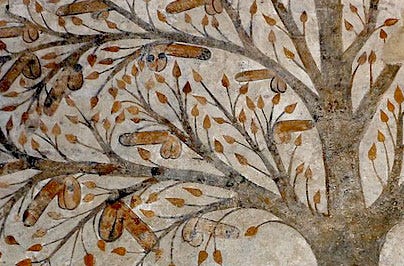
As a woman who has never contemplated stealing dicks (promise), I gave this one some thought. If I were to start a penis collection, I wouldn’t hang them in a tree. That is so crass. What would the neighbors think when I upstage their apple trees and rose gardens with my dick shrubbery? Rude!
Moreover, aren’t witches supposed to be sneaky? It is utterly illogical to think witches would flaunt their trouser trophies. But these were not logical times.
And thanks in part to Johann Gutenberg’s new printing press, the Malleus became an instant bestseller with 28 editions. Unfortunately, although the printing press led to the spread of information, it also led to the spread of misinformation. After the books’ printing, from around 1450 into the seventeenth century, approximately 60,000 people (primarily women) were tortured and murdered for witchcraft.
That’s a lot of dicks hanging out in trees.
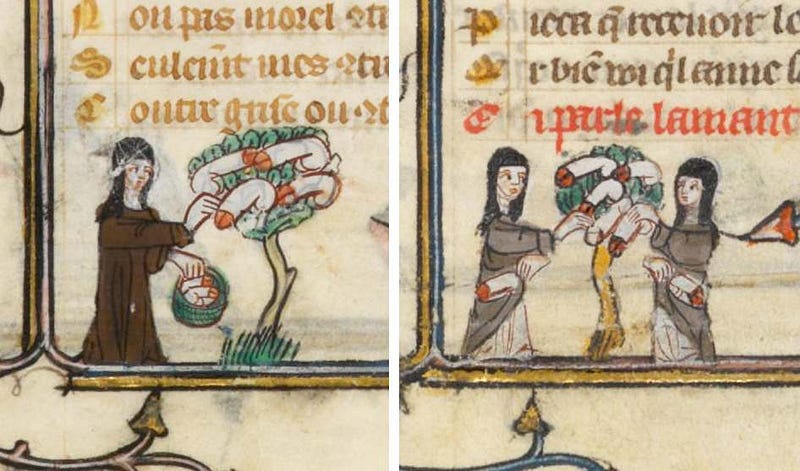
To be fair, penis trees were around before Kramer wrote the Malleus. For example, nuns gather penises in baskets in the fourteenth-century manuscript above.
As always, women are relegated to the gathering and not the hunting. And in this bawdy berry/penis picking illustration, why are the heads of the penises red? Everyone knows that when you go penis picking, you don’t pick the overripe ones.
Clearly, I am giving this too much thought. As Kramer reminds his readers, “When a woman thinks alone, she thinks evil.”³ And I have a predilection for lonely wicked thoughts.
Here is one— all it takes is one flame-throwing fruitcake to spread the seeds of misogyny, and then trees start sprouting dicks.
Sources and further reading:
(1) Mackay, 156. (2) http://faculty.tamuc.edu/slstewart/MalleusMaleficarum.htm (3) Mackay, 206.
Mattelaer, Johan J. “The Phallus Tree: A Medieval and Renaissance Phenomenon” Journal of Sexual Medicine, VOLUME 7, ISSUE 2, P846–851, FEBRUARY 01, 2010,
Smith, Moira. “The Flying Phallus and the Laughing Inquisitor: Penis Theft in the ‘Malleus Maleficarum.’” Journal of Folklore Research 39, no. 1 (2002): 85–117
Mackay, Christopher S. The Hammer of Witches: A Complete Translation of the Malleus Maleficarum. United States, Cambridge University Press, 2009.


