
The Anatomical Venus — Are These Models Disgusting or Beautiful?
And is it art or science?
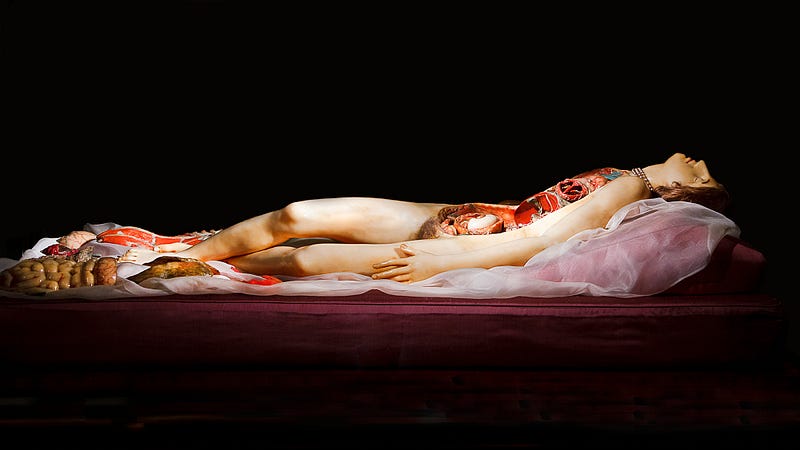

There’s nothing more seductive than a reclining Venus. From Henri Matisse’s brightly colored Reclining Odalisque to Titian’s enigmatic Venus of Urbino, a woman needs only lie on her back with a come hither look to invite the gaze of the viewer.
But there’s another reclining Venus with a darker past — the “Anatomical Venuses” (also called ‘dissected graces’ or ‘slashed beauties.’) Her bow-like mouth drops in a quiet surrender to death. Or is it ecstasy? We will never know. Her stilled eyes stare past us with blackened pupils. She does not invite us to look.
And still, we cannot look away.
Because unlike the coquettish repose of a reclining Venus, the Anatomical Venus surrenders far more than her naked body. Her breasts are spliced open and laid bare, revealing her winglike diaphragm. Beneath the swell of her stomach, organs spill out from glossy wax skin. The inner workings of her heart, lungs, and intestines juxtapose with the exterior feminine ideal of flawless skin and flowing hair. It’s unsettling.
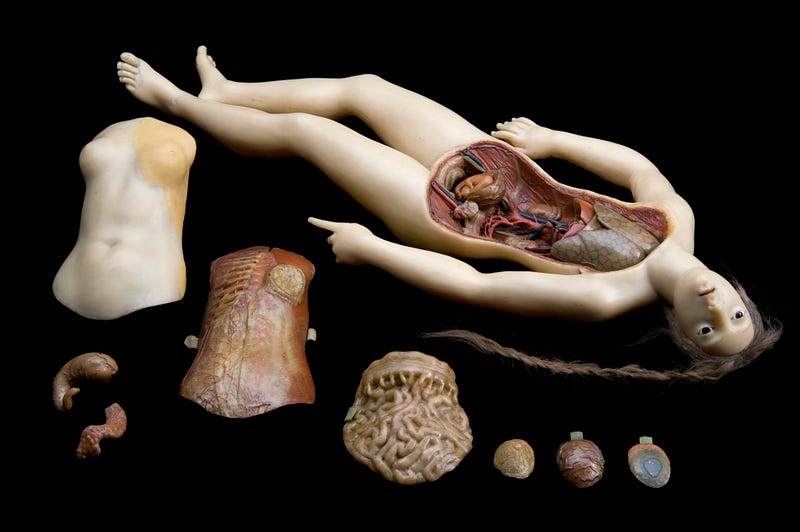

Most Anatomical Venuses are rendered in layers, with the final layer a tiny fetus peeking out like a Russian nesting doll. The hair and eyelashes are real (even the pubic hair). Some have pearl chokers tethering her to the role she once played as wife, mother, or daughter.
But now she has a different role — to teach anatomy to medical students. Because to learn such secrets not only made you more knowledgable. It also brought you closer to God.
Learning anatomy in the eighteenth century was messy work that required a steel stomach. Medical students’ models were decrepit corpses stolen out of unwatched graves by body snatchers. But then the Anatomical Venus appeared and unlike a real cadaver, she was odorless and sanitary. She was an anatomy lesson gussied up…and in pearls.
The first Anatomical Venuses were created in the workshop of master ceroplasticians (wax artists) Clemente Susini and Felice Fontana. These models became the star of Florence’s first public science museum — the Museum for Physics and Natural History. Today this museum survives at “La Specola” in Florence — one of the oldest science museums in Europe.
But these models were not just for educational purposes. They were also created as works of art to celebrate the feminine ideal. (You won’t find many male wax figures.) But that’s the uncanny part. Despite her beauty, there’s a disturbing, visceral corporeality to her form. She reminds us that beneath every perfectly tanned supermodel is a mess of blood, guts, and gore.
But this begs the question — is it science or art? And can a cadaver become an object of beauty?
According to Joanna Ebenstein, author of The Anatomical Venus: Wax, God, Death & the Ecstatic, eighteenth-century audiences would not have viewed her as a sexualized object. After the bubonic plague ravaged Europe, the Anatomical Venus was more sacred than profane.
But as society slowly recovered from the pandemic, the seventeenth century experienced a deluge of memento mori — skulls and morbid art as reminders of death lurking. By the eighteenth century, people had grown weary of death. The Anatomical Venus sought to make that science more appealing. Or at least less confounding.
She certainly was appealing to the medical community. In the early part of the nineteenth century, The Lancet lauded wax models as edification objects. But that changed as quack doctors hocked their nostrums and the first museums advertised “chambers of horrors” — collections of wax models created from people who encountered horrible deaths (usually syphilis). Suddenly, Anatomical Venuses had more shock than educational appeal.
By the Victorian period, public outcry questioned the morality of the body exposed like a ghoulish crime scene. The Anatomical Venus was forced underground, a relic of the Enlightenment. She remains a curiosity to museum visitors today and survives in the fascinating anatomical collection at La Specola.
The Anatomical Venus imposed order on a chaotic world. The gut symmetry of her exposed organs made the body not something to be feared but something to be idealized.
Today, when we look at snapshots of airbrushed models in magazines and filtered Instagram stars, one wonders what has changed in two hundred years? Bodies still wrinkle, bloat, and decay with time. And still, we cling to that moment in youth before time extinguishes beauty. The anatomist captured this timeless beauty in glossy wax. We capture it in pixels and brush over it with filters.
And just like the Anatomical Venus, modern women’s bodies are still laid bare and chained to impossible beauty standards — the paradigms of control. The only difference is now that control is self-imposed.
To read more and support The Grim Historian, please visit my affiliate link and become a Medium Member. A portion of your subscription supports my writing.