CULTURE|LANGUAGE
The Real Reason Japanese People Apologize Frequently
Is it an apology or a way to say thank you?

Apologies are a staple of Japanese culture, but their true meaning is often lost in translation. English speakers tend to misconstrue the situation, assuming Japanese people are truly apologizing and intend to take actions to ameliorate the harm caused by their mistake. However, these assumptions fail to take into account the cultural context.
Many English writers have extolled the virtue of Japan’s politeness and the long-lasting samurai culture that leads to today’s moral education, referring to the frequently-used phrase sumimasen. However, as a Japanese, I find these analyses to be incomplete and overlooking critical points. To be blunt, in many cases, I’m not actually apologizing for my actions even though I may be using words and phrases of apology.
Apologies as “Hi” and “Thank You”
There is a plethora of phrases to express remorse in Japanese. If someone says “gomen nasai” or the more polite “moushiwake gozaimasen” with a bow, it’s undoubtedly an expression of remorse. Nevertheless, understanding what the person means by their apology is important to avoid misunderstandings.
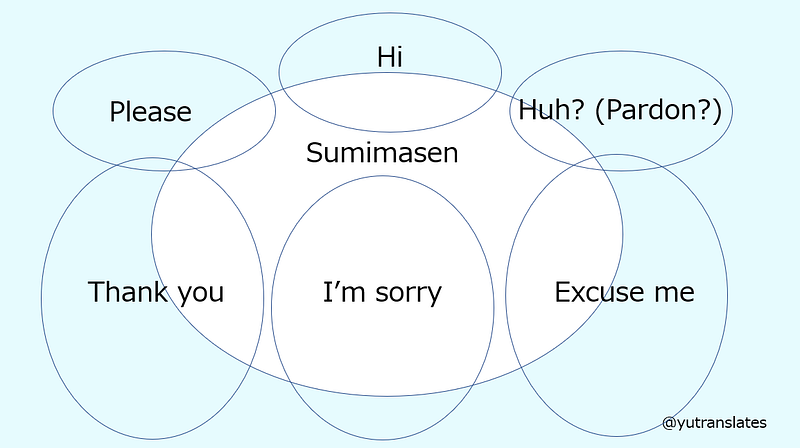
While the popular dictionary app Imiwa? defines sumimasen as “excuse me, pardon me, and I’m sorry,” this definition fails to capture the complexity of how it’s used in real life. For instance, Japanese dictionaries define this phrase as:
A word that tells one’s apology, gratitude, and request
This implies what English speakers perceive as an apology could really mean “thank you,” “please,” or even more simply, “hi” to start a conversation.
You may wonder why Japanese people don’t say “thank you” instead of the remorseful sumimasen. That’s partly because honorifics make a simple thank you into the rather long expression, arigatou gozaimasu. Although the clipped casual version, arigatou, is fine to use between friends and colleagues, it’s too informal for communication with strangers such as when someone holds a door for you.
On the other hand, you can never go wrong saying sumimasen. It’s handy and polite enough when you want to express a quick thank you as you slide through the entrance. Personally, I prefer to use arigatou gozaimasu in such cases, but it’s safe to say that a huge portion of the flood of sumimasen that you hear in Japan can be translated as thank you rather than sorry.
Apologies ≠ Admitting Fault
In Western culture, saying I’m sorry means admitting your mistake, which entails accepting responsibility for the consequences. However, Japanese language functions differently when it comes to apologies.
Even when a customer service representative says, “We’re very sorry,” don’t expect reimbursement or a free replacement.
They’re usually sorry for the situation that made you call, or the time you’re wasting. Or they may want to simply calm furious customers’ nerves. In other words, they might really be saying, “We’re very sorry for your time. We wish you knew that calling us wouldn’t change anything,” even though Japan’s customer service is famous for going the extra mile to do whatever they can to help.
Even at a press conference that begins with a deep and long bow, the stock phrase “この度はお騒がせして申し訳ございません (kono tabi wa osawagase shite moushiwake gozaimasen)” means, “I’m sorry for causing a disturbance.” The person is sorry for making a scene, but the apology is completely separate from whatever horrible mistake led to the need for a press conference in the first place.
These apologies are more like one step in serving matcha in a tea ceremony. As the tea master pours hot water into a bowl and throws it away to purify and warm the bowl before making matcha, apologies can warm up a conversation like an ice-breaking joke.
Emotions over Logic: The Prioritization in Japanese
That being said, it is understandable that English speakers feel uneasy dealing with forced apologies when they work with Japanese people.
Japanese companies place a premium on maintaining harmonious relationships because due to strong labor unions and flexible human resource management where nobody has a detailed job description, the person who caused the mistake won’t get fired. Besides, it’s shikataganai — the damage is already done.
Teamwork and collaboration are a must at Japanese companies. In the collectivistic corporate culture, being generous over apologies works as a lubricant to keep the team moving forward together. Withholding apologies as a last resort to be used only when you’re truly sorry is likely to label you as a difficult person who fails to respect the feelings of your teammates.
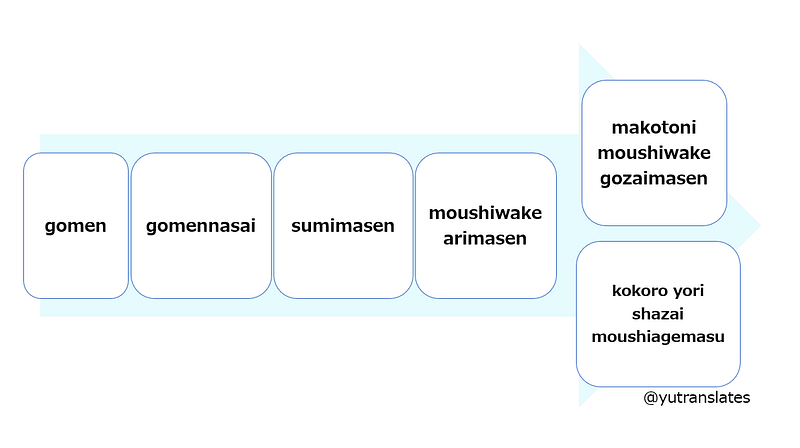
Japanese Apologies Are Conversation Starters
The etymology of sumimasen can be traced back to the verb 済まない, which literally means unfinished and unsettled. This accounts for its incredible versatility that enables Japanese users to express mixed feelings.
You can feel unsettled in a multitude of ways; sumimasen can be used anytime, anywhere, when you feel unsettled—even when receiving a gift. Not taking this phrase too seriously can make life in Japan more pleasant and manageable.
Sumimasen for bringing up such a complicated topic—well, that’s how I humble brag—but I hope this information has helped warm you up to have more enjoyable conversations in Japanese.
If you enjoyed this article, follow Yuko to read more stories like this. She’s currently writing her debut novel set in Japan.
You can also subscribe to Medium from the referral link, which directly supports the author without any additional charge. Mediumの購読はこちらからどうぞ。