
The Real Reason for the Great Wall of China — Fear of Nomadic Women
An analysis of ancient DNA has revealed that women played a very large role in the construction of a great nomadic empire that threatened China.

Scientists say “the Great Wall of China was built to defend against invasions by the Xiongnu people”.
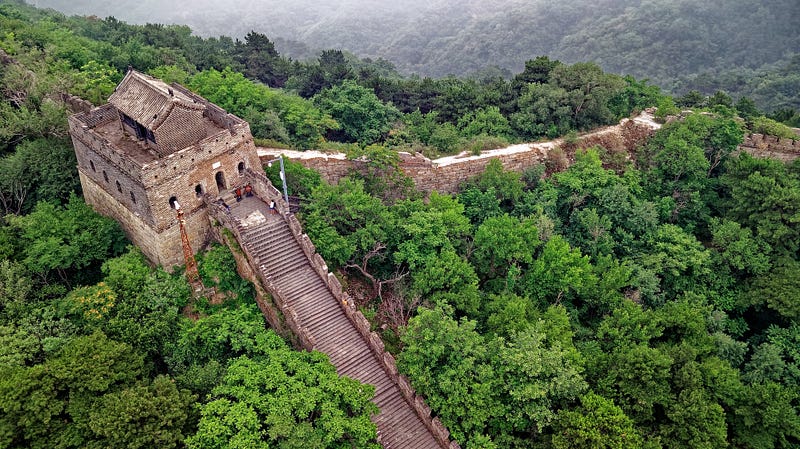
The huge system of fortifications consists of forts, watchtowers, defensive walls of all kinds, as well as natural barriers. However, the structures were built at different times and were done by different feudal states. The oldest defenses were probably built in the 5th to 6th centuries BC.
The Great Wall of China, or the wall of infinite fears
However, it wasn’t until around the 3rd century BC that the first Qin emperor was to commission the construction of the “10,000 Li Wall” (Wall of Infinity). It was to protect the northern part of the country from incursions by nomadic peoples from the Great Steppe. The emperor also wanted to demonstrate the power of the Middle Kingdom in this way. The gigantic rapid fortification also became a symbol of the Chinese rulers’ paranoia.
Until now, however, it was not known exactly who threatened China so much and what the emperors feared most. Now researchers from the University of Michigan and Seoul National University can shed new light on the history of one of the greatest civilizations in history. The researchers conducted an extensive analysis of ancient burials of nomadic peoples, as well as DNA testing, to discover the exact origins of these people. The results of their work are surprising.
Who did the Chinese fear?
The authors believe that the Xiongnu tribe posed the greatest threat to China. They are a nomadic people who were at the height of their power in the 2nd and 1st centuries BC. They controlled areas of present-day Mongolia, southwestern Siberia, Central Asia, Manchuria, Xinjiang and Gansu. Historians point out that the rise of this people is linked to the phenomenon of the birth in the 4th century BC of a class of elite mounted warriors who were known as “Hu.” They were what the Chinese often referred to as barbarians and threatened the northern areas of China.
The problem is that the Xiongnu left behind no written sources. The only chronicles that tell of their fate come from Chinese texts. That’s why a team of scientists decided to study the remains, deposited in two ancient necropolises that were located in the territory of the former nomadic empire.
Representatives of the Xiongnu elite and rulers were buried there. A genetic study conducted uncovers one of the greatest mysteries in the history of Asia. The research was published in the latest issue of the scientific journal Science Advances.

DNA research reveals that women played a major role in strengthening the empire of nomads
Scientists sequenced the genomes of 17 people whose remains were deposited in cemeteries. It turned out that these individuals showed a very high level of genetic diversity. This supports the thesis that the ancient empire was extremely multi-ethnic, and its rulers were able to unite peoples from the most remote regions of Asia.
Examination of the cemetery showed that it was women who were laid to rest in the largest and richest tombs. This means that they enjoyed extremely high status and probably enormous influence. Researchers suggest that they played a key role in the powerful Xiongnu state at the time.
The women’s tombs bore symbols of the sun and moon, which were equated with power in the empire of nomadic peoples. Moreover, the remains of six horses and fragments of a chariot were deposited in one tomb.
The construction of the Great Wall was a response to the danger from the north
DNA analysis has confirmed that the elite families who controlled the Xiongnu Empire likely sent their women to regions near the Chinese border to form political alliances with local elites. Archaeologists who participated in the study pointed out that the rich burials may have belonged to women who were involved in “foreign politics” at the time.
“We obtained evidence that the Xiongnu strengthened their empire by incorporating divergent groups and nomadic tribes. They also attached great importance to family relationships, which were the foundation for building a new empire,” says Choongwon Jeong, associate professor of biological sciences at Seoul National University.
According to researchers, the Chinese authorities acknowledged the potential hazards that arose from forming closer relationships between various clans and nomadic tribes. As a result, they initiated the construction of fortifications and defensive walls along the northern borders, which eventually developed into the concept of the Great Wall of China.
Interestingly, Xiongu later became the inspiration for nomadic peoples such as the Mongols and the Huns. Archaeologists acknowledge that China’s enemies left behind a remarkable legacy based on strength and unified power.
Cool that you made it to the end of this article. I will be very pleased if you appreciate the effort of creating it and leave some claps here, or maybe even start following me. It would be nice if you also left a tip! Thank you!