
The Railroader’s Wife, Part 1
A short story

Author’s note: Never really knew my paternal grandparents. I remember them as old folks. They both died when I was around five. When you see old people as a kid, that’s the only way you regard them.They’re difficult to picture as young and vibrant. I see that from my own grandchildren. As far as they know, I’ve always been old.
In that spirit, I took a look back at my grandparents, imagining them as young teen lovers, young marrieds, young parents. They were pioneer stock, him a hard as nails railroad man, she a no-nonsense mother of four, who as a little girl once had to hide from roaming Comanches. Both born in the 1870s, this is my tribute to them. Some of it is true — the house turning — but most of it is supposed.
It was well past midnight when Henry turned down 2nd Street. He’d just stepped off the train from Springfield, having returned from a week’s visit with Grant and Mag. Minnie elected not to go, saying she had too much to do around the house. Henry didn’t press the matter. Truth was he’d rather looked forward to the time alone.
The night had only a thumbnail moon, but the gaslight shine just off Commercial Street gave him some glimmer along his path, and the sky was starlight clear. It didn’t really matter. He walked home from the train yards so many times over the years, he could do it blindfolded. Knew exactly where the flagstone path to his front door came to meet the street and turned up it.
Twenty-three steps along, he turned right for another three paces. Stepping up the rocks step leading up to the door, he reached out to grasp the knob, but his fingertips touched clapboard. Puzzled, he sat his valise down and felt around for the door, finding only a blank wall. He stepped back thinking he hadn’t been paying attention and had turned down the wrong path to the house, perhaps that of old widow Hendershot whose place stood thirty yards north.
He retraced his steps to the street, squinting into the starlit night, first right, then left. No, he could see the bulk of Missus Hendershot’s house with the black mound of her large rose of Sharon bush in the front yard. He turned to look toward the house to his left again, saw the outlined hump of the root cellar twenty paces off his own front door, or at least, where the door should’ve been.
“What the hell?” he asked the night and started quickly back toward the dark hulk of his house. Searching the clapboard wall again, first at the top of the steps, then to either side, he found only the framed outline of a window, closed to the chill of the early spring night. During the search, his frustration built and his anger surged. Finally, he beat on the clapboard with his fists.
“Minnie! What in the hell have you done with the house!” he yelled.
That exclamation awaken Missus Hendershot’s dog, which began barking, that set off the Wylie’s dog across the street, starting a chain-reaction of woofing up and down 2nd Street.
A light came on in Missus Hendershot’s bedroom. Across the street Amos Wylie, the grain buyer at the elevator, sat up in bed and squinted out his front window. He’d been expecting this, but not in the middle of the night. He sighed, and said to his wife, Ada, who by then had sat up beside him, “Looks like Henry’s home.”
Henry, a railroad man for thirty years, had suffered Minnie as his wife almost that long. They’d met when he was eighteen, she a month shy of seventeen. Henry already had three years under his belt with the Frisco Railroad.
He started out on a road crew, laying and straightening rails, building and tamping beds, and doing whatever else needed doing along the line. The domain of the Frisco stretched from Kansas City to the north, St. Louis to the east, Mobile to the south, and the panhandle town of Floydada, Texas to the west. Henry traveled to all those places more than once in his job.
He hired on as a boy in Springfield, Missouri in 1884. Tried a year earlier, but they said he was too young, so he came back at fifteen. His fourteenth year and the year before were tough ones for young Henry. He was by all rights an orphan. His momma died when he was ten, and his daddy, a Union war veteran with consumption, had gone up to an old soldiers’ home in Sedalia.
“You’re gonna have to take care of your own self now, boy,” his daddy said to him before stepping onto the northbound train. “Grant will give you a place to live.” It was the last time Henry ever saw his father alive. The only other family he had was his half-brother, Grant, twelve years Henry’s senior and a blacksmith.
So thirteen-year-old Henry took care of himself, buck sawing cordwood in the winter, working as a farmhand during the growing and harvesting months. He helped around the blacksmith shop and lived in the humble quarters out back. But the railroad expanded, and the adventure of it called out to the teenager, so they hired him at fifteen. He didn’t have to lie much about his age. He could easily pass for eighteen; rough big hands, wide shoulders, already standing at a lanky six feet with a body as hard as Grant’s anvil.
Henry and Minnie first came across one another in Quanah, Texas. His crew had gone out there to repair a stretch of road some cattle cars jumped and torn up. Minnie served tables at Juanita’s Redeye Café, where the railroad men went to take their meals.
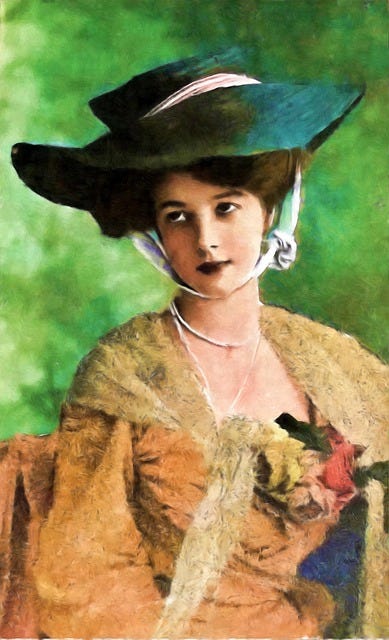
Minerva Maybelle McKnight was a pretty little gal; everyone said so. Kind of tall and skinny, she had ample red hair which she kept piled on top of her head, a pale coppery complexion, and the fierce green eyes of a highlander. The patrons at Jaunita’s and those around town called her Minnie, sometimes Minnie Belle.
“What do you want?” she asked Henry a second time, trying to get his breakfast order. But he only looked at her slack-jawed until the surrounding men started snickering and one jabbed him out of his trance.
“I’m, uh, I’m, uh… eggs,” he said.
“How?” she asked.
“Um… c-cooked,” he answered.
She sighed, a little annoyed. Minnie got a lot of that from young men. Still, it made her smile. “Scrambled,” she said, writing on her pad.
Henry nodded.
From that day in March until the crew packed things up in May, Henry ate every meal he could at Juanita’s Redeye Café. Those first few suppers he lingered past closing time to ask Minnie if he could walk her to her boardinghouse over on Lord Street. But she flatly refused. “I don’t need you walking me home,” she said the first time, sounding aggravated.
Flustered, Henry tried to recover. “Wull, I didn’t mean nothing by it. It’s gettin’ dark, I’s just concerned about your safety.”
“No need,” came her curt reply. “My boardinghouse isn’t far. Besides, my sister Mag comes by to walk with me.”
“She’s the schoolteacher,” she added, as if that would further explain why she didn’t need Henry’s escort.
On his second try, Minnie still said no, but Henry thought her not as brusque as the first time. On his third try she’d smiled at him, so it encouraged him to ask again, which he did the next evening while she was wiping down a table and filling a galvanized tub with dirty supper dishes. She threw her towel over her shoulder and pushed a loose strand of auburn hair behind an ear, fixing Henry with those claymore-keen green eyes for several long seconds. It unnerved him a little. He shifted his gaze away from hers and onto that strand of hair loosely tucked behind her right ear. He felt sweat popping out on his forehead.
“Oh, all right,” she said, which snapped Henry’s eyes back in line with hers and made his mouth open. “I’ve got to finish up here, though,” she continued. She picked up the tub and started toward the kitchen.
Henry blinked and swallowed. “What about your sister?”
Minnie turned to look at Henry again. With a slight smile she said, “I told her not to come tonight.”
Henry got to know a lot about Minnie that evening, and all those following until his crew’s May departure. He learned she was an orphan, too, her and her sister. When she was five, their father, a Reb soldier, had brought his family out to Texas from Missouri. Their ma had died from a tick bite on the trip out, and then their pa — who had survived the Battle of Champion Hill and the Siege of Vicksburg — died a year later when a stray bullet, fired by a celebratory drunken cowboy, struck him in the head. Some church ladies took in her and her sister, Mag — four years older than Minnie — for the next few years until Mag got appointed school marm.
It was easy for Henry to see that Minnie’s brief life had made her a resilient, self-reliant, and strong-willed young woman. He, of course, fell spike maul over tie tongs in love with her, but more for her red hair, slender body, and green eyes than anything else. However, he considered the other traits good in a woman, considering the life she would have as his wife.
Henry proposed to Minnie the night before he and his crew headed back to Springfield. Anyway, he meant it as such. But, of course, she turned him down.
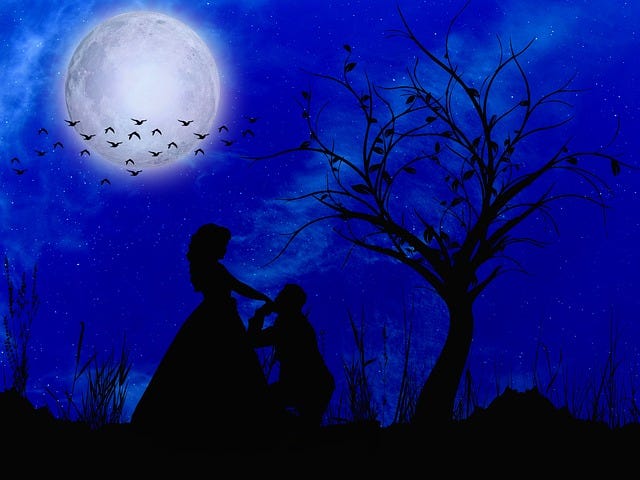
“I reckon we could find you a boarding house up in Springfield, leastwise until we got married,” he said.
“What makes you think I want to leave Quanah? And don’t say to marry you because I certainly have no wish to do that.”
Henry got a little flummoxed. He thought she liked him. “But I thought…” he stammered.
“Well, you thought wrong. Besides, I can’t leave Mag, she’s a spinster.”
“A spinster?” Henry stood, throwing his arms in the air in anger and frustration, seeking a counter. “Why, hell’s fire, she ain’t but twenty-one.”
“Yes,” Minnie said. “That’s true. But her prospects aren’t good. She’s, well, homely. And I’ll thank you not to swear around me.”
“Sorry,” Henry said. He ran fingers through his hair and walked in little circles, trying to reason things out. “So you’re wantin’ to stay here and become a spinster, too, just like your sister’s done?”
“Not necessarily,” she answered.
Henry stopped pacing and looked at her, crestfallen. Other young fellas, mostly cowboys, who’d come into Juanita’s to flirt with Minnie, hadn’t skipped his notice. “Well, I reckon it’s just me, then. I kinda thought you’s sweet on me, but guess I’s wrong.”
He put on his hat. “Well, goodbye, Minnie,” he said.
“Wait.” She reached out and put her hand at the crook of his arm. “I… I do like you, Henry… in fact, quite a lot. It’s just…”
Henry waited for Minnie to finish her explanation, but her green eyes filled, and she looked away. “Oh, shoot!” she said, wiping her eyes and sniffing.
Henry became confused and a little uncomfortable. “Whad I say?” he asked.
“It’s nothing you’ve said,” she replied. She wiped her nose and sniffed again. “It’s… Oh, hell, I’m scared.”
“Scared?” Henry asked. “Of what? Of me?”
“No, not you… well, a little, I guess. But Mag and I have got things steady here. After our daddy died, we promised we’d never leave each other’s side. I’ve never been away from her my whole life. Moving off to some place like Missouri without her terrifies me. I can’t break my promise to her.”
Henry sat back down, scratching the back of his neck. Suddenly, his eyes widened in a thought. “Hey, remember I told you about my brother Grant?”
Minnie daubed her eyes some more. “Yes. What’s he got to do with anything?”
“Well, for one thing, he’s kinda ugly, too, and he ain’t never married. Maybe we could bring Mag with us and introduce the two of ’em.”
Minnie sighed. “Oh, for Pete’s sake,” she said. “That’s the most ridiculous thing I ever heard.” Then she sat in silence, considering Henry’s proposal.
© 2021 by Phil Truman. All rights reserved PTI Publishing Broken Arrow, OK
Thanks for the read.
A shout-out to writers I admire: Claire Kelly, Stuart Englander, Britni Pepper, Dr Mehmet Yildiz, Tree Langdon, Bebe Nicholson, Liam Ireland, Terry Trueman, Terry Mansfield, Terry L. Cooper, Teresa Kuhl, Dr. Preeti Singh, Linda Halladay, Roz Warren, Karen Madej, Eve Paludan, Tarajohnsonn
Please visit to my website to preview my novels.


