
The Queer Question in AI, Or My Gay Gripes with Grammarly

As a writer who started in academic spaces, I am familiar with receiving and incorporating editorial feedback. I welcome critiques of my work as an opportunity to improve. However, with the advent of artificial intelligence, I’ve noticed a trend of more writers relying on large language models (LLMs) and typing assistants to assist them in the editorial process.
While working as a freelance writer, I became familiar with writing technology, because it was required practice in my company to use Grammarly, a writing AI, to check our grammar and spelling before submitting final drafts to the editors. Grammarly not only checks for grammar and spelling errors but also detects plagiarism, evaluates the tone of the writing, and provides suggestions for improvement based on specific criteria.
Although I never had problems with Grammarly as a writing professional, I started to have issues with the application critiquing my academic and personal writing. As a social media researcher, I often write about identity and popular culture. Specifically, I focus on how people perform their race, gender, and sexuality online. Therefore, I write about topics like feminism, racism, and queer theory. Since I write about contemporary social media platforms, my writing sometimes includes colloquial phrases and popular terminology.
However, Grammarly did not like that. I often wonder if Grammarly even likes me because writing with Grammarly requires the constant calculation of what Grammarly does and does not like about my writing.
And, while I take no issue if Grammarly wants to ding me with a red line or recurrent suggestion about using words like “bro” and other slang (which it dislikes), I am surprised by how often Grammarly tells me to reconsider how I use the word “queer.” Describing “queer” as sensitive language, Grammarly constantly cautions me against including the word in my writing unless I unintentionally offend someone.
Which always makes me think, “Offending whom?”
As a queer person and theorist, I use the word “queer” often, and Grammarly should know that by now. It should know me by now. And, if I am honest, it’s a little offensive to me that the AI assumes that I’m straight, or worse, that I am ignorant of queer language usage. I even started to believe that Grammarly would like me better if I was a little less queer or perhaps if I just used the word queer a little less.
After years of reading too much object-oriented ontology, I couldn't help but personify Grammarly, but then I remembered it's an AI and I am projecting.
So instead of psychoanalyzing my contentious relationship with technology, I want to talk about the ethical decision-making behind Grammarly’s recommendation systems and its critique of the word “queer.” In particular, I will distinguish between cultural sensitivity and cultural competency, explain how these concepts influence the development of AI models, and discuss why we need more technologically fluid artificial intelligence to understand both perspectives.
Identifier, Expert, or Ally: How Grammarly Categorizes Queer Interlocutors Online
Now, as mentioned, I am not an AI newbie, and I know precisely why Grammarly acts like I am a stranger off the street every time it reads my writing. During my research on the development of Grammarly’s sensitive language suggestions, I discovered that the platform had established a protocol to identify the users who use the term “queer” in a 2020 Pride Month article titled “How Grammarly Supports Inclusive Language for the LGBTQIA+ Community,” in which writer Mark Ramirez explains why Grammarly created the sensitive content suggestion.
Specifically, sensitive content helps “you stay empathetic to the LGBTQIA+ people in your life.” When discussing individuals from the LGBTQIA+ community, Grammarly Premium’s sensitive content feature provides three separate classifications: disrespectful or offensive language, outdated terminology, and reclaimed terms. My usage of “queer” falls under the last category, which comes with a caveat that distinguishes it from the other categories.
A reclaimed term is a term that was once considered offensive by a group but has been adopted and redefined by that group. Therefore, the article explains that Grammarly will flag you based on your pronouns when using a reclaimed term. For instance, if you talk about yourself being queer, you won’t receive any warning for sensitive content. However, you’ll get a flag when you speak about someone else. This criterion was particularly intriguing as someone who tends to do both things simultaneously (which Grammarly never seems to recognize).
The decision-making process around talking about the LGBTQIA+ community is intriguing because it raises questions about who is allowed to talk about queer issues and how they are allowed to discuss them. In my research, I have observed that Grammarly’s decision-making reflects three categories of people who can speak on queer folks with varying levels of inclusion: identifiers, experts, and allies. I have also ranked these categories based on the level of permissions they have, with identifiers having the most permissions and allies having the least.
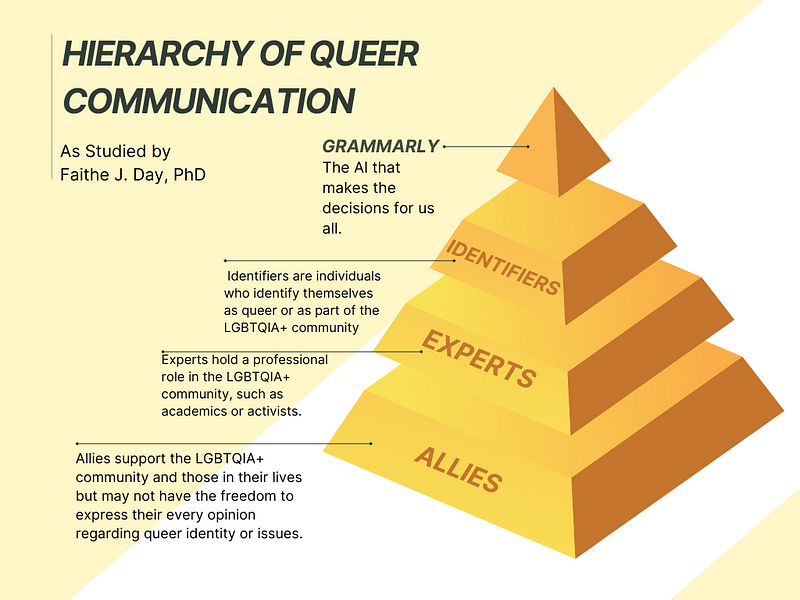
In my understanding, identifiers are individuals who identify themselves as queer or as part of the LGBTQIA+ community. On the other hand, experts are those who hold a professional role in the LGBTQIA+ community, such as academics, activists, or any different role where they must express their opinions on queer issues. Lastly, some allies support the LGBTQIA+ community and those in their lives but may not have the freedom to express their every opinion regarding queer identity or issues in the community. Grammarly puts them at the bottom of the totem pole.
At the same time, I often question the validity of hierarchies based solely on one’s credentials and experience. It’s important to remember that hateful and discriminatory attitudes can come from anyone, regardless of their identity or expertise.
So, is it helpful to make recommendations about language use based on pronouns or in-group status? And, if we use these criteria, why do I still need help to avoid being flagged by Grammarly? What will it take for Grammarly to love me? Because truth be told, I identify with and belong to all groups on the hierarchical list of queer linguists, so I should be a protected class to the AI. At the very least, Grammarly could do better to protect my feelings.
Queering Ethical AI: From Cultural Sensitivity to Cultural Competency
This hierarchy leads me to my second point. Many AI models strive to be ethical in their actions, but in doing so, they can sometimes come off as offensive or overbearing to the people they aim to protect. As someone who identifies at the intersections of multiple marginalized groups, I find it uncomfortable to be constantly reminded of my identity whenever I write about the community. I want to be able to write without being reminded that, for some people, my very existence is a “sensitive” subject.
I cannot help but think that I wouldn’t have to deal with these issues if developers were creating AI that learned to be culturally competent instead of just culturally sensitive. Especially in our current era, cultural sensitivity is a euphemism for political correctness, which is not always in the best interest of intersectionally marginalized communities.
Despite our efforts to reclaim certain words, political correctness has led to new terms and identities constantly being forced upon us. Even now, as I sit down to write, Grammarly corrected me about which version of LGBTQIA+ I was using (once again, correcting me on how to talk about myself).
In contrast to these models of political correctness, cultural competency requires a participatory design methodology that involves the communities under consideration and their opinions. At the same time, many of these platforms do consult with community members, so it is essential to recognize that a random sample of community members may only be able to represent part of the group.
But, for those who study ethical AI, this is now new information. Creating culturally relevant AI is a popular topic of discussion within academia, consumer insights, and Big Tech. And many platforms and AI, like Grammarly, exemplify how AI has adapted to be more culturally relevant. However, there is still a need to improve the language, suggestions, and overall understanding of the people who use these platforms.
The Dark Side of AI: When Users Aren’t So Well-Intentioned
Although I appreciate the efforts made by Grammarly and other artificial intelligence systems to be culturally sensitive toward intersectionally marginalized communities, I am also concerned about the possibility of individuals using these technologies with malicious intent. While Grammarly can suggest ways to improve our word usage, it ultimately does not force us to make any changes. It is also easy to ignore or turn off suggestions from the AI in specific areas.
Even as I wish for more culturally competent AI, I know that I am not the majority of people who use technology. So, after donning my user experience cap, I began to wonder if other users have a desire for AI that isn’t so ethical and well-intentioned. Specifically, I began to think about the users who were just as tired of Grammarly correcting them as I am, but for entirely different reasons. I also apologize for my editing because even when writing the following paragraph, I had to fight with Grammarly to edit it. After all, it might lead to “sensitive content”.
Several years ago, I gave a lecture about alt-tech platforms. Many of these platforms are fringe sites designed to act as alternatives to mainstream social media sites, with stricter community guidelines and punitive censorship algorithms. However, many alt-right, white nationalist and ultra-libertarian groups also use these sites to promote “free speech.” As a result, alt-tech platforms have become spaces for people with extremist political views to gather amongst themselves.
However, there are great uses of alt-tech platforms. These sites have always interested me because I research how users can counter-platform algorithmic systems often biased against intersectionally marginalized communities. Therefore, while I am not saying that we need alternative technology to AI writing assistants like Grammarly so that people can write more of their political or problematic rants, I do think a lot about how limiting the current AI systems are and how they police the type of topics that we are allowed to write about and talk about.
With more AI writing assistants and platforms emerging, we should strive to create alternative systems that do not reinforce politically correct views and ideologies. But that doesn’t mean cultural sensitivity should be thrown out of the window. Instead, we should focus on developing culturally competent AI that caters to groups that only sometimes communicate in ways easily understood by the mainstream.
At the same time, even the development of culturally informed AI brings up concerns regarding cultural appropriation and surveillance capitalism. But, I still believe in technological progress. I also look forward to the day when I can overcome my issues with Grammarly and other recommendation systems and finally coexist peacefully with technology.


