
Why are We Not More Worried About Surveillance Capitalism
Most stories of my life at this moment in time begin with the statement “Yesterday, I was watching a video on”. So, yesterday I was watching a video on TikTok and it was all about surveillance capitalism. Specifically, the video focused on the research and writing from Professor Shoshanna Zuboff’s book The Age of Surveillance Capitalism: The Fight for a Human Future at the New Frontier of Power.
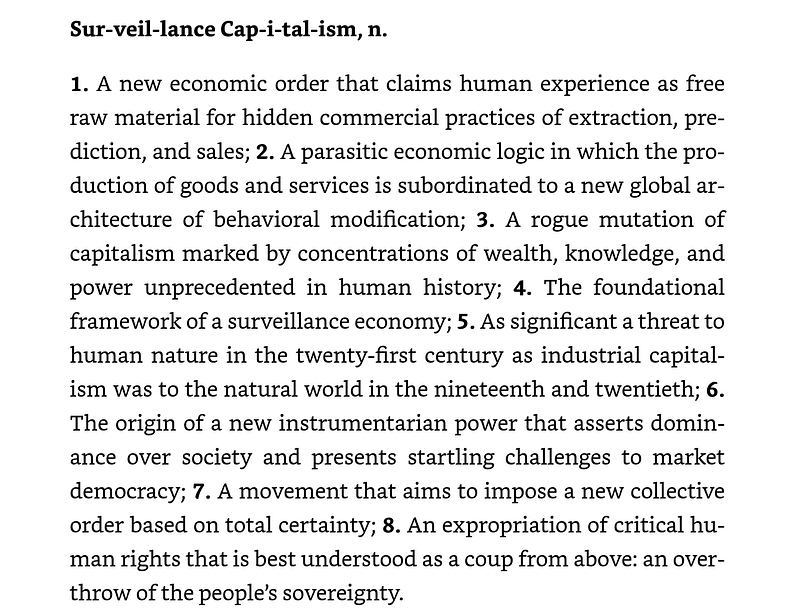
In the book, Zuboff gives an extensive definition of surveillance capitalism, but simply stated, the term can be used to describe an economic model which is based on the commodification of personal information and data. Regardless of whether you know the terminology, practices like data mining have made surveillance capitalism common knowledge to the public. However, what isn’t always common knowledge is the effects and future possibilities that an economy engaged in surveillance capitalism will bring.
Specifically, the video I was watching referenced Facebook’s experimentation with the newsfeed in order to manipulate the emotions and behaviors of its users, and I couldn’t help but be reminded that this commonly used example is now almost a decade old. In addition, this example speaks to the most commonly used argument when it comes to surveillance capitalism which discusses the term as something that technology companies are guilty of, but not as something that also influences user behavior.
Especially as we continue to critique the companies that are engaged in the race for platform dominance and user control, we must also acknowledge how the logic of early stage surveillance capitalism influences the way that we engage with each other.
Surveillance and the Digital Panopticon
Last year I was teaching a class on Black Digital Studies, and a large part of the course was focused on surveillance capitalism as it relates to the digital panopticon. While there are many people who have written on the digital panopticon, I will give some background below so you don’t have to follow all of the links.
During the 18th century, English Philosopher Jeremy Bantham developed the model of the panopticon in order to create a prison which required less supervision of prisoners by creating the illusion of surveillance. Specifically, the model of the panopticon features a central watchtower (in the middle of the prison) which is viewed as the space where the guards will watch the prisoners. However, due to the height and construction of the tower, the prisoners never actually know when there are guards in the tower watching them, or when the tower is empty.

In this sense, the panopticon psychologically controls the prisoners through the illusion of surveillance. When prisoners are in the eye sight of the tower, they are made to believe that they are being watched, and there is an expectation that they will act in accordance with this perceived surveillance. In addition to Bentham’s understanding of the panopticon, the concept of the panopticon comes up in discussions of surveillance in reference to Michel Foucault’s work in Discipline and Punish.
Specifically, Foucault expounds upon the concept of the panopticon in prisons to discuss how surveillance works in our daily lives. Within the construct of the panopticon, prisoners begin to surveill themselves and others because they never know when they are being watched. In many ways, this form of surveillance and policing of the self and others is also seen within society when it comes to behaviour. Most people in society have been conditioned to act in accordance with societal norms, modifying their clothing, mannerisms, speech, and other acts to fit into the culture and evade corporal or social punishment.
The Logic of Early Stage Surveillance Capitalism
Therefore, we must think about the role that culture plays in how we think about surveillance capitalism. And, because I love a play on titles, this is an opportune time to talk about Postmodernism, or the Logic of Late Stage Capitalism by Frederic Jameson.

In this philosophical text, Jameson explains how regardless of what cultural changes we are seeing in society, those changes are always connected to what is going on economically. Through a Marxist analysis, Jameson demonstrates the relationship between economic changes in society and what we came to know as the postmodern movement or the turn from modernism to postmodernism.
Applying this Marxist view of the relationship between culture and capitalism, I think that we can also think about the sociology of surveillance capitalism when it comes to the way that people behave online. Specifically, I think we should examine the cultural logic and psychology behind the impetus to constantly expose the most intimate parts of ourselves to the public. Conversely, we must also examine the cultural logic behind using social media to surveil the lives of others.
Under The Eye of People and Platforms
Like a real life “Handmaid’s Tale”, we have all learned how to surveil ourselves for, and as, all seeing Eyes. There is an ease to which people share information about themselves online, and even more of an ease in the way we share the lives of others based on what we have seen them post online. In our day to day lives it is common to pull up someone’s page to just “see what they’re up to” and meeting a new person is commonly followed by searching and looking through their social media profiles in order to find out more about them.
In my time spent studying the internet, I have also noticed that when you add any internet related adjective or addendum to a word (i.e. cyber, virtual, etc), the word that follows somehow becomes less serious, less real. For example, Cyberstalking someone is commonly joked about, but for some reason not viewed as an obvious violation of an individual’s privacy.
In reading the previous examples I’m sure that many of you thought, “Well, there’s nothing wrong with looking people up online, it’s public information”. And, that is exactly how foucauldian discourse works. Surveillance capitalism has made us comfortable with our current lack of data privacy by normalizing a lack of privacy in the way that we engage with both people and platforms through sharing.
It is now normal to share about ourselves online and for people to know things about us, so obviously there’s nothing abnormal about a technology company collecting that information and sharing it as well.
Corporations are people just like us after all.
Consequently, through the normatization of sharing ourselves and sharing about others online, we have freely given multiple institutions vast stores of information about everyone. And, whether it be social media platforms, the police, or government entities, we have little knowledge of how these institutions will use this information moving forward.
So, instead of buying into the belief that public data should be shared, perhaps we should be asking, Why are we sharing anything at all?
On Minding One’s Own Business
Especially when we look at the history of the web and the rise of user generated content, the model of offering our free digital labor online to companies who profit from this sharing was never a model meant to benefit users. It was a model created to benefit a technology industry which saw a way to profit from the lack of regulation around these norms.
In this sense, the logic of capitalism continues to creep into every part of our daily lives and habits, and surveillance capitalism is just the next stage. While social media corporations have taken most of the blame for this modern day surveillance culture, the ethos of surveillance has also crept into the way that we use social media. In the same way that social media platforms employ algorithms to spy on users, users also engage with social media for the purpose of spying on each other and reporting on themselves.
Our present day digital panopticon does not just include the all seeing eyes of the government and technology corporations, but the eyes of friends, family, and coworkers. And while these eyes might not appear as sinister, there is much to be said about what is generated when we are encouraged to focus more on others than ourselves.
Therefore, instead of acting in accordance with business models built on oversharing information and data, in the future we might begin to embrace the radical act of minding our own business through respecting and demanding data privacy.