
The Problem with “Feminism” Today
Why such a basic idea is still deemed controversial by so many.
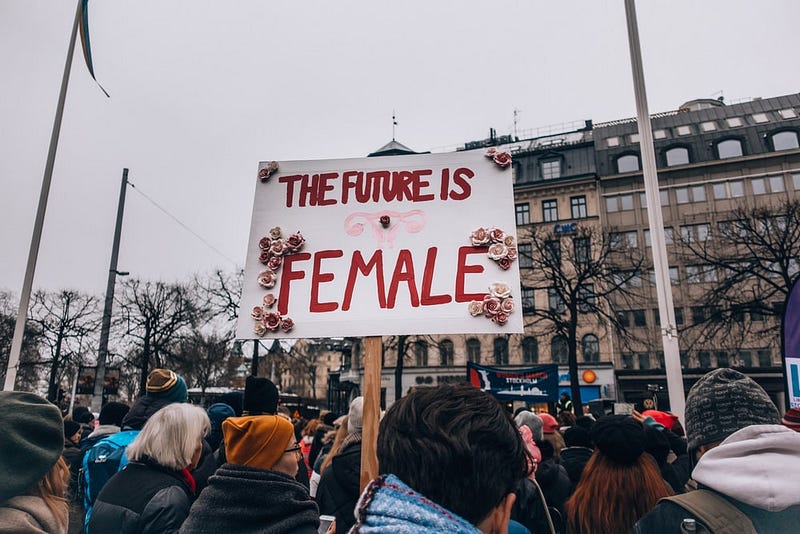
It seems that these days — whatever your gender — when asked if you are a feminist, your answer can only be damning.
Say no, and regardless of your own sex, you are branded a bigoted woman-hater. Probably even stupid and ignorant. You think women belong in the kitchen and men are the head of the household.
Say yes as a woman, and you are a bra-burning man-hater whose campaigning to “free the nipple” or show your underarm hair blinds you from real-world issues.
Say yes as a man, you’re instead branded as a “whipped soy boy” who is either labeling themselves as a feminist in a pathetic attempt to impress women, or to obey a domineering woman already in his life.
So… are these the only two options in society’s eyes?
What about the vast majority (I hope) of us who don’t subscribe to either of these extremes and believe that men and women — though often different in minor or superficial ways, are fundamentally the same.
Sure, there really are many bigots out there, as well as some misguided so-called “feminists” who mistake a movement of equality for an infantile rampage of naïve, tunnel-visioned, and self-centered privilege. But I propose that most of today’s alleged “gender war” is largely fuelled by semantics, definitions, and unfortunate misunderstandings…
The Origins of Feminism
Perhaps ironically, it was a man — Charles Fourier, French philosopher and utopian socialist, to be precise — who first coined the term “féminisme” back in 1837. The word and ideology behind it then circled Europe and North America throughout the subsequent few years.
Feminist campaigns in the years passed were a principal contributor to major historical societal changes for women’s rights today; credited with achieving women’s suffrage, more diverse academic and professional spaces, improved reproductive rights, and the right to enter into contracts and own property. These huge wins for gender equality cannot be understated.
But it is the term’s focus on the “feminine,” which often throws people today. And I have to admit that although I understand the etymology of the term — given that it has, historically, always been women to draw the short straw and thus the goal of women’s rights specifically that led the movement— it is perhaps misleading in this day and age to have such a heavy focus on the “feminine.”
For Feminism, Against Femininity?
Ironic, even, as many so-called “feminists” today actually shun all that is associated with the term feminine. This isn’t about a re-branding, but about a reactionary self-loathing of female identity, in favor of genderless monotony. It’s about women shaming other women for their natural affinity for more “feminine” career choices, aesthetic, or personality traits — just because we now thankfully established that these needn’t be enforced.
I’m by no means suggesting we regress back to the limiting gender roles and restrictions of the past. But you can be a feminist and acknowledge that femininity and masculinity exist, as concepts — as long as you can accept that it’s not an exact science, and most of us don’t feel 100% represented by either category. That although many of us relate at least somewhat to the tendencies of our gender, we make our own choices at the end of the day. And that’s okay.
Why are those most obsessed with the term “gender” also those who seem to want to snub out this entire concept altogether? Gender stereotypes may have a lot to answer for, but there are certain tendencies between the sexes that many feminists, still understandably hurting from the extremist interpretations of the past, choose to ignore altogether.
“A feminist is anyone who recognizes the equality and full humanity of women and men.” ― Gloria Steinem
How can we campaign for “female power” or celebrate “femininity,” when the feminist movement has started to turn against the same traits and interests that have been belittled by men since time began? Don’t we risk going full-circle, heading down a slippery slope to the very misogyny that our feminist foremothers first set out to eradicate?
Gender-Neutral Feminism
Perhaps we should take a leaf out of feminism’s own book, and consider that an updated, gender-neutral term would reflect the inclusivity and true intentions of the movement — to banish gender inequalities of all forms, affecting all people.
Many of us— both feminists and “anti-feminists” alike — regard feminism as more of a women-led and female-promoting movement. Any men who do participate, allegedly do so on an “ally” status. This in itself is harmful, as it suggests that this isn’t their fight too. Oh, but it is. Feminism is for everyone, despite what the term may suggest. This false belief of exclusivity is an unfortunate consequence of our continued use of a term to encapsulate equality — when it sprouted out of the injustices faced only by women.
Still a Woman’s Fight?
Nowadays, the term is still most often associated with prejudice against women. After all — despite the obvious progress made over the centuries, there is still not one country on earth that has achieved absolute gender equality.
Since the equalities of the past were even more crystalized as they are today, the fight for equality simply had to focus on this overwhelming task of elevating women’s rights at the most basic level. Nowadays, although the world still has a long way to go to reach overall gender equality, the movement ought to expand to the full range of gender discrimination issues facing the modern world.
From toxic masculinity leading to more depression and suicide among men, to the unfair bias against fathers when it comes to child custody battles. The idea that women fill some roles — as emotional and nurturing caregivers — while men do not, is harmful to everyone. Just because the overall norm is still that men have more privilege than women, doesn’t mean we should dismiss very real issues that men face.
While many women want to unsubscribe from this archaic trope of homemaker, many men now choose to step up to more domestic, traditionally female roles. Feminism isn’t just about taking women out of one box and placing them into another, but about smashing all the boxes…. A woman should be able to choose to be an astrophysicist, doctor, nurse, teacher or housewife — all without judgment. No kids or ten kids? — It’s her choice.
And the same goes for men.
“I am not free while any woman is unfree, even when her shackles are very different from my own.”
― Audre Lorde
“White Feminism”
This insidious new breed of “feminism” revolves around first-world problems such as body hair and the inclusion of obese models in fitness magazines and neglects some of the world’s most horrific ongoing gender-based violence such as female genital mutilation, forced marriage, or honor killings.
Granted, the former issues touch on the very real problems of the objectification and overall taboo surrounding female bodies. All I’m saying is that, as with any equality movement, we must learn to look beyond our own bubbles of relative privilege and consider that although our own issues do matter, other people are facing different battles.
Overall, I’m not trying to say that semantics and definitions are the greatest issues here. Most of us are well aware of what the term “feminism” really implies, and why it focuses on women’s rights by definition. Some people out there genuinely don't believe that men and women have equal worth or capacities — which is what we should be most concerned about.
However, one of the key obstacles when it comes to feminism’s current PR problem is those partaking in the movement who have cultivated a self-centered, self-congratulating approach to the cause. This, I would argue, only threatens the feminist movement and undermines what it truly stands for.
Equality is key
Feminism was initially invented due to a lack of women’s rights, and now, as we slowly progress in that department, the term is already beginning to crave a reinvention. I am not saying that women no-longer face injustices — only that the same injustices that they face often also have a knock-on effect on men.
For instance: Believing women to be the emotional sex not only makes women’s justified pain taken less seriously, but also makes men feel the need to bottle theirs up.
Believing women to be the caregivers not only often limits their aspirations by imposing expectations on them to be maternal above all else, but also means men are not regarded as equal parent material in the eyes of society and the law.
And believing women are always victims to be protected not only perpetuates the idea that they are the weaker sex and in need of men to save them but can also give them an unfair advantage in court cases where they are the accused offender, while men are quicker to be deemed capable of causing harm to others.
Some final thoughts
There are so many separate knots in this issue that it’s hard to know how to begin to detangle them. But to focus on the positive, feminism is still making huge signs of progress for gender equality: From women in Saudi Arabia finally getting the right to vote in 2015, to Belgium making the morning after pill free just last month. Sweden’s pioneering implementation of gender-neutral parental leave, to recent efforts among non-profits worldwide to tackle the disproportionate male suicide rate. Every country is at different stages in the journey and has different areas of improvement before it reaches overall gender equality.
Maybe take some comfort that for many of those people who reject the idea of feminism — it is more a case of misinterpretation. If someone says they don’t identify as a feminist, then clarify what they mean before you disregard them. Start a meaningful yet respectful conversation about it — we could use more of those.
As individuals, we all have different beliefs when it comes to tricky topics such as abortion or sex work. However, if enough of us strive for the goal of genuine equality, and truly want the best for all, then I hope that we can discuss these sensitive subjects in a civilized and respectful way; Learn to live with the fact that we won't all agree on every front — but we can at least try to work together to understand all points of view; Come to compromises that strive for the greater good for human wellbeing as our common goal.
Part of the feminist message is one of diversity and the right to free thought and self-expression. As such, we must find that sweet spot between common ground where it matters most — and allowing a degree of flexibility and tolerance when it comes to those issues which — although important — we perhaps will never reach consensus.
As much as many feminists crave a unified movement, perhaps this is an unrealistic dream. Now that feminism has expanded its purpose beyond women’s right to vote and become a more complex ideology, it is not always so black and white exactly what it stands for.
I hope that, as feminists, we can become a more inclusive and self-aware movement that doesn’t lay down alienating house rules. We shouldn’t put off well-meaning equality-driven individuals due to terms and definitions, or the current heavy focus on young, white, middle-class cis women. Then, maybe, we can open our eyes to the true scope of issues we should be fighting for.
Roxanna is a British-Iranian content writer specialized in human rights, identities, health, and welfare. With a languages degree from King’s College London, a Master’s in European Studies from LSE, and an EU communications background, she strives to increase visibility and encourage debate around ethical and sociocultural issues around the world. http://roxannaazimy.com Twitter: @roxannayasmin


