
The Personal Power to Fight Climate Change
An aggregation of marginal gains
Two years ago, I wrote my first article on climate change, The Four Reasons We Won’t Fix Climate Change. I stand by it.
And yet I can write the following article with no qualms, because it’s not about fixing it all, or solving it all. There is no panacea, no one solution to climate change.
We can talk about and debate scalable ideas; which ideas are more likely to work based on the science, the behavioral economics. But while we debate, the planet’s climate is changing. While we debate, we can be taking action.
Paper straws, like straw men, are easy targets. There are surely people who still think recycling soda cans and switching to compostable picnic cutlery is all that’s needed. It’s obviously much more than that. But knowing this doesn’t mean “do nothing until.”
Shortly after publishing a couple more climate articles, Medium informed me I was a “top writer” in climate change. Wait — what? The articles didn’t even particularly go that far and wide; it was just that there were so few of us.
Today I am no longer a top writer. That’s a good thing. I’ve laid off it a bit because I’ve said a lot of what I have to say, but my status drop has got to be because so many people are writing about it. The message continues to spread.
Each article is a marginal gain.
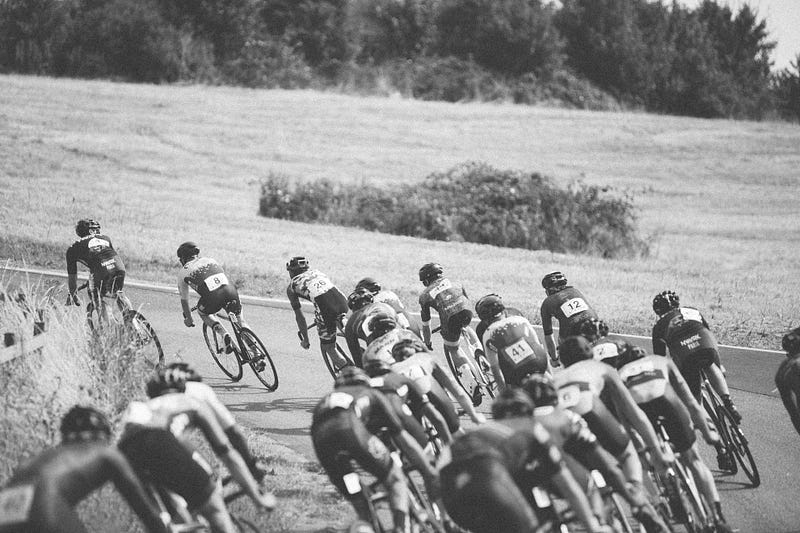
The Aggregation of Marginal Gains is a concept made famous by Dave Brailsford. Brailsford’s British cycling team had failed to make the Olympics for years. And then he proposed something.
If his team focused on a 1% margin of improvement for everything they did, every single day, this would add up, give them the edge they needed.
Brailsford focused on the seemingly insignificant things. Athletes bringing their own pillows and mattresses so they could sleep with the same posture every night. Extra hand-washing, avoiding shaking hands with others, and being extra careful with food preparation each day, to prevent illness. This is called “avoiding the marginal losses,” and part of what propelled the team into the Olympics five years later, where they dominated, winning an astonishing 60% of the available gold medals.
Their story is not a one off. There are many examples of marginal gains working. You can find some of them here:
We use this aggregation of marginal gains every day. It’s in how we parent our children, how we might be striving for a better position at work, how we strive for better health and fitness.
Maybe we’re weight training. We know, then, that avoiding “Friday night pizza” for eight weeks will have an impact. It’s not about thinking that avoiding pizza will solve all of our health problems with one fell swoop. Instead, we know that the key to good health is the right habits — an aggregation of proper rest, proper nutrition, exercise, and stress management, in our lives.
James Clear has written about marginal gains in his book “Atomic Habits.”
Clear says about Brailsford’s philosophy:
The whole principle came from the idea that if you broke down everything you could think of that goes into riding a bike, and then improved it by 1%, you will get a significant increase when you put them all together.
Why can’t we take the same philosophy and apply it to climate change? Why can’t we break down everything that goes into being a modern human in a hyper-consumer society and improve it by 1%?
Why are so many people dead-set on convincing us there’s nothing we can do? The world, really, is just one large body. We are the human super-organism; we can act en masse in ways other species cannot. And the Earth is a living collection of interdependent systems we know we can affect.
The most obvious reason to understand the value of the aggregation of marginal gains — is that it’s flip-side, the aggregation of marginal losses — is how we got here in the first place. We weren’t humming along in perfect utopia and one day set off a climate bomb. Sure, zoomed out to a geologic time scale, it’s kind of like that. But for our human time scale, it was one day at a time, one car at a time, one rainforest acre at a time.
This was one of my four reasons we wouldn’t “fix” climate change in that article. Because marginal losses feel innocuous. Shake someone’s hand? No big deal. Smoke one cigarette? No worries. Take that one flight to the islands? Hey, you only live once.
In the aggregate, we got where we are.
And I still think this is true — people will continue to behave this way, making exceptions and excuses, just having that “one” cigarette, right up until the very end. I even do it.
But I’m no longer talking about “solving” climate change, let alone reversing it. I’m talking about doing everything we can to help mitigate the worst of it. To slow it, to buy ourselves some time. To shave off half a degree of global temperature rise. To maybe help prevent that one flood, or heatwave, or wildfire.
To just do the right thing.
Emerging science allows us to attribute extreme events to climate change. But it will probably be a while (if it even ever happens) before we have an adequate science to truly show us the gains we can make with our personal contributions. I have solar panels now, and with it an app that says, just since December, when the panels went active, I’ve planted the equivalent of three trees.
Can I take that at face value? Can I be sure it’s accurate? I can’t, and I’m not, but it’s not the point. That’s more panacea-style thinking. I accept the science behind solar panels.
Like the cyclists, it’s about minimizing marginal losses and pushing for marginal gains.
Everyone has their own unique profile in this. Some people, based on where they live, what they can afford, what they understand, are going to be better at marginal gain A, while someone else is going to be better at B or C.
Here’s my profile:
I live in a small rural town. I am middle class. I have good working knowledge of climate change, though I’m always open to learning more. I work for myself so have time for some things others don’t.
What I do:
— Try to work climate change into conversation with people in my community. As more people are willing to discuss it, I plan to move the conversation towards local resiliency efforts. How we can best support our small farms, how we can be best prepared in a disaster.
— Eat almost no meat, unless it’s from a local farm, and even then, not much.
— Have a robust garden, expanding it each year, learning and becoming more efficient, now able to support my family with about 20% of our food needs, plus have some leftover to donate locally.
— I’m all about reducing fossil fuel emissions, too, which is why we just got the solar panels I mentioned.
Those are the big things, but it gets even more marginal than that: We like to camp on the lakes where we live, but don’t own a motorboat; we canoe. Wherever possible, whether it’s buying socks or coffee filters, we choose the sustainable option. Our kids have water bottles; we never buy water in plastic bottles, but use a filter for tap water. And this year, we cut our Christmas gift-giving by about half.
Etc, etc, etc.
Again, not everyone can do the same things. We all have a different profile. But the world is a big place, and things add up.
Just last evening I watched something about a pizza convention in Las Vegas. There were people with pizza pants on, and there were people doing gymnastics while tossing dough in the air.
The world is such a big place it contains acrobats flipping pizza dough.
I also learned that 350 slices of pizza are consumed every second.
Every second.
This has made mozzarella — not cheddar or even “American” — the most popular cheese in the nation.
We are legion. We are the aggregation of marginal whatevers.
I anticipate my detractors here and welcome them with open arms. Note carefully what they’re almost certain to say: This is all very quaint and Pollyanna, TJ, but our problems are much bigger than cycling or cheese pizza. Which is 100% right.
We’re up against it. Even if we accept the idea that marginal gains could have a demonstrable effect, we know the massive obstacles in our way: misinformation, disinformation, outright ignorance (some people just know nothing about climate change, or how it relates to fossil fuels, or industrial food production, etc.)
And then, of course, there’s our stark cultural division: people disbelieve in climate change — the problem of it or the solutions — through motivated reasoning, to stay allied with their sociopolitical group. TLDR: Trump supporters.
Yet the logic remains the same, imperturbable: to do everything we can. Even if Brailsford’s team didn’t going on to dominate and declare Olympic victory, they would have still been that much better at their sport for minding their marginal gains, that much less sick for minding their marginal losses.
But they did win that the Olympics. That’s important, too. We don’t know what might happen — lightning could strike. Remember well that during the pandemic, after mere weeks of lockdown, we saw an Earth rebounding. They called it the “anthropause,” a seismic noise quieting period unprecedented in human history.
Plants and wildlife rejoiced.
Certainly extreme, yet indicative of the power of human beings en masse.
Diagnosing the world as terminal is de rigueur. And it’s easy. Yet to me, even worse than a willfully obstinate Trump climate denier is someone who understands the problem, yet has talked themselves out of doing anything about it.
It’s not about fixing-it-all-or-nothing. It’s not a zero-sum game.
Start somewhere, anywhere. Because it will feel good and you’ll want to do more of it. The more you do, the less you’ll say nothing can be done. Do it for the sake of doing it, because it’s the right thing to do, and not because you think it’s going to fix everything like magic.
If enough people do the same…? Who knows. Maybe we at least nab a bronze.
TJ