
How I Justified a Week in the Bahamas
(Or, Why I am a Massive Climate Hypocrite)
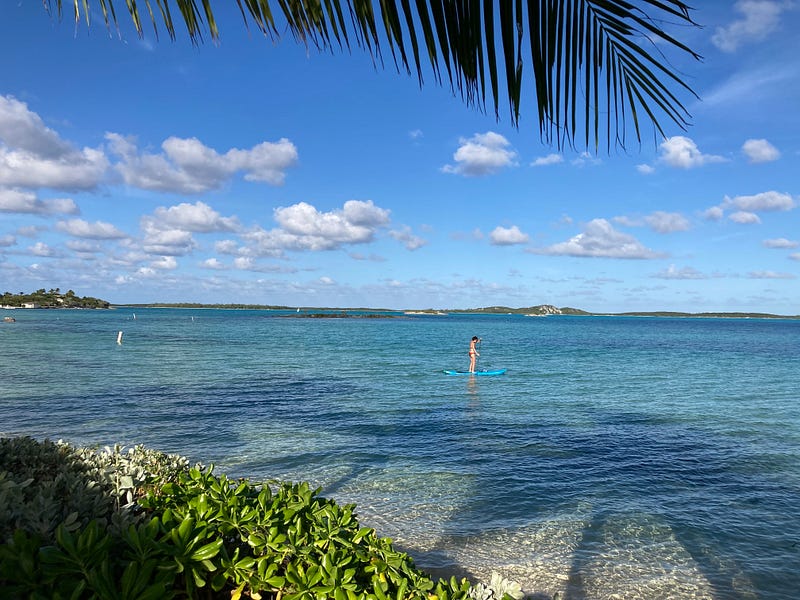
Recently, my wife and I flew to Great Exuma, an island in the Bahamas. We had been wanting to do something to celebrate our ten years of marriage and fifteen years together. The brief history of goes: When we met, I already had a son and my future wife had just completed her master’s degree and gotten a job. We never did much traveling together. We never did any traveling together.
When we got married, we kept it small. Very small. Each having big families, we decided that once we invited some people we had to invite all people and so the only stopping point everyone could understand (we hoped) was parents-only. And that’s what we did.
Our honeymoon was one night away, at a hotel not far from where we married. We had things we needed to get back to. Like puking kids. (There was a bad GI bug going around at the time.)
Ten years later, we’d still never gone anywhere alone together. We’d been working, raising our son and two daughters, building a life. I am an avid gardener, too, and that has grown into having some livestock — all things that are hard to get away from.
Still, I balked at the idea of flying to the Bahamas. I love my wife and wanted to do something together, but I spend lots of time reading and writing about climate change, and I’ve come up with a simple logic:
A.) Climate change is real, and B.) it’s man made. C.) We ought to be concerned not with “stopping” or “solving” it (it’s too late for that) but mitigating and minimizing and — crucially —D.) this means saving lives and minimizing suffering. E.) This comes in part through the aggregation of marginal gains, i.e. individual action. And finally, F.) avoiding flying on airplanes whenever possible is part of that individual action.
Ergo, not flying on planes today = minimizing future suffering of human beings in the future.
Flying to the Bahamas would be ignoring this logic.
But millions of people do it every day, right? Is there any way to really calculate the impact of that kind of choice? Any way to actually offset or balance it out?
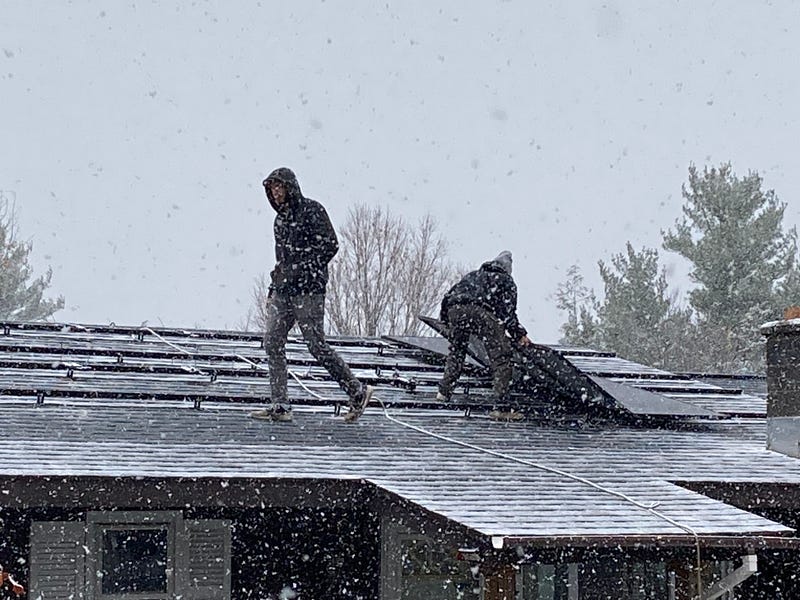
Just before leaving, we had solar panels installed, something we were planning to do anyway. Less than a week before flying out, the company came and put the panels on our roof (it snowed briefly).
In Exuma, I found myself wondering what kind of “credit” this might have bought me — if any. I’ve heard really nothing good about the efficacy of carbon tracker calculators. That personal culpability for a carbon “footprint” is just too complex; there are too many variables for such trackers to really be useful.
I’ve also heard people say these devices do the bidding of big fossil fuel companies, putting the climate change onus on consumers. And / or, they just keep us consuming and emitting, using bullshit metrics to feel better about ourselves while we do so.
Indeed, there’s probably way too much for some app to ever really factor in all the things in a person’s life — all the checks in the negative and positive columns — to give him or her an accurate idea whether he or she is still on the net positive side of things after flying from New York to the Bahamas.
Does it matter that I have big gardens? That we just got solar panels? That we recycle, cook most of our meals, use our own shopping bags? That my wife is a mental health therapist? How many credits would I get for the fact she and I had a small wedding and no real honeymoon, or that we’ve never gone to Disney World, that bastion of frivolous consumption and supply chain nightmares?
If we’d had relatives in the Bahamas we would otherwise never see, would that matter? What if one of us was dying, terminal, and this was the last trip we’d ever get to take?
Maybe someday AI will figure it out, able to calculate the ratio of contributions to consumption and all the relevant variables.
For now, we’re just left sort of winging it, and what I’ve noticed is that people have all kinds of ways to justify what they’re doing.
As the proverb goes: Every way of man is right in his own mind.
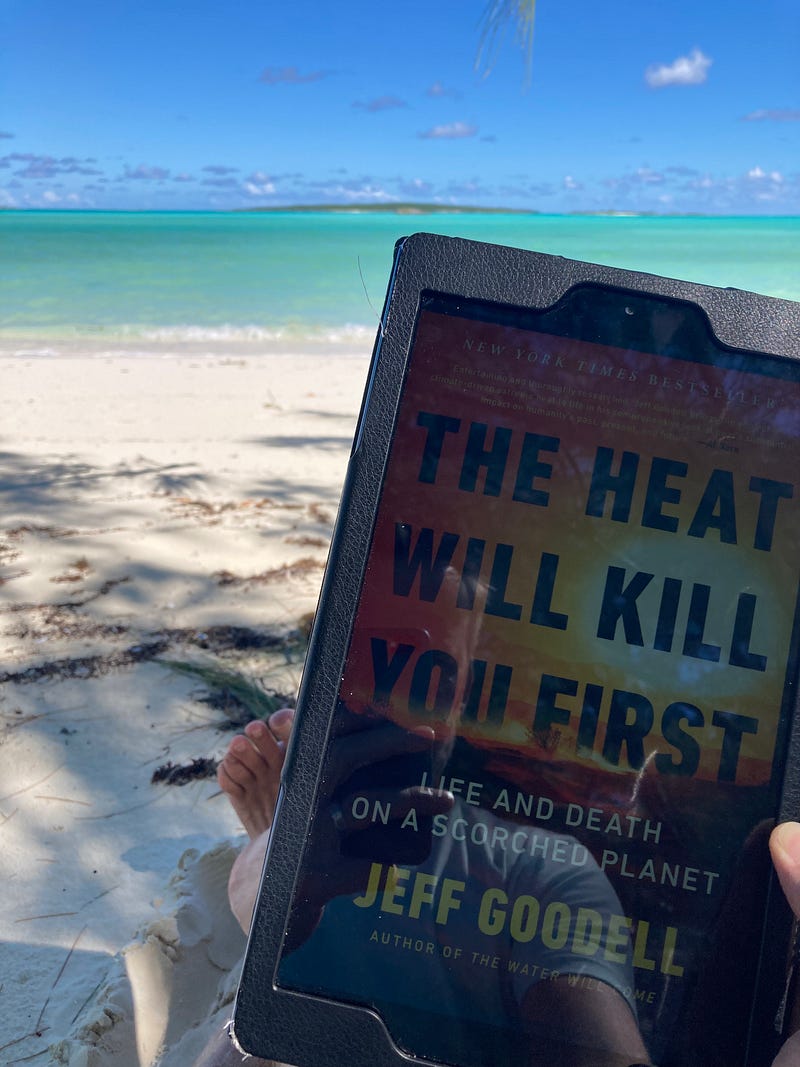
While on the trip, I was in touch with several friends. All of them know me to be strongly environmentally minded. As mentioned so far in this article (twice, I think): I have solar panels. Our next car is going to be an EV. I’ve read “The Uninhabitable Earth” and “The Heat Will Kill You First” and a dozen more books on climate change and have written copious articles. I’ve talked with experts and wracked my brain over mitigation strategies.
And yes, I’ve condemned others for their actions (or inactions) exacerbating climate change. However, when turning my judgment on others, I’ve not needed an accurate climate tracker, but have gone by *feel* — or at least by my A — F logic mentioned above. So when my high school buddy went on a cruise, I gave him grief for it. When friends flew somewhere for fun, or put on a big party, or just did some wasteful, environmentally unfriendly thing, I judged.
Now, I feel like a big fat hypocrite for flying to the Bahamas. And I shared this with my friends, some while texting, one in an email.
Perhaps it was their way of trying to comfort me — every friend basically told me not to worry about it. Every single one. But what was really interesting was how each one had his or her own way of making this kind of thing okay.
“I’ve been watching ‘Life on this Planet,’” one friend told me. The Earth has been here for four billion years, so “None of this really matters,” he said. “Earth will somehow bounce back from the effects of human civilization.”
I agreed with him that if you zoom out far enough, nothing matters. In four billion more years, we’ll be hotter than Venus and all life on Earth will be extinct.
But I’m not concerned with four billion years from now, I’m concerned with forty years from now, I said. And of course things matter. Murder, slavery, rape; we don’t just do whatever we want because of deep geologic time. Condemning people to unnecessary suffering in the near future so that we can, as my friend wrote, “enjoy hurtling through the sky in a metal tube to swim in the ocean for a few days,” is wrong. (He meant that we live in an amazing time, and I love and appreciate this friend, but the answer didn’t satisfy me one bit. )
Another friend said, “That plane is going down there once a week whether you’re on it or not.” (Actually it’s every day.)
In other words, the jet fuel would be spent and the C02 emitted with or without you.
But would it? Isn’t it because we all think this way — that’s what makes it so?We’re herd animals, that’s the thing. We’re tribal. We do what we see others do and react to our environments. Cleaning up graffiti and broken windows has been said to help reduce crime. People still pick up trash on the side of the road or on the beach even if more will turn up. We help someone across the street because it feels good, or we believe in karma, or heaven. Or, just to do it.
If we know flying is bad for the planet, for the people and living things on the planet, then we shouldn’t. There’s no other way to go here than just don’t do it.
If, instead, everyone is just rationalizing and justifying — including me — then are we truly and well screwed and never going to mitigate or minimize anything?
Another friend, who was being very genuine, wrote, “You guys have earned that (trip).” Then he send a follow-up gif of Aziz Ansari and Retta saying “Treat Yo Self.”
It was as though everyone thought I wanted absolution. But I didn’t. I wanted my feet held to the fire. That’s why I kept texting around. Who was going to give me the grief I deserved?
If anything, I wanted an expression of how we are all living with this now. How others, too, wrestled with this moral dilemma when they traveled, or did something for fun.
“I still admit to being demoralized by the realization,” one friend said, “as a cyclist, that months or even years of emissions saved by me cycling to the store or to meet a friend for dinner is wiped out by one afternoon of large-displacement gas-burning cars driving in circles for several hours.”
Okay, I get that— but what if you hadn’t done any of that cycling? Then it would be NASCAR plus your year of riding around in a car.
Climate efforts are not zero sum; our efforts are not “wiped out” by some other climate change causing event.
Maybe the problem just is, again, people need a way to calculate. Technology and science that is undisputed, or at least solidly peer-reviewed and endorsed. Because I’ve noticed what else can happen beyond the rationalizing and justifying: the subject quickly balloons into some big philosophical conversation dealing in abstractions like faith, values — everything.
Over dinner on our last night, I shared some of the feelings with my wife. She knew I was going through it, so she was prepared. “It’s okay to be imperfect,” she said. Her take was: even if this is a selfish trip in some ways, that’s okay. We can transgress every once in a while.
Her concern, because she a loving, caring person, was about my internal state. Was I being hard on myself because I wasn’t living up to some ideal? If so, she wanted to gently disabuse me of that.
Raised fundamentalist, she’d a period in her life where she was convinced that lacking in some virtue would result in her not being “saved.” Having since left all of that behind, she is now pointedly okay not following some strict curriculum in order to feel good about herself, or loved, or right with God, and I think this is very healthy.
But while we continued our dinner, it occurred to me that here we were talking about climate change and human impact on the Earth in such grandiose ways — and simultaneously such personal ways — and this is what happens, I thought, because we don’t yet have a way to really calculate our individual impact. We don’t have the science or tech yet to really know.
Look, I don’t want to just “feel better.” That’s not what I’m seeking; some kind of narcotic to wash away the guilt. I believe I am capable of having two seemingly contradictory experiences: I can know that I’ve contributed to the problem by flying to Exuma, by eating in the fancy restaurants, by staying in the air-conditioned cabin on the beach, and at the same time know I’ve had a wonderful time with my wife, great adventures, conversation, togetherness.
Of course, climate deniers, skeptics, and cynics love to point out these kinds of paradoxes often as “proof” that climate change is a hoax, or overblown: Al Gore flying around in his private jet while preaching emissions frugality. Leonardo DiCaprio partying with supermodels in some exotic county between his climate change movies. The Obamas buying a house on Martha’s Vineyard when sea level rise is supposed to be a concern.
In order to say anything or do anything about climate change, you have to be some sort of model of purity.
We have to get rid of this. We have to replace relying on our personal subjective metrics, because it leads to nowhere. It leads to Exuma.

The same friend who told me the plane was going down there anyway texted, “If you can convince someone to vote Democrat where they may otherwise vote Republican, now you’re making a change which I think is more significant than riding a plane.”
No doubt, policy is huge. New science is emerging in extreme event attribution — pinning specific disasters on climate change — and this has major implications for the courts. Someday soon, perhaps, we could also have policy based on the science of individual impact.
In the meantime, it struck me that this sentiment — voting is more important than any other behavior — was exactly what the sociocultural right hates about liberals. That they complain about housing shortage but won’t let Section 8 into their neighborhood. That they talk about climate change but then fly to Exuma without a whiff of personal responsibility.
I don’t want to be that. I want to be the example. At the same time, life happens. Shit happens. Was I going to just tell my wife “No?” Was I going to say, “I know travel used to be a big part of your life, but because flying on a plane will have some impact I can’t calculate — that I can’t measure against all of our positive contributions —I am just going to refuse going?”
You know how we funded this trip? The bonus my wife got for working through Covid. For going in every day, even during the scariest weeks and months, coming home and showering in the basement half bathroom before hugging her kids — that’s how.
But before you or anyone else says we earned it, the fact is we’re white, American, and we have more than pretty much everybody else, even if we’re considered frugal and conscientious among our cohort. We hit the zip code lotto; we should be the ones cinching our belts and being austere.
Instead, we flew to a place that was expensive for the locals, who don’t even get to go swimming or enjoy the paradise they live in because the cost of living is so high. I know this because they told me.
We did it because we could. We did it despite the costs — costs we can’t calculate, no, but costs we know, in our hearts, exist.
TJ


