
The Other Virginity in Lord of the Rings
When we lose our virginities, we go from always having been one kind of person to indelibly being the other. This ritual is associated with blood, which symbolizes the Scorpionic connection between life and death.
When we kill someone, we similarly go from having been one kind of person to irreversibly being another. We are no longer the same. Our relationship with death is no longer passive. We are now able to give and not only receive death.
These are the two human capacities that most directly mirror that of the divine: the ability to give life, and the ability to take it.
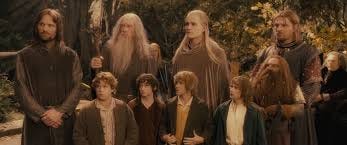
The nine journeyers of Lord of the Rings all kill during the quest, all, except Frodo. Frodo is the virgin of murder. In this sense, he maintains his purity even during a massive war that centered on his journey.
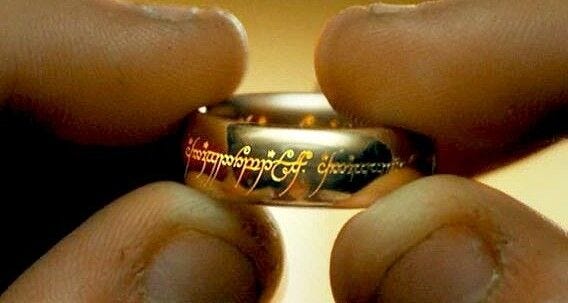
The Ring Frodo carries contains all the ambition, evil, power, greed, cruelty and malice in Sauron. The Ring represents how any soul can be corrupted in the direction of the Devil. It tempted everyone after bearing it for but a short time whereas Frodo carried the Ring for six months. The apparent exception to this is Sam, who carries the Ring for two days (in the book, not the film) without being corrupted, but even he hesitates (in both book and film) to return the Ring. He also kills Orcs on his way to rescuing Frodo, so that once he loses his murder-virginity, he can no longer be the ring-bearer.
The Ring is an archetype of power that manifests as evil. Individuals like Boromir and Galadriel can envision themselves empowered through the usage of the Ring, while the Ring works to become active by corrupting the heart of its bearer. This is akin to Jung’s statement that consciousness needs egos to become self-aware just as egos need consciousness for the same reason.
I believe Frodo’s unique virginity in this quest is what renders him different from others and insulates him from most of the effects of the Ring. He first inherits the Ring when he is 33: the Christ age. One could read Lord of the Rings as an allegory of the temptation of Christ within the heart of each human. This reminds me of Dostoevsky’s saying:
The line between good and evil runs through the heart of every man.
Frodo is a kind of Christ symbol who is marked as a virgin: the sacred vessel who carries with him the heralding of a new age. (I have written about Gandalf as the true Christ figure of the fellowship.) As Mary the archetypal virgin was a vessel for the living Christ, Frodo was a vessel for the nonliving antichrist: the Ring. I would delineate the feminine virginity as having to do with life (procreation) and the masculine virginity as having to do with death (murder).
Though virginity was likely hallowed in part because it ensured a husband would not be marrying a pregnant bride, it came to symbolize one who could give a sacred love to God because they (realistically, she) had not given a profane love to a human.
This is the innocence marked in Eden when the fruit of the Tree of Knowledge (עֵץ הַדַּעַת), when untasted, allows the human a oneness with the divine. There are two verbs for to know in Hebrew: lakir means knowing a friend as opposed to a stranger whereas ladat means knowing a person sexually. The Tree of Knowledge is the latter kind — the literal Biblical knowing of someone. To know anyone is to cease being a virgin.
The fruit of that knowing is the burgeoning consciousness that used to be the domain of God alone: knowing what it is to make life and take life. By becoming like God, we could no longer be one with Him. Sauron himself was the Tree of Knowledge — the Devil’s tree, that must grow down in Hell the way God’s does up in Heaven. The Ring is the fruit of that tree: by becoming like the Devil, we are brought to Him. As God and Devil are complementary symbols, they carry opposing dynamics with their followers. Jung wrote:
No tree can grow to heaven unless its roots reach down to hell.
Frodo did not know death. He could not be made like the Devil because he was the Hobbit who was still in the Garden. Perhaps this was Tolkien’s thought, conscious or not, when making Sam Frodo’s gardener. As Voltaire said, ‘We must all tend our garden.’
To follow me: https://medium.com/@myartman
To subscribe: https://medium.com/@myartman/membership


