
Gandalf’s Arc in Lord of the Rings
Gandalf fights a demon (Balrog), dies and resurrects, subsequently transcends his prior form (from Grey to White), performs an exorcism of an evil spirit (Saruman) and speaks of ancient prophecies while fulfilling his own. Gandalf is the Christ figure of Lord of the Rings.
Gandalf begins the quest as a Grey, a designation of magical consciousness beneath that of the White, which Saruman embodies. When the two wizards battle, Saruman overpowers Gandalf and takes him captive, demonstrating the superiority of the White. At the start of the hero’s journey, evil is often stronger. This is in fact what necessitates a hero’s journey.
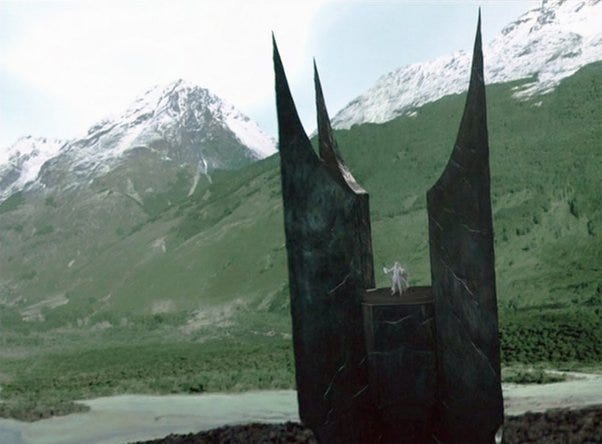
After Gandalf escapes, he leads the Fellowship of the Ring over the snow-capped Mount Moriah. Saruman then causes an avalanche from afar using magic that sends the Fellowship under the mountain to confront the demon awaiting them there, a Balrog. Saruman in fact renders this avalanche spell from the top of Isengard — the very place he imprisoned Gandalf. This symbolizes Saruman’s continuing attempt to imprison not just the body of Gandalf, but his consciousness. This begins Gandalf’s chthonic journey.
It is appropriate that the hero attempts to go over whereas the villain puts him under; the villain is forever attempting to make the hero less conscious, reminding us that the hero’s quest is itself to become more conscious. We gain consciousness by turning to where consciousness is hidden: the shadow, the depths, the demons. It is ‘evil’ that forces the hero to confront his shadow. And so ‘evil’ plays its part in the evolution of ‘good’. Perhaps ‘evil’ is what awakens to power and ‘good’ is what awakens to integrate it.
One does not become enlightened by imagining figures of light, but by making the darkness conscious. — Jung
The Balrog Gandalf confronts was a spirit born before the creation of the world, once light, who later became corrupted by the Devil. In other words: a fallen angel. After losing the War of Wrath, this Balrog hibernated for millennia under Moriah. The archetype of evil returned to the collective unconscious, having been deactivated. But nothing psychic is destroyed; it merely waits.
The dwarves who reigned in Moriah dug ‘too greedily and too deep,’ as they mined for gems, according to Saruman. Their greed for wealth parallels Saruman’s greed for power. There they awakened ‘shadow and flame.’ It is the egoic drives that reactivate the archetype of evil. For the dwarves, wealth meant power. For the psyche, power meant evil.
What seeks power in the psyche awakens to confront what seeks consciousness. This is the allegorical conflict of Saruman, who sought power above all else, and Gandalf, who sought consciousness. This battle of wizards represents the battle within the soul for what we do with our magic.
When the Fellowship is pursued by the Balrog, Gandalf turns to face him as a gatekeeper and famously bellows, ‘You shall not pass!’ on a bridge. This bridge separates the mines as a prison and the freedom awaiting the Fellowship on the other side. As such, it is a frontier of consciousness in which freedom requires letting go of one’s drive to power.
(This is all the more keenly seen in the Fellowship’s raison d’etre being the destruction of the One Ring they carry. Hence the darkness attempts to become more powerful by destroying consciousness whereas the light becomes more consciousness by letting power go. We see an impotent version of this demon fall into a flaming abyss when Gollum falls with the Ring at the myth’s climax.)
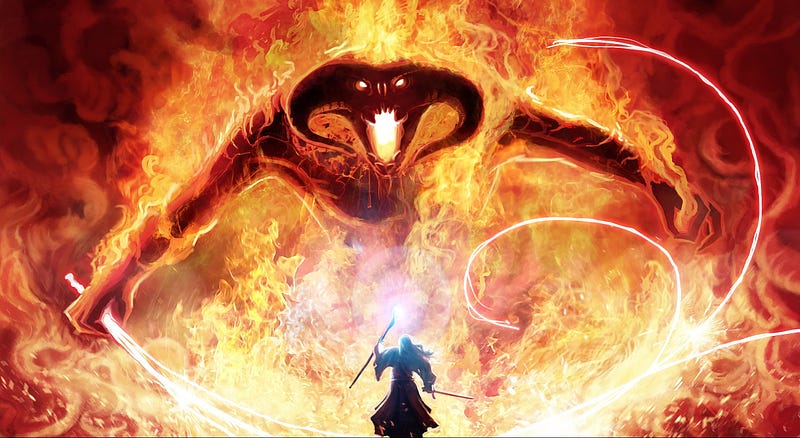
Gandalf destroys the bridge, causing Balrog to fall. Yet Balrog pulls Gandalf in as well, as if to say, Neither shall you. Into the abyss they fall, paradoxically, only to land on top of the mountain, as if the space itself unites opposites. Gandalf later tells him companions, ‘On the lowest dungeon of the highest peak’ he fought his enemy. The high and the low; flame and ice; sacred and profane; good and evil. Jung noted that in the mysterium coniunctionis (mystery of the conjunction) stage of alchemy, the wholeness of the psyche is revealed and realized. This marks Gandalf’s individuation process.
On top of the mountain, we once again see the striking image of what appears to be the roof of Isengard. Gandalf is fighting from where he had been imprisoned — when power was greater than consciousness. The films (not the books) depict Saruman dying from this same spot. The peak of Isengard appears to mean the peak of magic. So long as power reigns over consciousness, this is Saruman’s domain. Once consciousness reigns supreme over power, Saruman’s fall becomes literal: a fallen angel in disgrace: just like the Balrog.
Gandalf finally slays his demon, only to die himself. This is akin to Jesus’s crucifixion. When he resurrects, Gandalf is now the White. He is mistaken for Saruman only to augment the archetypal rather the personal identity:
I am Saruman. Or rather, Saruman as he should have been.
He then confirms that he fell through fire (alchemical purification) and water (baptismal rebirth). Gandalf’s rebirth parallels that of Christ. “But God raised him up, having freed him from death, because it was impossible for him to be held in its power,” (Acts 2:24). Now that he is a fully Realized being, Gandalf can do for the world what he has done within his own soul: dethrone shadow and the drive for power. As within, so without.
Jung believed the divine needed humans so as to become conscious in form. That without a form, the experience of perceptions could not take place. The divine is on the side of consciousness because it is consciousness. But the divine is on no ‘side’ because it is all things and all possible facets of those things.
(This takes place in Tolkien’s universe wherein Morgoth (the Devil) tells Eru (God) that he wants to destroy all Eru’s creation. Eru reminds Morgoth that he is Morgoth. Eru is all creation, including that which strives to destroy creation. God includes what opposes God, for God has no opposite.)
Similarly, magic needs wizards to become conscious in form. Just as Gandalf became the White as an archetypal identity, the White became Gandalf as an individual identity.
The White had of course first become Saruman, but this delimited the capacity of the White as Saruman sought power first, consciousness second. He lived magic as a means to an end, not serving the higher consciousness which manifested that magic. Consciousness went as far as it could in the form of Saruman and then molted into the form of Gandalf. The battle between Gandalf and Balrog allegorizes the alchemical joining of opposites within the soul of magic itself.
We see this when Gandalf exorcizes Saruman from Theoden’s body. Knocking the spirit of Saruman out of the king’s consciousness indicates a symbolic end to Saruman’s reign.
In order for the White to become Gandalf, Gandalf had to transcend his previous form. This involves a literal going through Hell. As Gandalf and the Balrog fall into the abyss, it gets hotter and more enflamed, complete with a fiery demon. This further alludes to the Harrowing of Hell in which Jesus goes to Hell between the Crucifixion and Resurrection.
Hence the White guided Gandalf to confront his shadow. Balrog was once a servant of the light, like Saruman, and appears to be Saruman in a more recognizably egoic form. On the outside, Gandalf and Saruman appear similarly: archetypal wizards with the long beard whose color (white or grey) indicate their corollary consciousness. Yet Saruman as an ally of the demons and a breeder of Orcs is more of a demon with wizardly knowledge.
Christ’s Harrowing lasts three days and nights, as does Jonah’s journey in his whale. Gandalf symbolically spends his three days with his demon: in the mines of Moriah; falling through the abyss; on Mount Moriah. Gandalf’s fourth and final forum in his chthonic journey is the afterlife from which he is ‘sent back until [his] task is done.’ Here you have the three and the one: the Jungian alchemical proposition that a fourth of differing essence shall complete the original trinity to form a transcendent quaternity.
Gandalf’s task as the messiah of wizards is to enact the divine will: to reunite human and divine consciousness. In Genesis, God states that he will have an angel with a flaming sword, just like Balrog, guard the entrance to the Garden of Eden to prevent humans from accessing the Tree of Life and so, living forever. That angel is a gatekeeper, which finds his symmetry in Gandalf’s being a gatekeeper: ‘You shall not pass.’
The demon ensures that humans remain mortal — remain separate from the divine. Gandalf gets past this demon to overcome his own mortality. Gandalf returns to divine consciousness not by avoiding death, but passing through it.
Finally, what is the meaning of this place, Moriah? In Genesis, Abraham is told to sacrifice Isaac for God only to be told at the last moment that he need not. A less conscious being, a ram, is sacrificed instead. Saruman attempted to sacrifice his ‘son’ Gandalf for the ultimate power. Instead, a less conscious entity, Balrog, was sacrificed in his place.
Moriah is the place where the unthinkable nearly happens and is revealed, instead, as a place wherein the human and the divine form a covenant. And this is what the Fellowship meant: a covenant to stop the ascent of the Antichrist. Gandalf, as its leader, had to align the Fellowship with the divine by aligning himself with his own inner divinity.
Also read The Other Virginity in Lord of the Rings, Star Wars as Christian Allegory and Moana I: Converting Gods and Devils.
To follow me: https://medium.com/@myartman
To subscribe: https://medium.com/@myartman/membership


