
The Original Valentine’s Day Was Soaked in Blood and Violence
Exploring the roots of Valentine’s Day.
What is your plan for Valentine’s Day?
A great Valentine’s Day includes chocolates, flowers, elegant restaurants, or a stroll around the park. It is ironic, though, that we may trace the origins of this sweet day to violence and gore.
Valentine’s Day as a romantic holiday did not gain popularity until the 14th century. The Lutheran and Anglican churches choose to observe this day in honor of St. Valentine, whilst the Orthodox Church recognizes July 6th as the day of love.
Who exactly was St. Valentine?
There have been several saints identified as St. Valentine throughout history. They have their own legends and beliefs. The most well-known was a bishop, named Valentinus or Valentine, who lived during the reign of Roman Emperor Claudius II (268 to 270 AD).
Valentine was also the patron saint of epileptics and beekeepers. He disobeyed the Emperor’s commands to marry couples, according to folklore. Let us learn about the legendary bishop on whose memory we celebrate Valentine’s Day.
Before we get into the story of St. Valentine, it’s important to talk about the Roman festival of Lupercalia, which took place on February 15th every year.
Historians think that Valentine’s day may have merged with the festival of Lupercalia.
Lupercalia: The original Valentine’s Day?
Before Valentine’s Day, in Rome, there was a popular festival called Lupercalia that was all about good health and fertility.
We derive the term Lupercalia from the Roman god Lupercus, who was the god of farmers.
According to legend, Lupercus helped the she-wolf who nursed the babies, Romulus and Remus.
Romulus is Rome’s mythological founder.
In Rome, people devoted the Lupercalia festival to pregnant women. The Roman priests sacrificed animals, and they planned a feast to commemorate Lupercus. Citizens prayed for the safe delivery of expectant women.
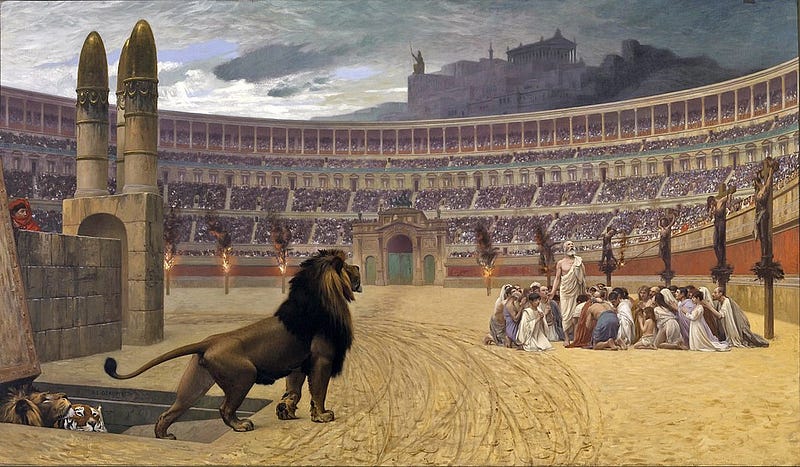
The rituals of Lupercalia might shock us today. Holy men raced through the streets naked, smacking ladies with bloody hides of the sacrificed animals.
According to the Roman historian Plutarch:
..many of the noble youths and of the magistrates run up and down through the city naked, for sport and laughter striking those they meet with shaggy thongs. And many women of rank also purposely get in their way, and like children at school present their hands to be struck, believing that the pregnant will thus be helped in delivery, and the barren to pregnancy
Not very romantic, I suppose!
You may wonder, Lupercalia sounds nothing like Valentine’s Day. So, why are we discussing this?
The feast and the date, February 15th, are the key aspects of the event. Later, Christian traditions of Valentine’s Day blended both, and Lupercalia was gradually abandoned.
Lupercalia continued to be popular among Romans who converted to Christianity. They still celebrated it in Rome despite the ban on several non-Christian festivities. There was never a ban on Lupercalia, even though the Pope didn’t want people to take part in fertility rituals.
This makes us question how Valentine’s Day became popular in Rome and why do people cherish it?
The legend of St Valentine’s martyrdom

There are several individuals who were identified as St. Valentine. Two of the most popular ones lived in Rome, around 270 A.D.
One legend suggests that Emperor Claudius II, also known as Claudius Gothicus, had restricted evangelism of Christianity.
Valentine, being a preacher, was jailed. The jailor promised to let the priest free if he cured his daughter of blindness. Saint Valentine cures the jailor’s daughter and handed her a letter written: “from your Valentine.”
If this legend is true, then the original Valentine message was non-romantic!
The impressed jailor freed Valentine. The release of the prisoner angered the Emperor, who then ordered the beheading of Valentine, thus making him a martyr.
We associate another tradition of Valentine with the Bishop of Terni, a town in Central Italy. In this version of events a judge, Asterius, approached the bishop Valentinus to cure his adopted daughter’s blindness.
The bishop heals his daughter and forty-four members of Asterius’ family embrace Christianity. As Valentinus continued to evangelize, Roman authorities caught him and sent him to the emperor Claudius.
Claudius admired the bishop. Unfortunately, Valentinus tried to convince him to convert to Christianity, which Claudius refused and ordered the priest’s execution.
Claudius gave Valentinus an option to renounce his faith, which he refused. He was clubbed to death and beheaded outside the Flaminia Gate, in Rome, on 14th February 269.
Another version of the legend suggests that Claudius had forbidden military men to marry. Saint Valentine was marrying couples against the emperor’s orders. Marriage would spare them from going to war. When the emperor found out about the activities of Valentine, he had him beheaded.
Many historians suspect there are different legends of the same person. The bishop of Terni was the same man who healed the jailor’s daughter of blindness and was marrying couples in secret.
We accept that February 14th is the date of the martyrdom of Saint Valentine. But the year of St. Valentine’s death is questionable.
Depending on the source, it could be 269, 270, or 273 AD.
How did Valentine’s Day become popular?
In 496 AD, the first formal Valentine’s Day celebration took place in Rome. Pope Gelasius I instituted a feast to commemorate Saint Valentine’s martyrdom.
The celebration of the day happened at the same time as the popular Roman festival Lupercalia.
Perhaps the goal was to get more people who were followers of the Roman religion to join Christianity.
“Valentines” are formal messages that are named after the letter that Saint Valentine wrote to his jailor’s daughter. They first appeared in the 1500s, in honor of the letter he wrote.
By the 1700s, printed cards had become fashionable for sending Valentine’s Day greetings.
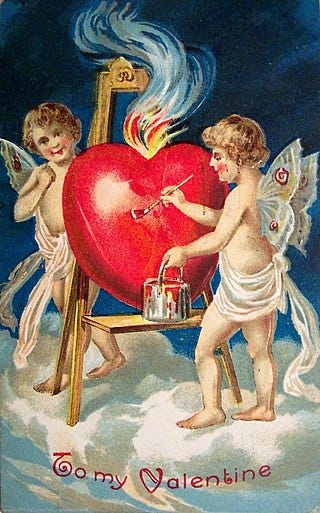
Cupid, the Roman deity of love, was frequently depicted in the cards. The prominent role of Cupid in Valentine’s Day shows Christians used many pagan elements in their celebration of the festival.
By the 1800s, candy, flowers, and red roses had become the go-to Valentine’s Day presents.
The blood-soaked history of Valentine’s Day had faded by then.
The martyrdom of St. Valentine’s has become a footnote in today’s celebrations of Valentine’s Day. But it is important to remember some of our modern customs have gory origins.
Do you enjoy learning interesting facts about popular holidays?
Then you will like the story of why Christmas was banned in England during the 17th century.
Enjoy this? Please consider supporting my work by subscribing to Medium using my referral link.
References.
- Oruch, Jack B. “St. Valentine, Chaucer, and Spring in February”, Speculum 56 (July 1981)
- Saint Valentine: Biography. Diocese of Terni. 2009.
- Valentine’s Day, Encylopedia Britannica.
- Kelly, Henry Ansgar (1986). Chaucer and the cult of Saint Valentine.


