
The One Trait That Makes Women More Authoritative
Research shows RBG knew the secret — “Better bitch than mouse”

If you want to know if misogyny is alive and well, just read the comments section of any viral feminist piece. If only I got a few more ducats for every time I was called the A word — “aggressive.”
At least they didn’t call me a bitch. I think.
It certainly wouldn’t be the last time a woman was called a bitch. Unbeknownst to her, Ruth Bader Ginsburg’s nickname amongst her law school classmates was “the bitch.” After Ginsburg was nominated for the Supreme Court in 1993, a classmate confessed the moniker to Ginsburg.
Her response — "Better bitch than mouse.”
And then there was Rep. Alexandria Ocasio-Cortez, called a “fucking bitch” by Rep. Ted Yoho. Aggressive would have been a tad kinder. But not by much.
“Bitch” has long been the preferred insult to put assertive women in their place. The word bitch surged in popularity in 1920 — after women got the right to vote. Coincidence? Perhaps. But from the time Delilah cut Samson’s hair, men have been losing their strength around those bold, brassy broads.
In medieval times, no one had to worry about outspoken women. Garrulous women were locked into the scold’s bridle. The iron muzzle enclosed the face with a bit pressed against the tongue to deter any of that annoying jibber jabber.
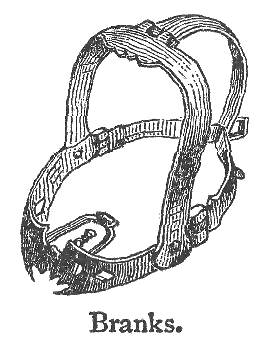

The women who dabbled in medicine were the most threatening of all, mostly because they dared to cross into the realm of men.
In the sixteenth century, those bitchy midwives/witches were hunted down and killed with help from the women-hating manual of its day — Malleus Maleficarum. The book declared, “No one does more harm to the Catholic Faith than midwives.” And then there was some malarky about midwives killing babies to sacrifice to the devil…blah, blah, blah, and a few more juicy bits about how they made men’s penises fall off. It’s a titillating read.
Flash forward to the nineteenth century, assertive women were given a different label — “hysterical.” They had to be out of their minds to say what was on their minds.
With such a long history of persecuting these outspoken shrews, it’s no wonder that many women have learned to stay silent and appease the masses. But that acquiescence has come at a price.
And the latest research shows just how steep a price we pay.
Rate my professor “bossy” if she is a woman
It’s a common belief that women are viewed as less authoritative in the workplace than men. As of 2019, only 22% of CEOs are women. And the tale gets grimmer for women of color — they make up only 4% of C-level executive positions.
But probably the most eye-opening glimpse into how women in the workplace are viewed is the 2012 study on the site RateMyProfessor.com. Researchers compiled fourteen million anonymous comments and found that students were three times more likely to use the words “brilliant” and “genius” to rate white male professors. Even more interesting, words such as “bossy,” “strict,” and “demanding” were more likely to be used when evaluating female professors.
This study is significant for two reasons. First, fourteen million is a drool-worthy data pool for any researcher. Second, the evaluations are anonymous, so it lacks the usual pitfalls of self-reporting bias.
Now, I hardly need to point out the obvious. Fourteen million students were more likely to call their female professors “bossy,” yet women are less likely to be bosses in the workplace. If only reality followed perceptions.
Naturally, you might conclude gender alone prevents women from being viewed as credible as men. Or even worse, assume that women need to be self-effacing and demur to play with the boys. But a recent study offers some hope on how women can appear more credible.
Why women need to be more assertive (despite the bossy label)
In this study, researchers asked roughly 1000 men and women to compete in an online game. The participants were then paired with a coach who taught the subjects game tactics. There were only two variables with these coaches — their gender and how confidently they gave their advice.
For example, less assertive advice was prompted by, “You probably have better problem-solving skills than I do, but here is what I am thinking….”
More assertive advice was prompted by, “If you listen to my advice, I can assure you that my skills and experiences will help you perform well in this game.”
Basically, some coaches bragged about how awesome their advice was, while others let the participant decide if their advice had value.
They then asked the subjects to rate the coaches’ credibility. The results were surprising.
The researchers found that gender did not influence how the coach’s advice was perceived. It was the way they communicated their advice that influenced their credibility. The coaches who used confident language (bragging) were seen as authority figures, while the meek coaches didn’t inherit the earth.
This presents the classic chicken vs. egg conundrum. In today’s culture, young women are taught never to proclaim authority on a subject unless, well,…they are an authority on a subject. Women speak softer and are interrupted more than men.
(So brace yourself…I am about to try out my newfound braggadocio…)
I have the most amazing and utterly profound conclusion. And due to my accolades and brilliance, I won't steer you wrong — we don’t have a gender gap. We have a confidence gap.
How a girl’s environment shapes her into a woman
Unfortunately, here’s where women get trapped in culture’s snare. Parents think they are gender-neutral, but girls are often conditioned to be less brazen than boys.
In one gender bias study, babies were tasked with climbing up and down an incline. Their parents could control the steepness of the slope. With the sons, parents cranked up that slope like their boy wonder was King Kong climbing the Empire State Building. With those precious daughters, they lowered it… a lot. (Sidenote: the self-assured baby girls actually climbed slightly better than the boys with the same slope. Just saying…)
If parents highlighted fewer gender differences, there would be less gender inequality. In other words, many of today’s gender biases are caused by environmental conditioning that alters neuroplasticity.
The research on neuroplasticity has shown how you use your brain matters. Never give a girl legos, and her spatial intelligence will develop slower than your typical lego loving boy. Never give a boy dolls, and he will struggle with interpreting nonverbal cues.
Tell a girl to act like a lady and not be outspoken, and she will be silenced.
I wrote about Katharine Hepburn in one of my books because I have always felt she was a strong role model for girls. But my favorite story about my movie idol concerns not Katharine but her mother.
Little Kathy was a tomboy as a child and spent her days with dirtied knees, playing with boys, and climbing trees. When she was eight, she cut off her hair, stole her brother’s clothes, and asked her family to call her “Jimmy.”
One day, a neighbor called Mrs. Hepburn to inform her that “Jimmy” had climbed a rather tall oak tree. Her mother replied, “Yes, I know. Don’t scare her. She doesn’t know that it is dangerous.”
This apocryphal tale is the secret to raising strong, resilient girls — never tell them to fear their boldness. There will be people who call these women aggressive. (Both men AND women.) Some will even call her a bitch. But there will be others who adore her fearless, take no prisoners, tree-climbing, ballsiness.
Let’s raise girls who never fear that climb to the top.
*If you listen to my advice, I can assure you that my skills and experiences will help you perform well in this game called life. (Just trying it out…)