
The One Book That Changed My Thinking About Money.
The real book of FAKE makes us think critically about money.

If we are ready to learn, the right books will start appearing. It is funny how the invisible hand of Humankind works. The same bookstore at different times presents a different bookshelf, it seems.
I have been a student of money and have been obsessed with Personal Finance. The depth of this topic astonishes me. It is one topic we can never learn enough because of its complexity.
And I have always wanted to learn more about money in school. The closest was Mathematical problems sums using the dollar-sign as a unit of measure.
That said, Mathematics is not about money. I have never applied techniques of differentiation on my investments.
My attention got diverted away from the classroom to the bookstore. I was in desperate need to understand what Money really is.
No one around me could explain it better than I did. I knew I needed external help. Bookstores were my go-to.
I have never found a book that answered my questions, even after 10 years and change. And then, as destiny have it, one book caught my attention as I walked past one afternoon.
It was whispering loudly to me as if it was saying Psst Psst. You have been waiting for me. Pick me up!
I turned my head and saw a bookshelf stacked with Robert Kiyosaki’s books, including a new release, Fake.
I read his famous book, Rich Dad Poor Dad. But, Fake?
It piqued my interest. I picked it up and started reading. 5 minutes later, I completed my book purchase. Here’s why.
Fake Explains The Big Picture Of Money.
In this book of Fake, Robert Kiyosaki goes in-depth into the Big 3 Fakes of our modern-day society. They are Fake Money, Fake Teachers, and Fake Assets.
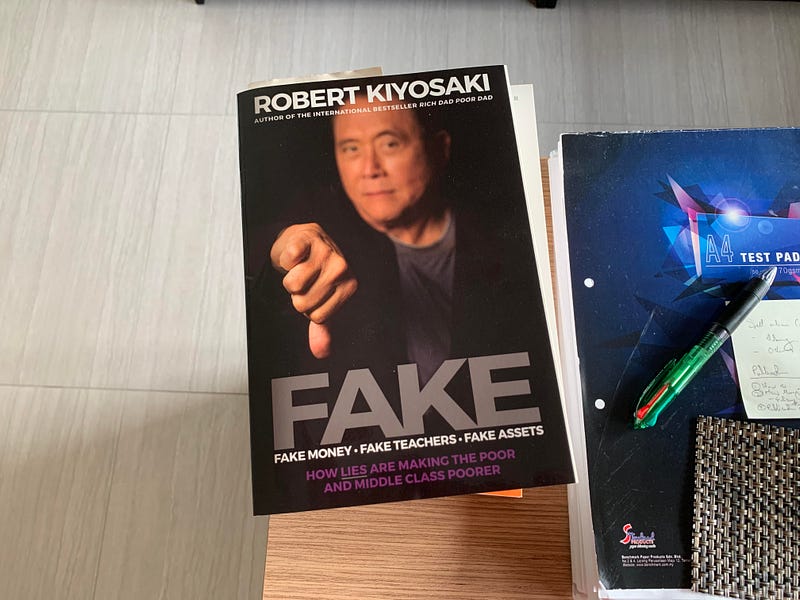
He explains in his usual bohemian manner that the Big 3 Fakes belong to 1 system, and they are 1 and the same. That is a big claim.
I have to acknowledge that he is a good marketer. This book is a testament. Now, back to Fake Money.
1971 is the year he repeatedly referenced in the book. That was the year The President of the United States, Richard Nixon (known infamously as Tricky Dick), took the U.S. Dollar (USD) off the gold standard.
It was the beginning of the corruption of real money. Before 1971, currencies are claim checks for money. We could use it to exchange for gold and silver in the bank vaults.
That relationship ended in 1971.
From that moment onwards, the U.S. Dollar went from an indirect anchor for all other currencies backed by gold to a free float exchange rate system.
The USD became a currency backed by debt and is backed by the economy of the United States. A claim check on real money turned into a pure currency.
Astronomical Economic Growth Followed. Wealth Gap Got Wider.
Robert Kiyosaki went on a personal mission to study the fundamental changes in our money and currency. His Rich Dad (His best friend’s father, not his biological father) repeatedly told him that the World has changed.
Robert did not understand it. Actually, many people who grew up during the 1970s did not. One famous example — Ray Dalio.
Ray Dalio, the founder of Bridgewater Associates, frequently recalls 1971 as a year of deep learning. He expected the Stock Markets to collapse after President Nixon’s announcement.
What he witnessed the next day shocked him. The Stock Market roared to unprecedented highs, and the price of gold went from USD 35.00 an ounce (fixed via the Bretton Woods Agreement in 1944) to an open market price of USD 43.00 an ounce.
1971 shocked many people.
In a recent interview with London Real, Robert Kiyosaki went on tape saying that the current Wealth Gap did not originate from this decade. It started in 1971 when money became currency.
His Deep Mistrust Of The System Brought Him Back To A Personal Gold Standard.
Robert didn’t believe in the dollar bills that printed In God We Trust. He puts his faith behind real, hard money. In Fake, he calls them God’s money.
There are 2 variations of God’s money, in his opinion. gold and silver. He saves in gold and silver coins. He believes that they have been around before we are born, is around when we are alive, and will still be here when we are gone.
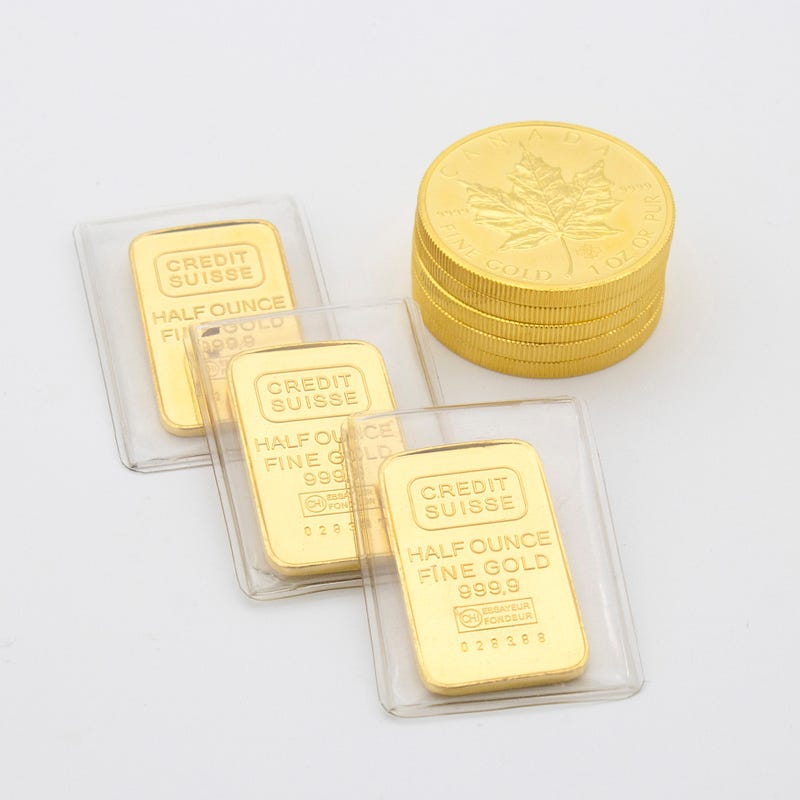
The 2 precious metals will continue to remain real money until Humankind becomes extinct. He compares the longevity of gold and silver to cockroaches in his usual sense of wicked humor.
He briefly mentioned that he is excited about the development of Bitcoin as well.
He Extended His Thinking From Fake Money To Fake Teachers and Fake Assets.
Robert has a systematic viewpoint on currencies, teachers, and assets. To him, they are the same.
When the World of Money changed in 1971, teachers in schools did not change. He believes that they protracted the divide between the Haves and the Have-Nots by teaching children to work for and save fake money (currencies).
This is a belief that works if we are saving in real money of gold and silver. Not currencies. To him, many teachers do not understand the difference.
Robert believes that school teachers are not taught the 3 different types of income governed by Tax Laws. That is why students around the World remain ignorant of the best form of income.
Steven Brill and Robert Kiyosaki Think Alike.
In Part 3 of Fake, he quoted a Times Magazine article written by Steven Brill, How My Generation Broke America. In Robert’s opinion, his financial education was complete.
He knows that the game of money is rigged against you and me through Fake assets known as Mortgage Back Securities, Collateral Debt Obligations, and Credit Default Swaps.
These fake assets (in his opinion) are designed to separate those shouldering the responsibility from those obtaining the sugar high gains.
His opinions on this section is an eye-opener. So is Steven Brill’s article. To Robert’s point — No one taught us anything about it.
My Real Thoughts On Fake.
It is a fascinating book. It is one of those rare ones that I could not stop flipping the pages.
Robert keeps things simple. In a World of finance where people mask their ignorance using complex terminologies — I get what Robert tells me right off the bat.
This book is a worthwhile investment because it answers many questions about money, and many of those have been in my head for years.
It Answers Why Savers Are The Ultimate Losers.
I never understood why people who work hard never got ahead (financially). Now, I do.
Fake is an important sequel to Rich Dad, Poor Dad. Robert opines that it is crazy to save something (currency) where the Central Banks can print them at a much faster rate than we save.
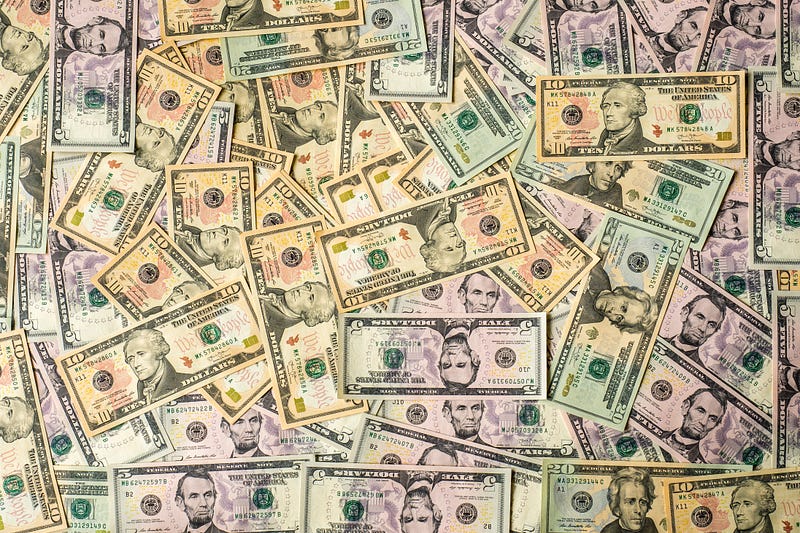
The ability for currencies to multiply through a fractional banking system is the exact reason currencies lose value over time.
In short, an infinite supply of currencies works to devalue our savings by reducing purchasing power.
We will understand this concept when it is applied to a Mona Lisa painting, for example. The value of the Mona Lisa will collapse if there are multiple authentic Mona Lisa paintings.
Rarity maintains value. Infinite supply crashes it.
It Explains Why We Have Record-Low Interest Rates On Our Deposits.
The moment I understood that currencies are instruments of debt — I got this point immediately.
The nature of a debt instrument is to facilitate further borrowing. When we deposit money into our savings accounts, it pressurizes the banks to pay us interest annually on our deposits.
Banks pay us by lending our money through loans at a higher interest rate. The bank administers a loan of 2% interest on principal to pay the 1% interest owing to the depositor.
The bank earns 2%, keeps 1%, and pays us 1%. That way, the bank earns, and we do. In reality, a wider interest rate gap works to their advantage.
To put things into perspective, the effective annual interest rate of a credit card debt is around the ballpark of 20%, while deposits yield around sub-1%.
Banks work to multiply their earnings with our money.
It Explains Why There Is Inflation.
Plenty of work has been done to make us believe that the sheets of paper we carry in our wallets have value till perpetuity. They are aesthetically appealing, and they are accepted as a form of payment for our bills.
And because we exchange our time and labor for these sheets of paper — We want to keep some. We tend to park them around somewhere for future expenditure.
That is the start of the Loser’s Game because inflation starts working against us.
The quantity of currencies increases as the Government, Businesses, and Consumers increase their borrowings. That means we have more paper currencies chasing after one MacDonald’s set meal.
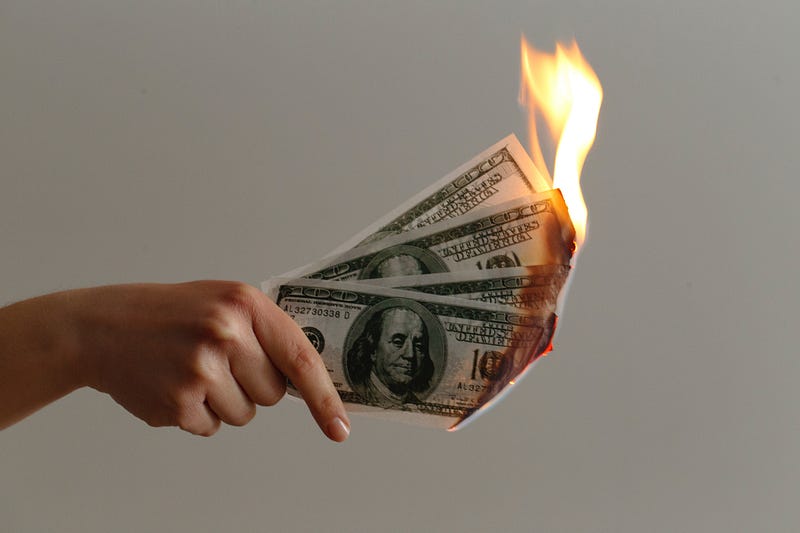
No wonder prices of food, gas, electricity, stocks, cars, smart devices have gone ballistic throughout the years. Various markets work to attain a daily equilibrium through inflation.
Match the increasing rate of supply of currencies to the goods and services produced by societies and we will realize that we are playing a Loser’s Game.
That equilibrium works against you and me when we do not invest to multiply our money savings (currency deposits). We lose when the inflation rate is higher than the yields we receive from our deposit accounts.
My Newfound Perspectives About Money.
I learned a lot more about money, currency, and related topics from Fake than 20 years of formal education. It is an interesting read.
Robert has many strong statements in Fake. I think he cares for the little guys. After all, we toil for our keep, and the system invisibly robs us from behind.
His profound understanding of money served him well. Any form of savings in real gold and silver has appreciated against USD since 1971. I cannot say the same for paper money deposits.
The last I checked 5 minutes ago — My savings account pays me 0.25% on my deposits. Would I be able to retire in peace and happiness with $1,000,000.00 in my bank account?
I doubt.
Encore — My Thoughts On Taxes.
Robert presents a perspective to understand taxes. The 3 different types of income exist because of different tax rates.
There is a different tax rate for Ordinary Income (Employment Income), Portfolio Income (Capital Gains Income), Free Cashflow (Dividends/Coupons) which is income from investments.
We get slapped the highest tax rate when we work for money. We pay the lowest taxes when we invest and collect Free Cashflow.
This was initially counter-intuitive to me until I understood that Tax Laws are written by Central Governments.
Voters vote them into a position to solve problems of unemployment and social stability.
Policyholders can dictate policy but they cannot run a business. A multi-billion infrastructure project has to be constructed by developers.
If we support the Central Government’s objectives (which is the objective of the voters) by bidding and working on the infrastructure project — We get rewarded with lower Tax Rates.
That is the active investment via Businesses.
We get to enjoy lower Tax Rates as passive investors as well. The dividends from the company involved in the infrastructure project are taxed at a much lower rate than Employment Income.
For the purposes of clarity, Robert mentioned that Ordinary/Employment Income is taxed at about 40% (Worldwide), Capital Gains are taxed at about 20% (Worldwide), and Free Cashflow is taxed at 0% (Worldwide) in Fake.
Fake made me rethink about money. It imparts real lessons and a necessary back-to-drawing-board exercise for future retirement.
Money is a profound topic, indeed.
Money Matters,
Aldric
Related Stories from the Author.
About the Author:
As a content contributor, I write my observations from daily life and my business exposure.
Because our life experience is the bedrock of our unique perspectives.
As a Consultant by training, I believe in making the complex simple.
Because simplicity adds value.
And with clarity — We grow.
Follow me for my stories on Medium!
This is more “About Me”.


