avatarAgustín Muñoz-Sanz

Free AI web copilot to create summaries, insights and extended knowledge, download it at here

3624

Abstract

e founding fathers. The “original” virus came from some reservoir bats and intermediate mammals. But it could live earlier in humans and have passed from them to other mammal species. Then, it continued mutating into animals and returned to humans. It is the reverse zoonosis. One knows that the pandemic coronavirus affects at least twenty-three species of mammals.</p><p id="fa1a">In December 2020 happens, a historical moment. An <a href="https://www.thelancet.com/journals/lancet/article/PIIS0140-6736(20)30154-9/fulltext">outbreak</a> in a local (Wuhan, China) and a distant (for us) generated a growing epidemic. Three months later, the <a href="https://www.who.int/director-general/speeches/detail/who-director-general-s-opening-remarks-at-the-media-briefing-on-covid-19---11-march-2020">WHO</a> made the pandemic official. Now Spain and other European countries have considered it over, but it is still active. Look at <a href="https://www.nytimes.com/2022/03/29/world/asia/china-shanghai-covid-lockdown.html">Shanghai</a>, China. Or many other places.</p><h1 id="a96c">Second season. The Greek family.</h1><p id="e5fb">The animal coronavirus entered the human scene. Later it expanded during a short chronological stretch of two years. After that, it has continued to mutate at the pace imposed by evolutionary chance. Then, finally, new members of the family were born.</p><p id="22ad">Several Greek letters baptized the variants. They conform a novel list of names: the settlers of the Hellenic alphabet. But let us go to do justice and honor the great Greek people. The pandemic is not a responsibility of Greece, the cradle of occidental civilization.</p><p id="394a">After that, things happened as in the previous epi/pandemics. The surge of hundreds of millions of infected persons. And an enormous burden of sick and dead (Our World in Data, <a href="https://ourworldindata.org/coronavirus">Coronavirus Pandemic</a>). But, in parallel, also the number of natural immunes (protected) subjects grew. And science developed with promptness several effective vaccines. The majority counteracted the severity of the different viral lineages.</p><figure id="59d8"><img src="https://cdn-images-1.readmedium.com/v2/resize:fit:800/1*kDUukkDCY9-Wzi5xz-Erkw.png"><figcaption>Figure 1. Different mutacional profiles (Wild type coronavirus, Delta, and Omicron variants). Credit: García-Beltrán et al, medRxiv.</figcaption></figure><h1 id="3cd4">Third season. The Omicron arrival.</h1><p id="75fd">And <a href="https://www.who.int/news/item/26-11-2021-classification-of-omicron-(b.1.1.529)-sars-cov-2-variant-of-concern">the Omicron variant</a> came to step up to the world epidemiological scene. It was at the end of November 2021. Yet, genetics studies confirm the existence of an Omicron’s progenitor. The ancestor circulated e for some months before March 2021. <a href="https://readmedium.com/it-is-never-too-late-to-debate-about-mice-deer-and-the-animal-markets-d67a4131f678">Mice participated in the genesis</a>. And so, unbeknownst to anyone, the family SARS-CoV-2 grew. It began a new saga or lineage. But the discrete variant birth was not of a single individual but three: The Omicron trio (BA.1, BA.2, and BA.3).</p><p id="1329">Genetic differences between sublineages are very noticeable (Figure 1). They are not different viruses but have other genetic profiles. Thus, when one says Omicron, it is necessary to clarify what they are talking about. Or to say which sublineage one refers to.</p><p id="3d3c">The BA.1 lineage entered the official scene at the end of November 2021. It was an epidemiological sled

Options

gehammer. It appeared when collective immunity grew — both by natural infection and vaccines. It happened despite the tremendous geographic differences. The astonishing number of mutations of BA.1 allowed it to be more contagious.</p><p id="0f5a">It is not for nothing BA.1 sublineage was the most infectious in the whole family. And the best in evading immunity (immune escape). The practical result of this worrying capacity is millions of infections. It can appear in subjects without immunity (it is logical) and immune too (it is surprising). Also, it uses to change the typical clinical pattern. Because of BA-2 causes fewer cases of pneumonia and many more oropharyngeal infections.</p><p id="8b78">In the beginning, the BA.2 subvariant only concerned certain geographical areas such as Denmark, Nepal, and the Philippines. BA.1 is so contagious that it immediately accounted for more than 90% of the cases in many places. But BA.2 is now claiming its share of infective power. It displaced BA.1 (in February 2022, it was the world variant dominant). BA.2 has eight mutations in the spike that BA.1 does not show (Figures 1 and 2). BA.2 is more transmissible than BA.1 but less evasive of immunity. And here is good news: immunity against BA.1 also protects against AB.2.</p><figure id="e14f"><img src="https://cdn-images-1.readmedium.com/v2/resize:fit:800/1*jS-Yof1iNUGoN2xKBwd0Og.png"><figcaption>Figure 2. <i>Omicron BA.1 and BA.2 sublineages mutations in the spike protein. Credit: Ju et al., NEJM 2022.</i></figcaption></figure><p id="5903">The BA.3 subvariant has less strength. Yet, it looks “less selfish” and has hardly caused any problems. But, it shares many mutations with BA.1 and BA.2 (Figure 3).</p><h1 id="53e4">Fourth season. Will the saga be ongoing?</h1><p id="c759">The variant succession spree looks far from over: <a href="https://www.forbes.com/sites/williamhaseltine/2022/03/16/an-omicron-omicron-recombinant-ba4/?sh=710cb93559b0">BA.4</a> is a new member that joined the Omicron saga. The production mechanism is not because of mutations but by genomic recombination of BA.1 and BA.3 sublineages. In other words, it is an Omicron-Omicron recombinant with two mutations of its own. In other words, it is a genuine member of the Omicron saga. But it is not unique: there is a new recombinant Delta-Omicron in the USA (<a href="https://t.co/JWaxb9FZHQ">bioRxiv</a>, Mar 21). There seems to be some things going on and <a href="https://github.com/cov-lineages/pango-designation/issues/367">some people are investigating</a> them very well.</p><figure id="b0ee"><img src="https://cdn-images-1.readmedium.com/v2/resize:fit:800/1*AadHdIPIxgJA-Er6qxaYVA.png"><figcaption><b>Figure 3. Family Omicron. Similarities and differences between members (Venn Diagram). Credit: Dr. W. A. Haseltine, Forbes.</b></figcaption></figure><h1 id="59d0">The moral</h1><p id="0368">There is a moral to the spectator of this natural story. One can think that the Omicron saga will continue to grow in the future. Because of mutational and recombinant changes. Or it may not. At this point, nobody knows.</p><p id="91b1">But now, there is no doubt about an assertion. The <i>Coronaviridae</i> family will continue expanding the list of its members. Also, it will grow up its diversity. It is a fact linked to continuous human and animal infections. And to the viral capacity to change or adapt the genome.</p><p id="ba51">This tragic soap opera of the Covid can occur like in many audiovisual platforms’ series.</p><h2 id="05eb">In conclusion: The end of a season does not guarantee the series’ end.</h2></article></body>

The Omicron Saga

“The family is a precious treasure” (Pope Francis)
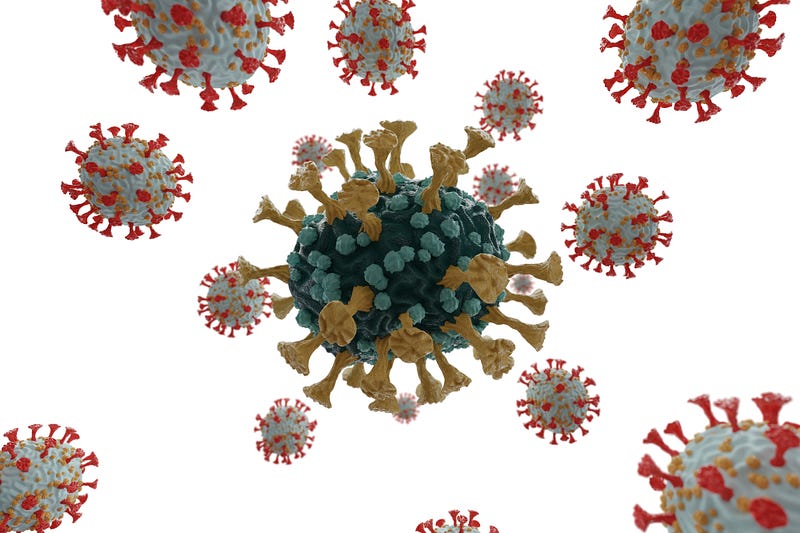
3D Rendering of Omicron Variant by galitskaya licensed by editor from depositphotos.com

The Coronaviridae family keeps growing because viral generations follow one after the other. A similar process happens to human beings. In humans, it depends on many factors that can interact. But the viruses fulfill a mandate written in the species’ genome. The genetic selfishness I treat here refers to an evolutionary sense and not moral or etic. That is, on to permanence or continuity. This fact is a tool at the service of viral fitness. In other words, it is an adaptive instrument. Chance leaves it in the hand of the genes and their circumstances. Whatever is to come will come. That is evolution.

The viruses’ succession mechanisms.

Coronaviruses have been circulating in nature for thousands of years. They inherit themselves through random changes in their genome. The changes are mutations. They happen by three mechanisms:

-Substitution of one nucleotide for another.

-Loss of nucleotide(s) (deletion).

-Addition (insertion) of new acquisitions in the genome map.

Also, it can be two other ways: recombination and intragenomic reassortment. Recombination means to combine two. It refers to two variants of the same virus. Or two different viruses that infect the same cell. They change parts of their genomes. The result is a new virus.

Recombination is a common phenomenon among human catarrhal coronaviruses. And in other kinds or species of animals and humans’ viruses. For example, it was the cause of pandemics influenza (1918 and 2009). And it works in the HIV world too.

Intragenomic reassortment is a bit more complicated to explain. But it is crucial for the apparition of a new virus. It means the duplication of some genetic segments. And after their ubication in other sites of the genome. Thus, new strains, variants (lineages), and subvariants can come onto the evolutive scene.

The surge of new viral variants by mutations, recombination, or reassortment is natural. But it is not a TV series like “Succession,” “The Sopranos,” “The Crown,” or “Games of Thrones.” Instead, in nature, things can happen like in some powerful families. For example, those of novels and Netflix or HBO Max series.

First season. The beginning. The founding immigrant fathers.

The evolutionary journey of the pandemic virus throughout humanity’s roads began with science. It was in China when the year 2020 ended. I mean the SARS-CoV-2. It was when the mutant virus (Wuhan-1), of zoonotic origin, jumped to humans. The first viruses were like the founding fathers. The “original” virus came from some reservoir bats and intermediate mammals. But it could live earlier in humans and have passed from them to other mammal species. Then, it continued mutating into animals and returned to humans. It is the reverse zoonosis. One knows that the pandemic coronavirus affects at least twenty-three species of mammals.

In December 2020 happens, a historical moment. An outbreak in a local (Wuhan, China) and a distant (for us) generated a growing epidemic. Three months later, the WHO made the pandemic official. Now Spain and other European countries have considered it over, but it is still active. Look at Shanghai, China. Or many other places.

Second season. The Greek family.

The animal coronavirus entered the human scene. Later it expanded during a short chronological stretch of two years. After that, it has continued to mutate at the pace imposed by evolutionary chance. Then, finally, new members of the family were born.

Several Greek letters baptized the variants. They conform a novel list of names: the settlers of the Hellenic alphabet. But let us go to do justice and honor the great Greek people. The pandemic is not a responsibility of Greece, the cradle of occidental civilization.

After that, things happened as in the previous epi/pandemics. The surge of hundreds of millions of infected persons. And an enormous burden of sick and dead (Our World in Data, Coronavirus Pandemic). But, in parallel, also the number of natural immunes (protected) subjects grew. And science developed with promptness several effective vaccines. The majority counteracted the severity of the different viral lineages.
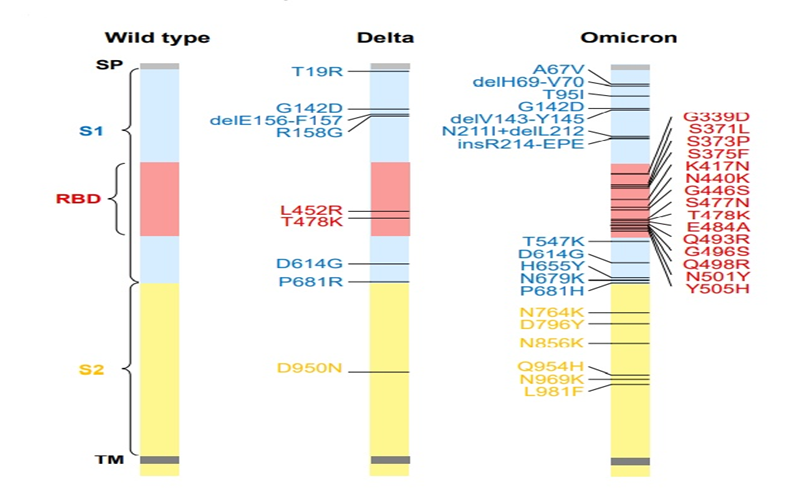
Figure 1. Different mutacional profiles (Wild type coronavirus, Delta, and Omicron variants). Credit: García-Beltrán et al, medRxiv.

Third season. The Omicron arrival.

And the Omicron variant came to step up to the world epidemiological scene. It was at the end of November 2021. Yet, genetics studies confirm the existence of an Omicron’s progenitor. The ancestor circulated e for some months before March 2021. Mice participated in the genesis. And so, unbeknownst to anyone, the family SARS-CoV-2 grew. It began a new saga or lineage. But the discrete variant birth was not of a single individual but three: The Omicron trio (BA.1, BA.2, and BA.3).

Genetic differences between sublineages are very noticeable (Figure 1). They are not different viruses but have other genetic profiles. Thus, when one says Omicron, it is necessary to clarify what they are talking about. Or to say which sublineage one refers to.

The BA.1 lineage entered the official scene at the end of November 2021. It was an epidemiological sledgehammer. It appeared when collective immunity grew — both by natural infection and vaccines. It happened despite the tremendous geographic differences. The astonishing number of mutations of BA.1 allowed it to be more contagious.

It is not for nothing BA.1 sublineage was the most infectious in the whole family. And the best in evading immunity (immune escape). The practical result of this worrying capacity is millions of infections. It can appear in subjects without immunity (it is logical) and immune too (it is surprising). Also, it uses to change the typical clinical pattern. Because of BA-2 causes fewer cases of pneumonia and many more oropharyngeal infections.

In the beginning, the BA.2 subvariant only concerned certain geographical areas such as Denmark, Nepal, and the Philippines. BA.1 is so contagious that it immediately accounted for more than 90% of the cases in many places. But BA.2 is now claiming its share of infective power. It displaced BA.1 (in February 2022, it was the world variant dominant). BA.2 has eight mutations in the spike that BA.1 does not show (Figures 1 and 2). BA.2 is more transmissible than BA.1 but less evasive of immunity. And here is good news: immunity against BA.1 also protects against AB.2.
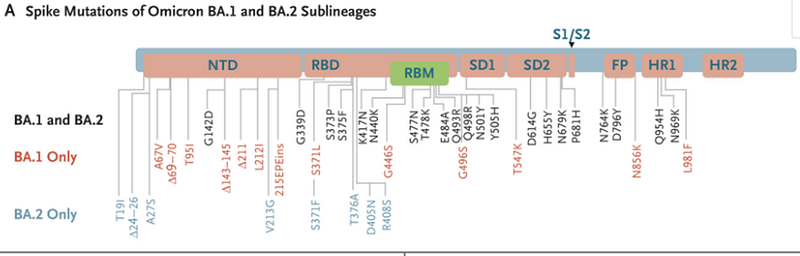
Figure 2. Omicron BA.1 and BA.2 sublineages mutations in the spike protein. Credit: Ju et al., NEJM 2022.

The BA.3 subvariant has less strength. Yet, it looks “less selfish” and has hardly caused any problems. But, it shares many mutations with BA.1 and BA.2 (Figure 3).

Fourth season. Will the saga be ongoing?

The variant succession spree looks far from over: BA.4 is a new member that joined the Omicron saga. The production mechanism is not because of mutations but by genomic recombination of BA.1 and BA.3 sublineages. In other words, it is an Omicron-Omicron recombinant with two mutations of its own. In other words, it is a genuine member of the Omicron saga. But it is not unique: there is a new recombinant Delta-Omicron in the USA (bioRxiv, Mar 21). There seems to be some things going on and some people are investigating them very well.
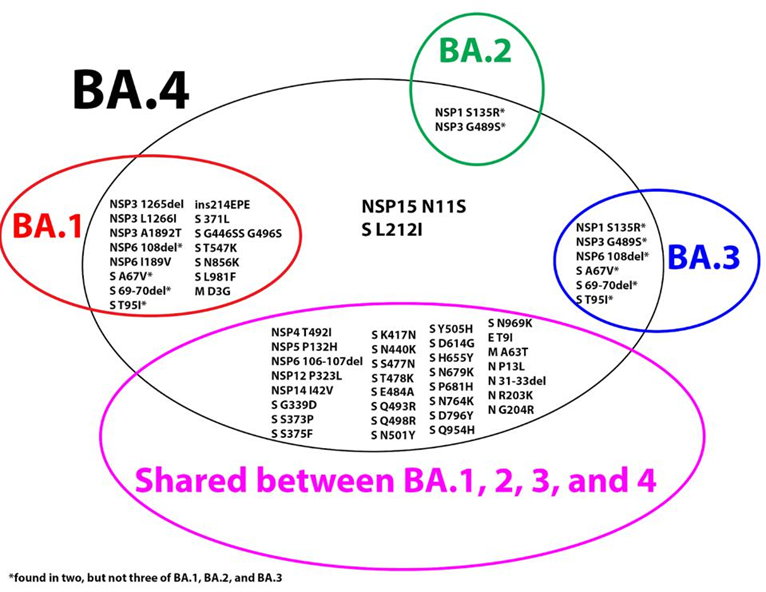
Figure 3. Family Omicron. Similarities and differences between members (Venn Diagram). Credit: Dr. W. A. Haseltine, Forbes.

The moral

There is a moral to the spectator of this natural story. One can think that the Omicron saga will continue to grow in the future. Because of mutational and recombinant changes. Or it may not. At this point, nobody knows.

But now, there is no doubt about an assertion. The Coronaviridae family will continue expanding the list of its members. Also, it will grow up its diversity. It is a fact linked to continuous human and animal infections. And to the viral capacity to change or adapt the genome.

This tragic soap opera of the Covid can occur like in many audiovisual platforms’ series.

In conclusion: The end of a season does not guarantee the series’ end.

Omicron
Coronavirus
Pandemic
Mutation
Recombination
Recommended from ReadMedium