
It is never too late to debate about mice, deer, and the animal markets.
Let us say a little more about the Omicron evolutionary journey and the first departure station.
In a recent article published in ILLUMINATION, I discussed the evolutionary journey of the Omicron variant. To this end, it was necessary to address the complex relationship between coronaviruses and the animal world. As for the virus’s origin, we analyzed the three most widely accepted hypotheses.
I now recall the three hypotheses:
1. Emergence and expansion of the new variant by defect or lack of genomic detection in the region where it occurred.
2. The generation of many silent and continuous mutations in an immunocompromised host. Most likely, it was an untreated HIV-infected subject and unvaccinated against the coronavirus.
3. The existence of a reverse zoonosis, i.e., an infection of one or more animal species (mammals) from humans. Later, the production of evolutionary mutations in the animal host surged. And then, the contagion of humans with the “new” coronavirus already full of mutations.
As a late-breaking extension, I also summarize an article from The Lancet about the infection of some pets (hamsters) originating in the Netherlands and imported to Hong Kong. In this zoonotic episode, there were three humans infected. They were the sales clerk, two store customers (mother and daughter), and other members of the same family.
The zoonotic coronavirus variant had three mutations in the spike and one in ORF8, suggesting the possibility of enhanced binding to the ACE2 receptor. Moreover, the ability to evade natural, vaccine, and therapeutic antibodies.
In summary,
- I deliberated on the significance of the animal collective beyond the bat world as a very likely intermediate station of the prevailing pandemic coronavirus.
- The spread of viruses in this collective increases the possibility of new mutations.
- Also, it can increases the risk of genetic recombination.
- Finally, and this is a matter of no less importance, it is the consideration of the animal world (especially mammals) as an active reservoir of many other viruses that may give future epidemics/pandemics.
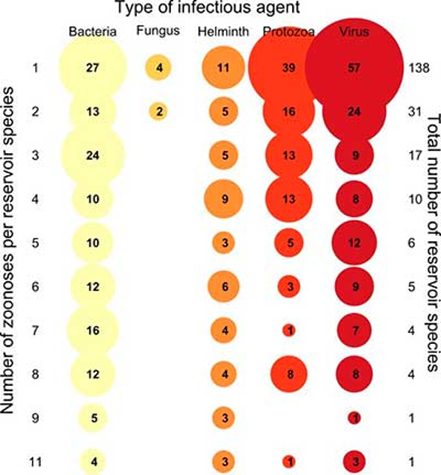
In other words, nature can be an endless factory of virus and mutations. In a passage of the removing issue, I said that “…after rodents (from the order Rodentia), bats are the most abundant mammals (22%). Not to be overlooked, distracted by bats, is the role of rodents in this story.” Rodents are the most significant mammal: more than 2,000 species worldwide. Thus, this animal collective is a disturbing source of zoonotic infectious diseases (Figure 1).
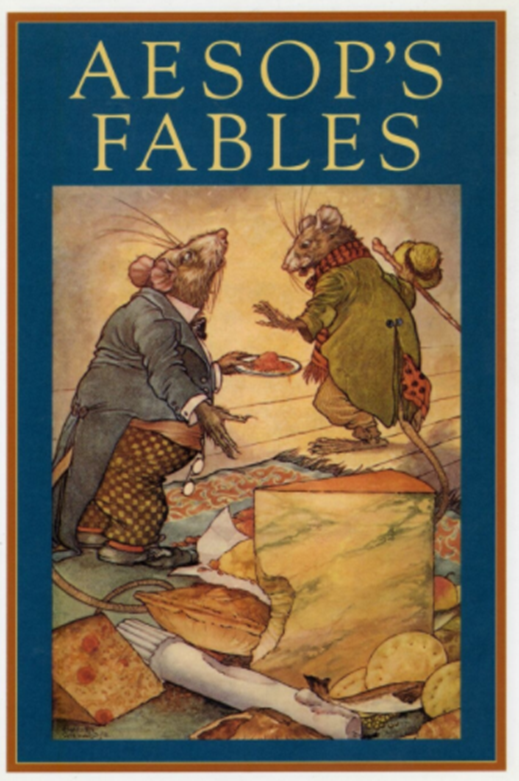
The mountain gave birth to a tiny mouse.
In his fable, The Mountain in Labour, Aesop (6th century B.C.) surprised humanity. He did it by saying that sometimes an event that seems very dramatic and of unforeseen consequences ends up being a trifle. Something like an unimportant joke that, when revealed, makes men lose their fear. Furthermore, they burst out laughing.
In Aesop’s fabulous tale, the appearance of a tiny mouse was the culmination of an uncertain and disturbing telluric explosion. It was a geological incident that generated uncertainty and concern among humans. But, in proverbial language, much ado about nothing. How many times has this sensation been present during the two years of the pandemic?
Nevertheless, even knowing the moralizing power of fables, one should not underestimate mice. Nor the rats. Much less the coronaviruses. Because in nature, there is no small enemy.
Mice and rats are mammals (from the Mammalia class) of Rodentia order, consisting of five suborders. Rodents belong to the suborder Myomorpha. In turn, it have two superfamilies: Dipodoidea (gerbils) and Muroidea.
The latter is a superfamily with 1,300 species. It includes five prominent families, one of which, Muridae, is the largest of the mammals (650 species). Within it, it is the subfamily Murinae belong the mice (genus Mus) and rats (genus Rattus). Together they spread about 35 diseases to humans.
The rodent microbes are acquired by handling the animals in experimental laboratories, by contact with their feces, urine, or saliva, or by bites. They can also spread through a vector (ticks, mites, fleas, lice) infected after feeding the rodent’s blood carrying the microbe.
As mentioned above, rodents can pass many infectious diseases to humans. Here I recall some of the most prominent ones caused by viruses:
Moreover, there are also rodent-specific infections that do not affect humans as far as I know. These include mouse hepatitis virus (MHV) and rat coronavirus (RCoV). In turn, RCoV has two viral prototypes: sialodacrioadenitis virus (or SDAV, before called rat coronavirus) and Parker’s RCoV (RCoV-P). Both pathogens (MHV and RCoV) are of the family Coronaviridae. They pertain to the genus Coronavirus.
Mouse Hepatitis virus has intestinal as well as respiratory tropism. The second virus is associated with the lacrimal and salivary glands (SDAV) and the respiratory tract (RCoV-P). There is an antigenic relationship between the two murine coronaviruses. Also, with several other viruses. Including two human coronaviruses: MHV with hOC43 (seasonal respiratory coronavirus) and SDAV with hOG38.
Concerning to their pathogenic power in rodents, both are very contagious in mice (MHV) and rats (SDAV and RCoV-P). MHV is usually asymptomatic in immunocompetent mice. However, it also can cause epizootics of fatal diarrhea, hepatitis, and severe neurological involvement or severe cachexia in the athymic mouse (a mouse without the lymphoid organ thymus).
As for rat coronavirus, it can cause enzootics in the pup colonies. And epizootics in some susceptible animals at the weaning stage, also in adults. It causes very high morbidity (dacryoadenitis and seropurulent sialadenitis the SDAV) and low mortality. Besides severe lower respiratory infection (interstitial pneumonia) (the RCoV-P).
The mouse is related to the surge of the last and explosive variant.
Until recently, investigators and experts thought that the mouse (Mus musculus), is not a good target for human coronaviruses as SARS-CoV-2. It is not a good host. This fact concerns the coronavirus interface. I mean the interaction between the spike protein and the murine membrane receptors (especially ACE2). A paper published in the Journal of Genetics and Genomics may change this idea.
The research provides a study in favor of the animal hypothesis. That is to say, the third hypothesis (reverse zoonosis) is the origin of the omicron variant. The title of the paper already reveals the fact with clarity: Evidence for a mouse origin of the SARS-CoV-2 Omicron variant.
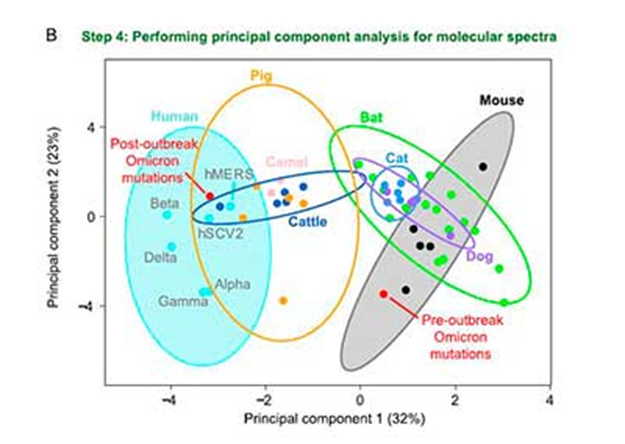
The article has been online since December 2021. The authors are Changshuo Wei and collaborators, all members of the Beijing Academy of Sciences (China). Investigators use the analysis of the molecular spectrum of SARS-CoV-2 Omicron variant mutations. It is a technology appropriate to search for the origin of the host or the closest hosts. The summary of their research is as follows:
1. The number of mutations (57 in total) and the speed of appearance overtime in the parent virus circulating before the outbreak of the Omicron variant (November 2021), mean the existence of a strong positive selection. The ratio (dN/dS) between non-synonymous (dN) and synonymous (dS) mutations is around 6. This positive selection (higher number of non-synonymous mutations) is here more intense than in any human variants of concern. The fact suggests the existence of jumping between species. The natural phenomenon of interspecies jumping could have occurred around mid-2020. The date coincides with the proposed emergence date of Omicron. In South Africa and Botswana, or other places.
2. The molecular spectrum of mutations before the Omicron explosion argues against the existence of evolutionary history in humans.
3. The same type of molecular analysis supports evolutionary history in mice.
4. Pre-Omicron mutations in the spike (S) protein overlap with mutations in the SARS-CoV-2-adapted mouse.
5. Mutations in the pre-Omicron progenitor’s RBD (receptor binding domain) increase the affinity for mouse ACE2 receptors.
6. The genomic changes show the highest affinity to the mouse ACE2 receptor compared to 32 other mammalian species.
Moreover, the mutations show a pleiotropic effect, i.e., they can infect other animals (camel, goats). Thus, a chain effect can be triggered by expanding the number and variety of animal species reservoirs (so far, only bats have played a recognized role) or acting as intermediate hosts.
Wei and colleagues conclude by saying that Omicron progenitor (the closest ancestor in the evolutionary line) jumped from humans to mice. Then it accumulated many mutations in its murine pathway. That allowed the coronavirus to return to humans (reverse zoonosis) after infecting rodents.
In essence, it is a phenomenon indicative of an evolutionary trajectory between species. Furthermore, it supports the animal origin of the outbreak of the SARS-CoV-2 Omicron variant (Figure 2).
The fable of deer and mouse.
Since ancient times, large and small mammals (rodents) have interacted in nature. The natural world exchanges microbes (viruses, bacteria, fungi, protozoa) as a rule. That can occur via the air, the digestive tract, contact, or insect vectors. An excellent example of this kind of interaction is a classic in infectious medicine. I mean Lyme disease. A disease with severe consequences for humans.
White-tailed deer (Odocoileus virginianus) is an animal well known in the veterinary world and among hunters. It jumped onto the global media scene and specialized scientific publications in the 70s and 80s of the XX century. It was after the description, in 1977, of a mysterious outbreak in children and young people.
The disease was multisystem and resembled seronegative juvenile rheumatoid arthritis. It concurred geographically in an area with abundant populations of white-tailed deer. The zone holds three rural communities (Old Lyme, Lyme, and East Haddam).
The spirochete causal and several types of tick vectors appeared soon on the epidemiological scene, along with the deer. The bacteria was Borrelia burgdorferi. The ticks were some of the Ixodes species. It did not take long for a small and very abundant mammal to join the epidemiological roster. I mean the white-footed mouse (Peromyscus leucopus).
The phenomenon is an arch-repeated natural design in the ecosystem. A scenario in which microbes, insects, animals, and humans have participated since the beginning of time.
The SARS-CoV-2 coronavirus pandemic led by the Omicron variant is still raging in many places. Health authorities have not closed the pandemic because millions of persons are still infected, and thousands die every day. On February 28, when the masses were occupying the streets for Carnival in Hong Kong, corpses were piling up at the doors of hospitals.
During the coronavirus pandemic, North American white-tailed deer have once again taken on a leading role. Along with European and North American mink, those animals are recipients of SARS-CoV-2 from humans. They are excellent candidates to take part in the maintenance and spread of the coronavirus in nature. At the same time as they are also a source of mutations.
Researchers from several Canadian institutions have published (on February 25, 2022) a paper in bioRxiv. It is a pre-print or not peer-reviewed article. The Canadian investigators analyze the deer coronavirus’s role and relationship with humans. For this purpose, they studied 300 deer from the Ontario region. The vast majority (94%) of the animals were adults, with sex parity (55% males versus 45% females).
The scientists obtained nasal and retropharyngeal lymph node exudate samples from 298 animals. Six percent of the total samples were positive (RT-PCR) for SARS-CoV-2. Deer virus genome belonging to lineage B1 (Pango)/class 20C (Nextstrain) had a profile mutating.
In total, it had 76 mutations when compared to the original human Wuhan Hu-1 strain. And around 49 changes relative to the closest ancestor in the GISAID shared repository collection.
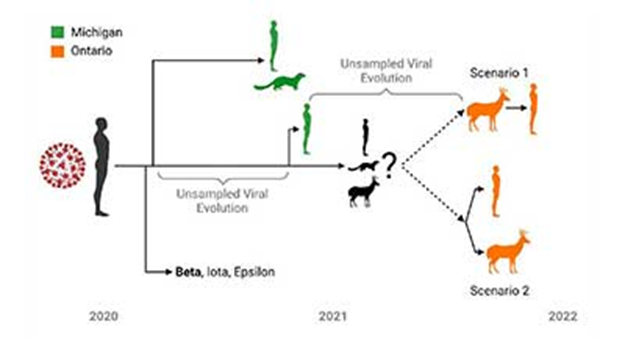
According to the Canadian authors, the closest genome in this collection is a human one from Michigan (collected in November-December 2020) and very close to a mixed clade of human and mink genes, also from Michigan, although collected in September-October 2020. By appropriate analyses, the authors reasonably excluded the possibility of genomic recombination.
In the study of 75 mutations shared between the five highest quality deer genomes and one human genome, 51 are in ORF1ab, and nine are in the S-spike genomic segment (6 deletions and five substitutions). Of interest is to know that these changes are present in bats, cats, hamsters, and minks. In addition, analysis of the relationship between non-synonymous (dN) and synonymous (dS) mutations showed a neutral selection profile indicative of sustained viral transmission with minimal immune pressure in a susceptible population.
The immune study showed negligible impact, i.e., no problems when confronted with available vaccines.
The authors put forward two possible scenarios to explain the relationship between infection in deer and humans (Figure 3).
Trade of live animals and the geographic origin of the pandemic.
Almost from the onset of the pandemic in China, a bitter scientific, political, and media debate raged over the actual origin of the pandemic coronavirus: nature or laboratory. Two antagonistic positions prevailed: a random natural phenomenon conditioned by certain (regrettable) epidemiological circumstances or an intentional human origin (manipulation of the virus). In addition, the possibility of an unintentional accident (laboratory leakage) surged immediately.
The literature for or against each position is enormous and irreconcilable. And it is not always objective.
An excellent and well-documented late-breaking article provides crucial information on the geographical origin of the pandemic and highlights, once again, the importance of animals in the emergence of infectious outbreaks of coronaviruses. This topic is a natural phenomenon that is not new, nor will it be the last.
The article is the collaborative work of a multinational team (United States, Canada, United Kingdom, Australia, Netherlands, and Belgium). Michael Worobey, from the Department of Ecology and Evolutionary Biology at Arizona University (Tucson), heads the work.
According to the authors, multiple lines of evidence point to the origin of the SARS-CoV-2 pandemic. It occurred at a specific point in the Huanan seafood market, located on the western bank of the Yangtze River, in the Chinese city of Wuhan (population 11 million), in late November 2019. Some of the evidence is:
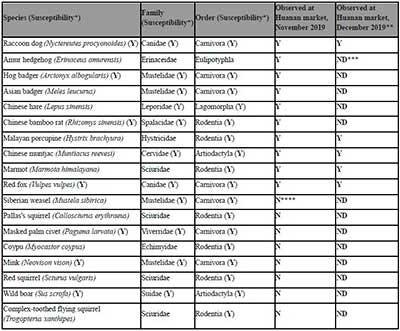
1. It existed a high sell of animals susceptible to SARS-CoV-related coronaviruses in November and December. Among others, prairie dogs, although the list is very numerous (Table 1).
2. Suppliers selling live animals provided many environmental samples positive for pandemic coronavirus.
3. Positive environmental samples were in the western section of the seafood market.
4. The most significant number of positive human cases (among vendors) clustered in this area.
5. The first cases of secondary infection occurred among people who visited or worked at the market or, alternatively, had contact with its workers.
6. The virus lineage A circulated in or near the market at the onset of the epidemic.
7. The spatial pattern of cases in or around the market is not explained by chance, given the high population density of Wuhan city.
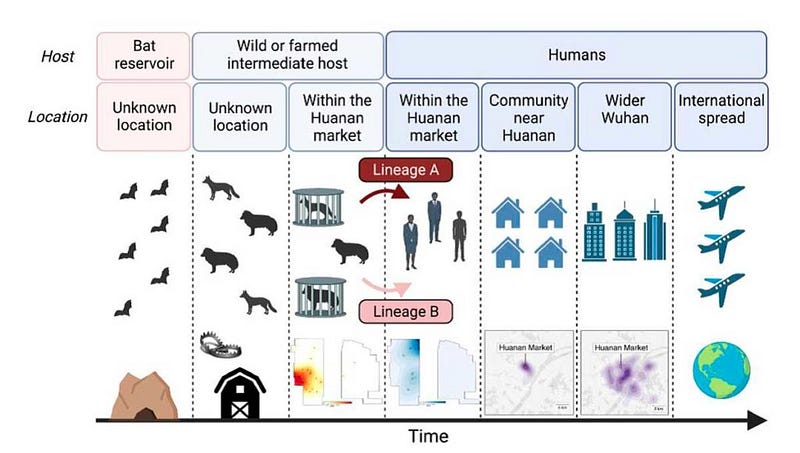
Figure 4 schematizes the evolution of events that originated in the Huanan market outbreak and led, later, to the pandemic. From the original bats’ reservoir (Rhinolophus affinis or RaTG13), living in an unknown location, intermediate animals were infected in the wild or farms, and some objects related (cages and traps) outside and inside the market.
It happened in the southwest corner of the western section of the market where lineage A (and, most likely, B) emerged. And infected some humans inside the market (suppliers, buyers, visitors), then many more humans in the vicinity of the Huanan market, later the city of Wuhan, and, finally, spread throughout China (Wuhan is an extraordinary railway junction) and the planet (via air). From the Huanan-Wuhan’s market outbreak happened a global epidemic (pandemic).
Last February 25, an article was published online. Its title is Surveillance of SARS-CoV-2 in the environment and animal samples of the Huanan Seafood Market. The authors are Chinese investigators lead by George Gao (from the Academy of Sciences). This paper also certifies that the origin of the pandemic was in the Huanan market.
The notable difference with the previous commented work of Pickering et al. is that now all the positive samples were environmental. Seventy-three out of 923, or 7.9% in and around the market. Sixty-four out of 828, or 7.7%, inside the market. The investigators managed to isolate three “live” viruses with high or very high viral loads (i.e., with a low Cycle threshold/Ct).
Moreover, the environmental sample coronaviruses showed a very high nucleotide homology. Around 99.98–99.99% with the reference strain (HCoV/Wuhan/IVDC-HB-01). And a complete homology with the Wuhan-Hu-1 strain. A striking fact is that any samples analyzed from 457 animals had coronavirus. The analytical samples were from 188 individual animals belonging to 18 different species.
For these authors, the market, its west wing, acted as an amplifier of the outbreak. However, it remains unclear where it came from and how the virus reached the market.
Conclusions.
Once again, all we must appeal to the care and vigilance of global health. With a planetary and multispecies (OneHealth) perspective:
- We need to understand our planet as a place where humans are embedded in a complex and dynamic ecosystem.
- All we need not to forget that nature has its own rules alien to humans’ problems. Because nature it is not insensitive to human activities by action or omission.
- For the politicians and administrators: It is necessary to invest in research. It is not a matter of doing it when, as now, the problem explodes.
- Knowing what is happening in real-time in nature is the best way for humanity can face viral outbreaks. The epidemics or pandemics that will come. Right now, in the tangled animal world where the nasal cold of a simple house mouse can change the course of history.
- If we follow this rule consistently, the trite saying that prevention is better than cure will never be more appropriate.