
The Oasis
A walk in the desert, and a clue to what might lie ahead for us
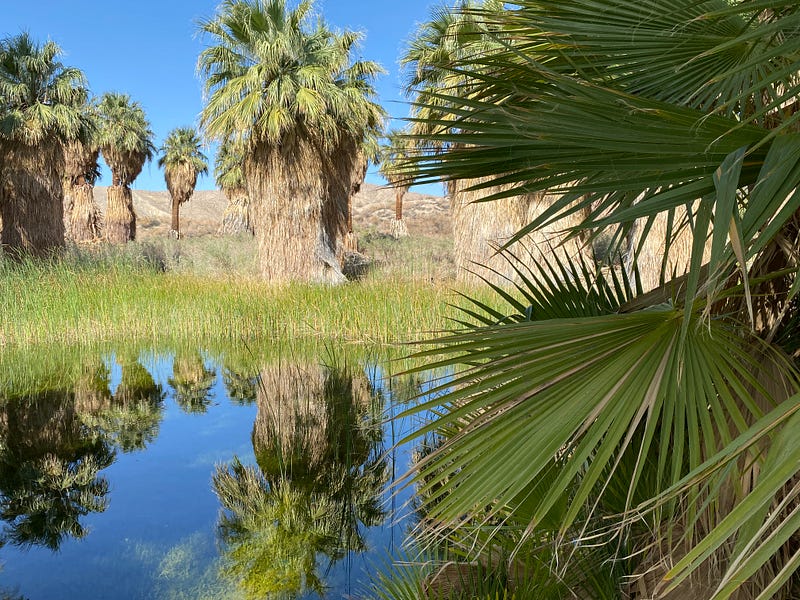
I parked the car at the side of the highway and walked a mile into the desert, in the direction of a big stand of palm trees.
The walking was not easy. The sand was deep and loose, making walking a little like trying to run on a beach. With each step I picked up another grain or two of sand, adding to the small piles accumulating in the bottoms of my shoes. The heat wasn’t quite blast furnace, but close enough.
A breeze appeared from out of nowhere as I took my first steps down the trail, knocking the heat off my face and arms and making me forget for a moment the blazing sun overhead. But the wind was just another desert nomad and soon made its way off toward the distant mountains, leaving only the sun, the small bottle of water clenched in my fist, and the otherworldly landscape. The guide book mentions creosote bush, burrobush, smoke tree, desert lavender. I’m sure I was surrounded by all that and more as the trail cut deep into the landscape.
A sign advised against feeding the wildlife but just down the trail was another sign warning of poisonous snakes and mountain lions working the area, which made me think the wildlife had more agency in this matter than I did. I could only hope none of them were hungry enough to think about putting me on the menu.
I was following the path of the San Andreas Fault, the famous defect in the earth’s crust that we’re told might someday cause a huge hunk of Southern California to break off and drop into the Pacific Ocean. But in this small stretch of desert the fractured earth has the more benign effect of allowing a pool of ground water to bubble up to the surface. The result is a palm oasis stunning in its natural beauty.
One moment you’re walking through the blazing heat, the next you’re surrounded by palm trees, your eyes transfixed on a small pond set like a sapphire in the stone of the desert. The palms are the stocky native variety, not the tall, slender imports that arch gracefully over the boulevards of Hollywood and Santa Monica. Maybe it’s my Scandinavian heritage, but to me they look like giant trolls wearing shaggy grass skirts, topped by an unruly thatch of green palm-frond hair. Once you get into the thick of them it’s like walking through the cool, silent corridors of a cathedral.
An oasis is a useful thing when you’re trying to survive in the desert, and I think the same concept applies in a larger sense to the rest of our society. Read the news and you’re filled with questions about where we’re at with the torturous global pandemic as it stretches into a third year. Are we done with it? is it done with us? Is it crazy to even think about being done with it when we have no idea what the virus might have in store for us next?
Better to think of the current respite in COVID case rates and hospitalizations as an oasis.
My walk in the desert came as a part of my first actual vacation in more than two years. The sort where I got to see some sights, sit by the pool and read a book, have a good dinner at a restaurant. I even danced at a wedding, although I have to say this felt a whole lot better knowing the bride had been thoughtful enough to insist the guests be triple-vaxxed. I wasn’t exactly living a life of wild abandon, but compared to my hermit-like existence of the past two years it felt that way. The trusty N-95 that’s been my suit of armor for so long mostly stayed in the suitcase.
It feels right to live this way for the time-being and maybe it’s even necessary, like arriving at an oasis when you know the surrounding desert is filled up with ways to kill you. You need time to rest and restore.
For those asking where we’re at with the pandemic right now, that’s the answer. We’re at an oasis. It would be dumb to kid yourself and think it’s anything more — that it’s time to just close your eyes and move on. The desert is still out there and it’s still treacherous. You know that and so do I. The next SARS-CoV-2 spin-off is already making its troubling presence known in some parts of the country. Philadelphia is back to asking people to put on their masks. We need to take a deep breath and live a little while we have the chance, because that’s the only way we’ll be ready to take on whatever might comes next.
Deserts focus you, if for no other reason than that you don’t want to step on anything poisonous. An oasis gives you a break, lest it all become too overwhelming. If we understand both of these concepts we might yet get through this perilous moment of history together.


