Estimate of the Situation
The New York Times Says Crashed UFOs May Exist
In a heavily edited piece, the Times says UFO studies, reports and briefings are on-going, and crash wreckage is probably a reality, too.
After weeks of build-up, rising tension and the usual thrust-and-parry in the UFO echo chamber, the New York Times finally published its latest article trying to normalize a subject that the paper, politicians and the public have been in denial about for over seven decades.
Expectations were high for what was widely rumored to be game-changing coverage from reporters Ralph Blumenthal and Leslie Kean.
Instead of a Smoking Gun with a shocking headline to match, the Times published a committee report, probably the result of friction between the natural conservatism of editors and the passion of reporters. Oh, it’s full of bombshells, but they have buried the lead (or lede) because it’s too wild — that we probably have crashed UFOs in our possession and have for a while.
So, flaws and all, the article is going to go down in the history yet to be written about the early days of the confirmation of UAP reality. It does not, and probably cannot, answer the two obvious follow-up questions. If these things are real, then who built them, and what do they want?
In their article, the New York Times — the so-called newspaper of record for the U.S. — quotes former Senate Majority Leader Harry Reid (a day later retracted by Reid) along with multiple other individuals with high security clearances about their beliefs that we possess crash wreckage. In plain English, the bottom line of that testimony, cutting through the cautious tone of it all, seems to be:
UFOs have likely crashed, we’ve picked up some scraps and maybe some saucers, probably started studying them since before Hula hoops were cool, and both big government and big business are in on it, whatever “it” is.
More will come in the next days and weeks, not just from the New York Times, but other journalists. Disclosure is on. Today was a turning point.
Blumenthal and Kean deserve a lot of credit for what they have accomplished in a string of UFO/UAP articles at the New York Times, including this latest. Still, one suspects it was a probably a tough sentence-by-sentence slog through the first draft to what we have here before us. It feels deeply impacted by the “some say yes, some say no, we say maybe” form of “balance” that journalism likes.
This is not to say that the article is bad. It just reads like more than a few people got their hands on it. This is understandable, given its hot potato potential. It does manage to start with breaking news that sounds promising:
Despite Pentagon statements that it disbanded a once-covert program to investigate UFOs, it was in fact renamed and tucked inside the Office of Naval Intelligence. For more than a decade, the Pentagon program has been conducting classified briefings for congressional committees, aerospace company executives and other government officials, according to interviews with program participants and unclassified briefing documents.
This is interesting to the extreme but not shocking to anyone who stays current on the topic. Activists argue that it ought to make the public angry. Briefings are on-going that admit the phenomenon as reported is authentic. Yet the U.S. government has not leveled with its own people. How long has that been going on? To what degree?
What comes later in the article, however, has the power to rock a reader’s world. There are paragraphs in it that are stunning to read in the nation’s most famous newspaper. Here are a few other favorites:
Mr. Elizondo is among a small group of former government officials and scientists with security clearances who, without presenting physical proof, say they are convinced that objects of undetermined origin have crashed on earth with materials retrieved for study.
Mr. Reid, the former Democratic senator from Nevada who pushed for funding the earlier U.F.O. program when he was the majority leader, said he believed that crashes of vehicles from other worlds had occurred and that retrieved materials had been studied secretly for decades, often by aerospace companies under government contracts.
“After looking into this, I came to the conclusion that there were reports — some were substantive, some not so substantive — that there were actual materials that the government and the private sector had in their possession,” Mr. Reid said in an interview.
READ THE FULL ARTICLE: No Longer in the Shadows, Pentagon U.F.O. Unit Will Make Some Findings Public
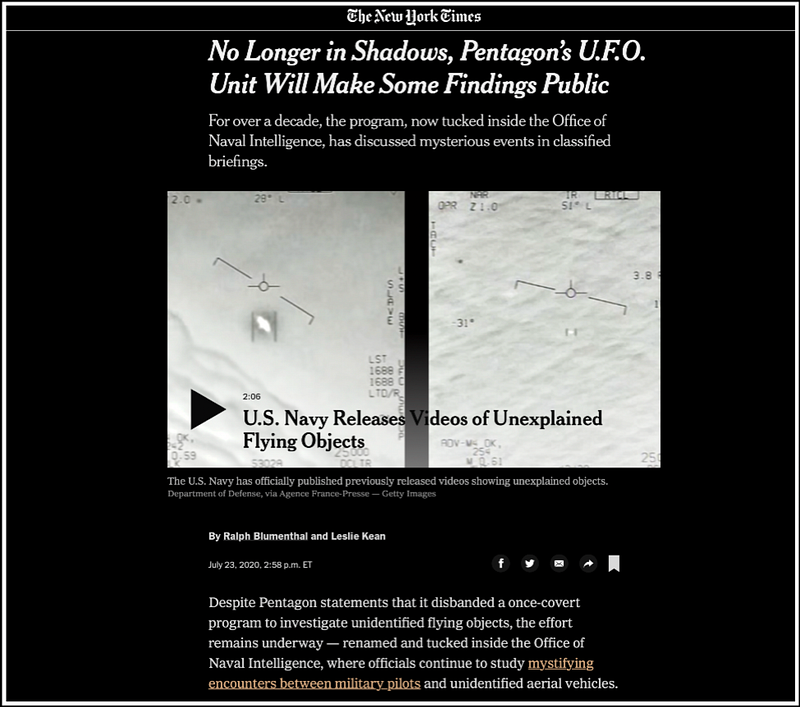
Note: The quote from former-Senator Reid was denied the day after the article’s publication. It remains in this analysis because it was obviously the intent of the journalists to put it there in the first place and, based on the reputations that Keane and Blumenthal bring to their reporting, they wouldn’t have included it unless they thought they had it solid and accurate. Altering it after the fact seems more likely a reaction to pressure whether from editors or from Reid himself who quite probably received enough pushback in some quarters to give him cold feet. Whether the New York Times stands behind the Blumenthal/Keane reporting, Trail of the Saucers does.
These are incredible claims, made by compelling sources, and to read them in the New York Times does feel historic. Think about it:
- Multiple government intelligence people and scientists with security clearances state their beliefs now that UFO crashes have occurred and materials retrieved for study.
- Harry Reid, the former Majority Leader in the U.S. Senate, seems to believe we do have crashed UFO wreckage and have been studying it for decades, both in government and private enterprise.
The article wanted to be about crash retrievals, based on where its reporting ended up going. Someone, probably the editors, thought that was a bridge too far for a lead, so they, literally, buried it. They constructed an article to hide it as long as they could with the article’s other big idea, that the government seems to have admitted, more or less, that they don’t know what these UAP are, and are going to study the situation and get back to us. Finally. After all, it’s only been 73 years since Roswell got weird.
Times editors probably should have divided this article in two, done a deeper dive on each half, published each one separately, and given this shocker about crash retrieval its due. It doesn’t take a crystal ball to realize that will come later.
All of this, of course, is splitting hairs when talking about the story of a lifetime that could change everything. The cover-up has been built over seven decades, according to insiders and researchers. They insist it will take more time to end it fully.
Some of us are old enough to remember how the very idea there might be a UFO crash retrieval story to be told in public seemed like the stuff of extreme science fiction. It wasn’t.
Established reporters with credible track records are writing about crashed flying saucers in the pages of the New York Times.
Oh, my.
Trail of the Saucers is published by Stellar Productions and Bryce Zabel, the co-host of the popular new podcast Need to Know with Coulthart and Zabel.