
Media Freakout
New York Times Reporters Take Aim at Internet “Frenzy”
Ralph Blumenthal and Leslie Kean complain about activists not understanding their process and annoying them with speculation about their article on crash retrievals.

Reporting on the Reporters
It’s not easy being an investigative reporter. I get that. At the beginning of my career, I spent a couple of years with that job description at PBS Los Angeles, won a few awards even. It’s hard work, usually the people you’re investigating don’t want to talk, and they try to stop you in any way possible.
Also, although I don’t know Times reporters Ralph Blumenthal or Leslie Kean personally, I do know people who say they are absolutely terrific people. Professionally, I have tremendous respect for their skills, guts and tenacity.
So I was very interested in hearing what they had to say about their story that was published on July 23, 2020.
In an interview just posted on YouTube, Jay from Project Unity (based in the UK), landed the first interview with Blumenthal and Kean. It was a real coup getting both reporters the day after this piece broke, and it was great to hear the reporters speak at length about the topic and the process that allowed these articles to be written.
What shocks most in the interview is that the reporters reserve their deepest and harshest criticism not for the people who have allowed the truth to be suppressed for over seven decades now, but for a few folks on the internet who dared to talk about the story before it was published.
The story itself already has a flag on the play with Senator Harry Reid’s day-after-publication tweet that he never said what they said he said. On this interview, they fought back against that characterization, saying they changed only one quote out of three, but it is what it is.
An entire column can probably be written about Reid’s about-face. Suffice it to say here, it’s an even-money bet that Reid said whatever Kean and Blumenthal wrote, but that he got blowback on it immediately and, for reasons unknown at this time, he felt a strategic retreat was in order. More to come…
In any case, given the need to get quotes right on a topic of such magnitude, it feels right to let the reporters — Leslie Kean and Ralph Blumenthal — have their own words heard exactly as they said them.
Leslie Kean
“There was this frenzy that built up on the internet about the story. When is it coming out? When is it coming out?… So basically, we don’t even want competing media to even know we’re working on another story at all, period, let alone have people talk about what they think the story’s going to be about. The problem is there’s such a build-up of expectations that some people, when it comes out, express a disappointment. What? Is this all it is? The power of the story kind of gets lost in the frenzy of expectation that was building and I want to make a point that Ralph and I had absolutely nothing to do with any of that. This is a self-generated, self-created intense discussion, and rumor and all this stuff.. It would be a great help to us and to everybody to not do this in the future. It just doesn’t serve any purpose that I can see.”
Ralph Blumenthal
“It does not help if you’re out there as a Times reporter trying to put together a story to find this traffic back and forth about giving away snippets of your story that maybe sources were able to report from somewhere else. Little leaks of things that make it more difficult. For people who are supposedly concerned about getting the truth out, it really gets in the way. It annoyed us to no end to have to worry about not only nailing down the facts of the story but watching our back because people were sniping at our heels. They’re gonna do this, they’re gonna do that, often based on absolutely no information whatsoever. This is what they’re gonna talk about, this is what the Times is gonna do. It really is a very infantile environment to be working in for a serious subject. So I would urge people in this field who seem to, or say they have an interest in getting at the truth at heart to give reporters a little slack when they’re serious reporters and they’re looking into something. It definitely got in the way… It’s not policed. It’s the Wild West.”
UFO disclosure activists could be forgiven for reading or hearing these comments and feeling that they were being told that, basically, they should all just shut up and wait for the Times to tell them what’s what. Let’s break this down:

Summary of Kean/Blumenthal Objections
- The pre-publication buzz about their article was a “frenzy.”
- This frenzy allowed other newspapers to know what they were working on when they would prefer to do their jobs without them knowing anything.
- Leaks make their jobs more difficult.
- The buzz built up expectations to such a degree that it caused some readers to unfairly express disappointment at the final product.
- No purpose was served by this pre-publication interest.
- The internet discussion of what they were up to got in the way of them doing a good job.
- More than that, it annoyed them.
- They think people writing about their work before it’s published is infantile behavior.
Another Way to See It
For starters, characterizing a few people on Twitter writing about what they think is an upcoming New York Times article as a frenzy is not what I observed. The word is used pejoratively here. There was keen interest. Most journalists would be thrilled if the public cared wildly about what they were working on.
Arguably, the story that Blumenthal and Kean are chasing here is going to be far more influential in the end than the one Woodward and Bernstein were chasing. Even so, it’s impossible to imagine the earlier reporters complaining if people were speculating about what they might write next and when. There was no Twitter back then but, if there had been, it would have been on fire with people criticizing their work and often getting it wrong.
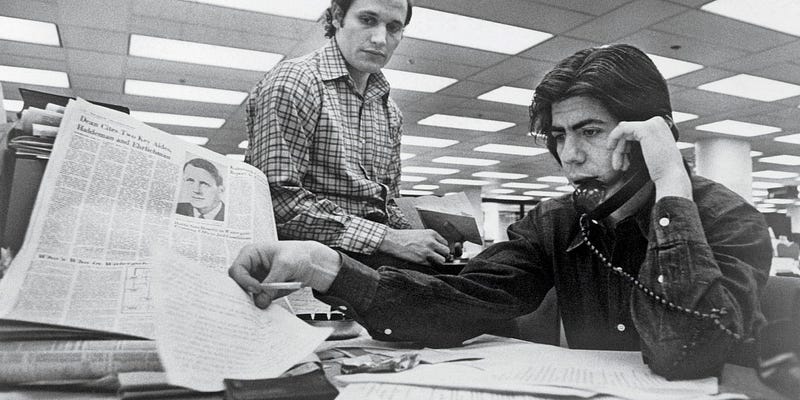
Woodward and Bernstein also tried to control the integrity of their stories, and hated it when rumors circulated about their work when they had five seconds to think about it. And they were up against some real tough opposition in the Nixon White House, plus editors at the Washington Post who were just as tough as the ones at the New York Times. Remember also that once they broke the story other papers started joining in and trying to break their own stories.
The idea that other reporters at other papers were able to see people on Twitter speculating about the next New York Times article on UFOs is not something that can be considered a valid objection in a free society. Frankly, it will be a good thing when, any day now, several other major media organizations join the fray and start to compete with Blumenthal and Kean in breaking their own stories. That will be good for the truth.
The objections are also impractical. Telling someone with a Twitter feed, knowledge of the subject, contacts of their own, and time on their hands to wait patiently is just not in the cards. It will never happen. As for leaks making their jobs more difficult, we have to remember that people do not have an obligation to make their jobs easy by shutting up.
Blumenthal and Kean are acting like the people they’re complaining about were 100% wrong on all counts and were peddling lunacy-like fringe theories. They were not. Overall, they said the New York Times was working on a story about crash retrievals and that it was imminent. They were correct on both counts.
Should these activists be restrained from comment because they are not “serious journalists”? We can’t all be New York Times journalists.
Blumenthal and Kean feel that this pre-publication interest built expectations so high that the final article was a let-down and people felt disappointed. That seems to be an overstatement. The article stands as what it was. Most were thrilled to see it, but even so, some, like myself, felt that it buried the lead (lede), and read as if it had been written by a committee composed of editors who made every sentence a slog to get qualified for the final product. And, listening to them describe the “rigorous process” they had to go through, it wouldn’t be surprising if in an off-the-record moment they might agree.
Still, it is completely understandable why they felt this was irritating and frustrating for them. That, however, is not the issue. Almost everyone reading this gets irritated and frustrated every single day in our jobs. How the behavior makes reporters feel is not the issue. The White House doesn’t make it easy for reporters these days either. Still they have to cover the story and shut out the madness.
Most of the people having fingers wagged at them here are passionate, pretty damn smart, and connected. They certainly do not think what they are doing is “infantile” and neither do I. These people care deeply about truth. Good for them.
In cold hard print, these comments made by Blumenthal and Kean look elitist and entitled whether they intend that or not. We’re supposed to “give reporters a little slack” when they’re “serious and looking into something.”
No. We’re not. I went to the University of Oregon and got a BA in Journalism. Not once in four years did any professor of mine ever state that we should expect to be protected from people “sniping at our heels” and that the public should just keep it zipped while we did our jobs at our own pace by our own rules. Journalists must have thick skins. Period.
The Bottom Line
Ralph Blumenthal and Leslie Kean have a secure place in the history books. Their work has paved the way for an astonishing global revelation that will be picking up in intensity every single day going foward. They need to be bigger than this. Instead of expressing their annoyance, they should be offering an apology.
Getting the truth out in a democracy, during a time when the truth is in short supply at high levels, is a wonderful calling. These two great reporters should keep their heads down and keep grinding away. At the end of the day, no one will remember a few inaccurate or bothersome tweets. The people will, however, remember this compelling story that is soon to break all around us.