
The Most Valuable Everyday Math Skill
mental math series, part 10
Percentages. They come up all the time, in the most casual places: shopping, dining out, grabbing a latte, checking grades, banking, taxes … that makes them the most valuable everyday math skill I can teach you.
I’m proud to say my mom taught me this trick when I was very young. We’d spend Saturdays shopping and she’d quiz me over and over, having me calculate the discounts mentally.
I cannot stress enough how much I want you to master this! The next time you’re out dining, I want you to fill in the tip on your receipt with confidence and gusto and without even one glance at your phone calculator. How’s that sound?
A Little Trick
A percent represents the portion per 100. So 15% means fifteen per one-hundred. Of course most of the time we are not taking a percentage of 100, but of a different value like 10% of 250.
The 10% Trick
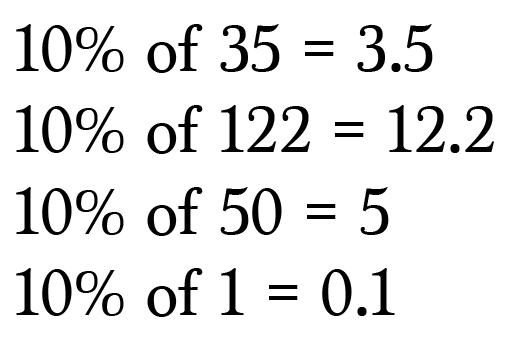
To calculate 10% of a number, move the decimal point one position left.
Here are some examples to illustrate:
Why does this work?
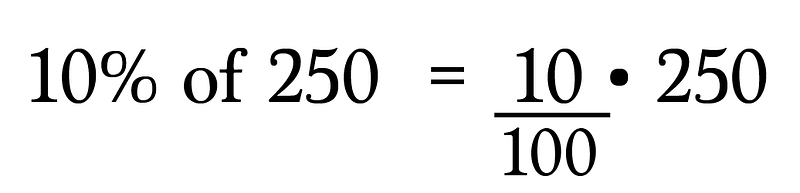
Suppose we were calculating 10% of 250 long-hand. I would begin by rewriting 10% as 10/100 and multiplying.
Then I’d reduce 10/100 by canceling out factors of 10.
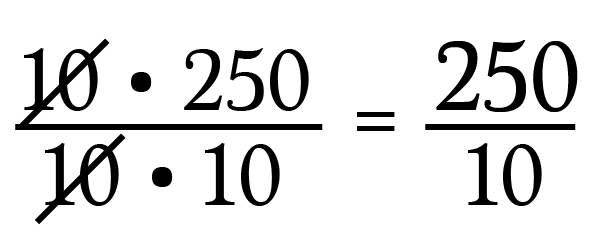
In Lesson Thirteen we learned that when dividing by 10 we move the decimal point one place to the left. So 10% of 250 is 25.

Calculating Restaurant Tips
Using the trick we can calculate common tip percentages of 10%, 15% and 20% mentally. Suppose your dinner bill comes to $48.50.
10% Tip Mentally
To find 10%, use the 10% trick.

15% Tip Mentally
To calculate 15% combine 10% and 5% of $48.50. Five percent is half of ten percent, so 5% of $48.50 will be half of 10% of $48.50.

For practical purposes you can approximate the tip, so feel free to round up to $2.50. Finally combine the 10 and 5 percent approximations.

This is only 22 cents away from the exact value of 15% of $48.50!

20% Tip Mentally
To find 20% double the 10 percent value.

Again we may wish to approximate instead.

Approximately 20% of $48.50 is $10.
Calculating Discounts
Another everyday scenario where you might encounter percents is while shopping. For example, suppose we have a sub-total of $168.75. Let’s calculate a variety of possible discounts.
10% off
First take 10 percent of $168.75.

Since it is 10% off, subtract $16.88 from $168.75. An estimate will suit our purposes so round $168.75 and $16.88 to the nearest dollar and subtract.

Our estimation is very close, only 13 cents over the exact answer.
25% off
Now let’s try 25% off. We have two options for finding 25% mentally:
- 25% is one-fourth of 100 percent, so we may divide our total by 4.
- we may compose 25% by adding two 10%’s and one 5%.
Option One:
Since an estimate is suitable begin by rounding $168.75 to $170 and then use strategic division to divide $170 mentally.

Note: If you struggle to perform those divisions mentally, you may wish to split them into pieces and divide individually. For example, 170 = 160 + 10.

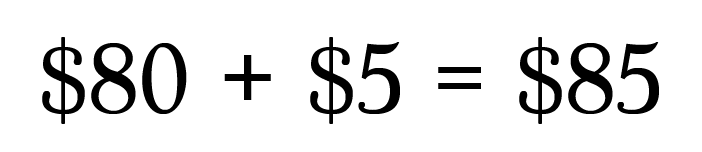
Likewise, $85 ÷ 2 can be split apart and divided individually by 2 to yield $42.50. Hence the total after discount is approximately $127.50.
Option Two:
Using this method we’ll compose 25% from 10% and 5%. First, approximate 10%.

Secondly, find 5% by dividing 10% in half.

Then combine two 17’s and 8.5 to obtain an approximation for 25%.

30% off
To calculate 30% add together three 10%’s. We’ve already approximated 10% of 168.75 as 17, so add three 17’s together.

Therefore 30% off is $51 off and the total after discount is about $119.

50% off
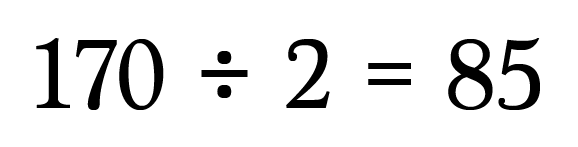
Fifty percent is half off. All we need to do is divide 170 by 2. Therefore the total after discount is $85.
That’s a great start! These techniques will aid you in most percentages you’ll experience day-to-day. In the next lesson, we’ll take a look at how to mentally calculate percentages to the exact percent.
Next Lesson: How to Tackle Difficult Percentages Mentally
Thanks for reading!
Please click the ❤ to let me know you learned something new!


