avatarBrett Berry

Free AI web copilot to create summaries, insights and extended knowledge, download it at here

2567

Abstract

800/1*oZLldtuvmpqB8ri53L_xpA.png"><figcaption></figcaption></figure><p id="2a2a">Continue the exponent pattern to the right of the decimal point, <b>subtracting 1 from the exponent of each place-value.</b></p><figure id="fb69"><img src="https://cdn-images-1.readmedium.com/v2/resize:fit:800/1*8IWB6HWlvg3sWIXXO4349g.png"><figcaption>diagram 2: decimal system with exponent labels</figcaption></figure><p id="3b5c">We now have <b>negative exponents! </b><i>How awesome is that?!</i></p><p id="0274">Compare the exponent representation in diagram 2 to the traditional representation in diagram 1. What patterns do you notice?</p><figure id="ae5d"><img src="https://cdn-images-1.readmedium.com/v2/resize:fit:800/1*eaOkSr8dEBvfHrRJR6Hu1w.png"><figcaption></figcaption></figure><p id="9e6f">You might notice that the second and third column are very similar. This is an important insight regarding negative exponents.</p><p id="c8b1"><b>Negative exponents</b> express how many times 1 must be <i>divided by</i> the base number.</p><h1 id="4d9d">Example</h1><figure id="5ef9"><img src="https://cdn-images-1.readmedium.com/v2/resize:fit:800/1*5yrXvQv5xXQhDFRcKH7mAw.png"><figcaption></figcaption></figure><p id="f9b2">Using the place-value assignments, 25.375 is equivalent to 2 tens, 5 ones, 3 tenths, 7 hundredths and 5 thousandths. We can express this in expanded form using exponent notation.</p><figure id="ebfd"><img src="https://cdn-images-1.readmedium.com/v2/resize:fit:800/1*dfj_5yjm1cl5JnHPXSE_BQ.png"><figcaption></figcaption></figure><p id="bb12">Or simply by the equivalent of each place-value.</p><figure id="3974"><img src="https://cdn-images-1.readmedium.com/v2/resize:fit:800/1*azZqn7LUyttn6tsLrB3hWg.png"><figcaption></figcaption></figure><p id="7d4f">If we multiply the products together and perform the addition, we arrive back at the original value.</p><figure id="c48b"><img src="https://cdn-images-1.readmedium.com/v2/resize:fit:800/1*k0EH8pzj6GHGZzwM6XSH9A.png"><figcaption></figcaption></figure><h1 id="8a52">Reciprocals</h1><p id="1689">At this point you may be wondering:</p><p id="54e8" type="7">Is there a relationship between positive and negative exponents?</p><p id="2fde">There is! They are called <b>reciprocals</b> or <b>multiplicative inverses </b>because when multiplied together they result in 1. To demonstrate, we’ll multiply the following two values together.</p><figure id="60e6"><img src="https://cdn-images-1.readmedium.com/v2/resize:fit:800/1*JR6yR1GqQ_BtL03jpDVLTA.png"><figcaption></figcaption></figure><p id="f5da">A negative

Options

exponent can be rewritten with an inversion:</p><figure id="22cd"><img src="https://cdn-images-1.readmedium.com/v2/resize:fit:800/1*IU_AIT6JIbbYTy2IKrsA9Q.png"><figcaption></figcaption></figure><p id="3d23">Next, expand both exponents and simplify the answer.<i> That proves they are reciprocals of one another.</i></p><p id="c9e5"><b>For more on Negative Exponents, including how to simplify algebraic expressions involving negative exponents, check out the video above or <a href="https://www.youtube.com/c/mathhacks">check out the Math Hacks YouTube channel!</a></b></p><div id="533e" class="link-block"> <a href="https://readmedium.com/the-decimal-system-exponents-and-a-few-perfect-numbers-c363f2778177"> <div> <div> <h2>Decimal System, Exponents and Perfect Numbers</h2> <div><h3>Every number system has a base. It is the underlying structure the system is built upon. We’ve already seen two…</h3></div> <div><p>medium.com</p></div> </div> <div> <div style="background-image: url(https://miro.readmedium.com/v2/resize:fit:320/1*-EUc9cddN8zM1hpCvIKo0g.png)"></div> </div> </div> </a> </div><div id="3162" class="link-block"> <a href="https://readmedium.com/prime-numbers-the-sieve-of-eratosthenes-ee22c119b6de"> <div> <div> <h2>Prime Numbers & The Sieve of Eratosthenes</h2> <div><h3>When it comes to number envy, primes definitely steal the show, and for good reason. They’re fundamental, mysterious…</h3></div> <div><p>medium.com</p></div> </div> <div> <div style="background-image: url(https://miro.readmedium.com/v2/resize:fit:320/1*JwCzgISCLEzuNE3O62FRbQ.png)"></div> </div> </div> </a> </div><div id="8d34" class="link-block"> <a href="https://readmedium.com/find-perfect-squares-mentally-with-this-trick-b8fa2c116d73"> <div> <div> <h2>Find Perfect Squares Mentally with this Trick</h2> <div><h3>mental math series, part 6</h3></div> <div><p>medium.com</p></div> </div> <div> <div style="background-image: url(https://miro.readmedium.com/v2/resize:fit:320/1*2MMK774vWGNZ6Mqrq2TulA.png)"></div> </div> </div> </a> </div></article></body>

Negative Exponents & the Decimal System

Today we’re learning all about negative exponents. What are they? And how do you handle them when they show up in algebraic expressions?

The Decimal System

In a previous lesson, I introduced the decimal system and exponential notation. Recall the decimal system is base 10, meaning we have 10 symbols and we assign value to the symbols based upon the symbol and its position.

To tell you the truth, this is only half of the story. Don’t worry, math is inherently balanced, so the other half of the decimal system is a simple extension of what we have above. Let’s derive it.

Beyond the Decimal Point

Begin by marking the decimal point to the right of the one’s place. The decimal point separates the whole number values on the left from the fractional values on the right.

Moving left-to-right along the decimal place-value system is equivalent to dividing by ten each time. Continue this dividing process to the right of the decimal point to obtain the rest of the decimal system.
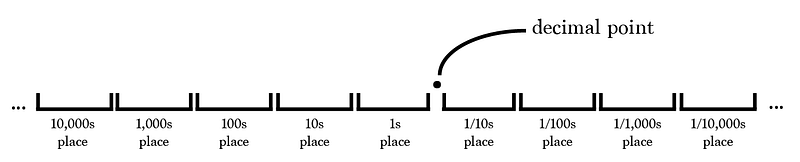
diagram 1: decimal system with numeric labels

We call these place-values: tenths, hundredths, thousandths, ten-thousandths, etc.

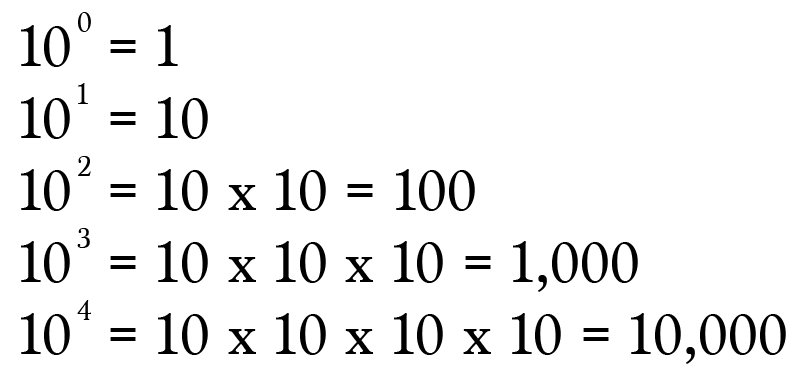
Place-values on the left can be represented in powers of ten:
Continue the exponent pattern to the right of the decimal point, subtracting 1 from the exponent of each place-value.

diagram 2: decimal system with exponent labels

We now have negative exponents! How awesome is that?!

Compare the exponent representation in diagram 2 to the traditional representation in diagram 1. What patterns do you notice?
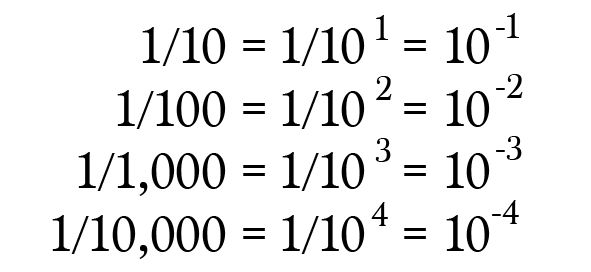
You might notice that the second and third column are very similar. This is an important insight regarding negative exponents.

Negative exponents express how many times 1 must be divided by the base number.

Example
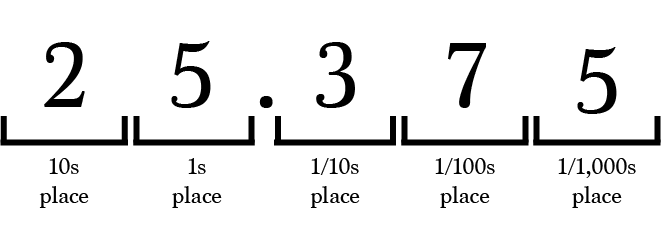
Using the place-value assignments, 25.375 is equivalent to 2 tens, 5 ones, 3 tenths, 7 hundredths and 5 thousandths. We can express this in expanded form using exponent notation.

Or simply by the equivalent of each place-value.

If we multiply the products together and perform the addition, we arrive back at the original value.

Reciprocals

At this point you may be wondering:

Is there a relationship between positive and negative exponents?

There is! They are called reciprocals or multiplicative inverses because when multiplied together they result in 1. To demonstrate, we’ll multiply the following two values together.
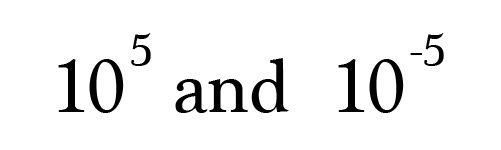
A negative exponent can be rewritten with an inversion:

Next, expand both exponents and simplify the answer. That proves they are reciprocals of one another.

For more on Negative Exponents, including how to simplify algebraic expressions involving negative exponents, check out the video above or check out the Math Hacks YouTube channel!

Mathematics
Math
Math Fundamentals
Math Education
Exponent
Recommended from ReadMedium