
FUTURE
The Most Important Needed for Global Justice and Prosperity
It’s there all the time, but we talk far too rarely about it: the main cause of injustice and poverty in the world.
What is the main cause of injustice and poverty in the world?
It is that society is rigged for the benefit of certain individuals, peoples and ethnic groups,
and that the world has an economic system based on free competition, selfishness and the cultivation of inequalities between human beings’ living conditions?
Strong forces in all countries work tirelessly on a daily basis to preserve and reinforce inequalities and the unjust economic system.
This society of injustice is supported by some myths that inequality and unfair distribution of resources and privileges are necessary to maintain the prosperity of the world.
Global income and wealth inequality, 2021
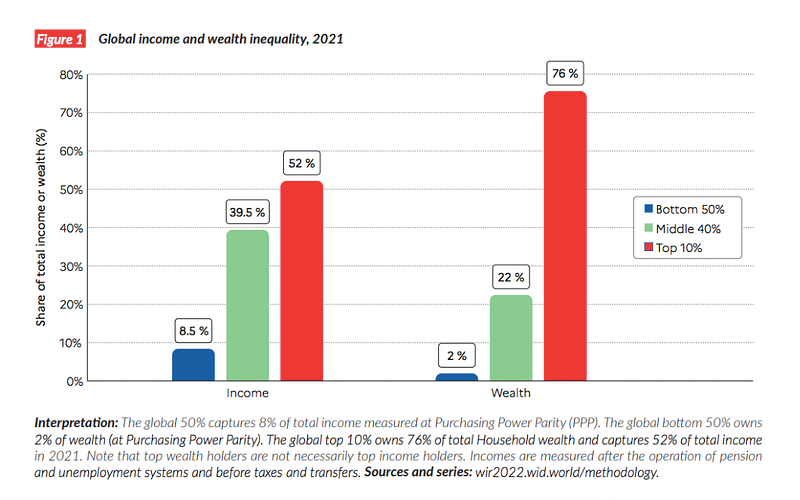
The richest 10% of the global population currently take home 52% of the income. The poorest half of the global population? Well they earn just 8%.
On average, an individual from the top 10% will earn $122,100, but an individual from the bottom half will earn just $3,920.
And, when it comes to wealth (valuable assets and items over and above income), the gap is even wider. The poorest half of the global population owns just 2% of the global total, while the richest 10% own 76% of all wealth.
Source: https://www.weforum.org/agenda/2021/12/global-income-inequality-gap-report-rich-poor/
What are the reasons why global inequality and injustice still dominate today?
A Google search provides the following 11 reasons for global poverty:
11 Top Causes of Global Poverty
Around 8% of the world’s population lives in extreme poverty — but do you know why? We look at 11 of the top causes of global poverty.
Living on less than $2 a day feels like an impossible scenario, but’s a reality for around 600 million people in our world today. Approximately 8% of the global population lives in extreme poverty, commonly defined as surviving on only $1.90 a day, or less
There is some good news: In 1990, that figure was 1.8 billion people, so serious progress has been made. While many wonder if we can really end extreme poverty, we at Concern believe the end is not only possible — but possible within our lifetimes. There’s no “magic bullet” solution to poverty, but understanding its causes is a good first step. Here are 11 of those causes, fully revised for 2020.
1. INEQUALITY AND MARGINALIZATION 2. CONFLICT 3. HUNGER, MALNUTRITION, AND STUNTING 4. POOR HEALTHCARE SYSTEMS — ESPECIALLY FOR MOTHERS AND CHILDREN 5. LITTLE OR NO ACCESS TO CLEAN WATER, SANITATION, AND HYGIENE 6. CLIMATE CHANGE 7. LACK OF EDUCATION 8. POOR PUBLIC WORKS AND INFRASTRUCTURE 9. LACK OF GOVERNMENT SUPPORT 10. LACK OF JOBS OR LIVELIHOODS 11. LACK OF RESERVES
(Source: https://reliefweb.int/report/world/11-top-causes-global-poverty)
These 11 causes of worldwide poverty are based on a unifying factor, one reason for the crisis the world is in:
The belief that pure capitalism and free market forces are the only viable economic system for the world community.
This system secures economic and political power in the hands of political elites who influence virtually all important decisions.
Is this a just society?
Why is it “fair” that some can gather power and means almost indefinitely, while others have to struggle every single day to survive?
Many of capitalist societies are built on lies, illusions, and a false belief that it is ‘just’. For a long time, people have fought for and cemented the belief that this is ‘the good society’. The thing is, this society can be very good for a few, “to live with” most of the time for large groups, but unfair for many.
If we look at statistical facts, it seems obvious that it is deeply unfair that the richest 10% of the world’s population owns 76% of all wealth, while the poorest half of the world’s population owns only 2% of global wealth.
It is more than obvious that in order to tackle the major challenges facing the world community, strong reforms and improvements are needed in the way we organize the economic system.
A larger part of the resources and values in society must be under greater state and social control, perhaps following the model of some European social democratic societies.

Øivind H. Solheim — Norwegian author and nature photographer. Writes in Norwegian and in English: novels, short stories, creative short prose, poems, essays, and articles. Has since 2017 published stories on medium.com. He has published six novels, two non-fiction books, and a collection of poems.
You can become a paying member of Medium and support the author Øivind H. Solheim with referred membership. Your membership fee ($ 5.00 / month) directly supports Øivind H. Solheim and other writers on Medium. You will also have full access to all the content on Medium. https://oivind47.medium.com/membership