
The Mistake Smart People Make That Causes Divorce and Other Miserable Things
The reason we have conflict with the people we are closest to is because we’re smart. All of us.

By Matthew Fray
How well do you know your spouse or romantic partner? Your parents? Siblings? Best friends?
If you were to take a personality test, answering questions as you imagine they would answer them, how confident are you that the results would match reality?
People frequently have conflict — often minor, sometimes major — with loved ones and people they spend a lot of time with and know well.
And the reason we have conflict with other people is not because we’re dumb nor is it because they are (even though that would be nice and neat, right?). The reason we have conflict with the people we are closest to is because we’re smart. All of us.
No matter how lacking you think you or someone else is in the intellect department, I’m here to try to convince you that almost EVERYONE you encounter is incredibly smart. Amazingly smart.
And the reason you might not see it in others, or possibly yourself, is the same blindness that causes all of those fights, arguments, disagreements — conflict — in our interpersonal relationships.
Would You Marry Someone You Didn’t Know?
One of my coaching clients is getting married in three days. She has known and dated her fiancé for more than 10 years.
Something I ask all of my married or dating clients to do is take the awesome (and totally free) personality test at 16 Personalities, which is sort of a hybrid version of Myers-Briggs.
First, I ask them to take the test for themselves and confirm for me their accuracy. (Still 100% reporting as accurate.)
Second, I ask them to take the test answering questions as they believe their spouse or romantic partner would answer them. I love the insights and conversations that occur naturally when we discover the gaps between what we believe and what’s actually real.
I like to say that the majority of conflict that exists between two romantic partners lies in that gap.
My soon-to-be married client is brilliant. Impressive. Master’s degree holder. Objectively intelligent in all of the measurable academic ways. And subjectively intelligent in all of the ways you experience when you’re conversing with her about big-picture life stuff.
So, I was totally floored this morning when I learned that she got ALL FOUR PILLARS of her near-future husband’s personality totally wrong.
If you’re not familiar with Myers-Briggs, there are four letters to classify a person’s personality. Each letter slot can only be one of two letters. (For example, I am ENFP.) There are 16 possible combinations.
My client sent me the results of her “guess test” for her fiancé — the results of a test where she guessed how he would answer questions.
The result?
INFP.
Then, this morning, her real-life fiancé sent me his real-life results.
ESTJ.
It was a relationship coach’s wet dream. Not only did my brilliant client get her fiancé’s personality traits 100% backward, but it turns out that his personality profile is the same as her’s.
You are Scary Smart (and That’s Why This is Dangerous)
The reason you don’t usually spill your drink down your shirt, or crash your shoulder into doorways you’re walking through, or cut yourself when handling sharp objects is because your brain is constantly processing information in real time and essentially guessing what your body needs to do to avoid injury.
And our brains are AMAZING. They’re right almost 99 percent of the time about everything it’s in charge of guessing. We usually don’t crash our cars. We usually don’t wander aimlessly off the edge of a cliff. We usually don’t mistake some fatal substance for a common meal.
That’s why, even though our bodies are pretty frail compared to most of the stuff on earth, we still have a life expectancy greater than 70 years.
It’s a miracle.
We’re always subconsciously guessing EVERYTHING, all of the time, and statistically speaking, we’re pretty much always right. We have every reason in the world to trust our instinctual thoughts. They happen on auto-pilot. We’re smart. And we know it.
So, when we’re having a conversation, and our brain (or “gut”) is automatically interpreting and reacting to what’s happening without us even having to think about it, it’s really difficult to check ourselves and think: “Wait a minute. Could this be one of those fewer-than-1% things I’m getting wrong?”
Every time someone says our does something — just like our brain guessing keeps us from crashing into stuff and falling off cliffs — we are applying our own internal belief filters to what they are saying and doing.
We almost never account for the possibility that they could mean something entirely differently than what we interpreted on auto-pilot.
All of this bullshit happens in our blindspots. We are so good, and so correct, and so on-point the vast majority of the time, that we all just trust the statistical likelihood of that being true in whatever moment we’re in, and are thus surprised, disappointed, shocked, humiliated, ashamed, or whatever, when we realize we’re wrong and have our asses handed to us.
I’m an Asshole, but I’m Trying Hard to Not Be
The thing I’ve tried really hard to do throughout these past six years of being divorced and trying to reinvent myself — and I still mess up a lot (but I’m getting better) — is to mindfully account for my human fallibility. It’s CERTAIN that I am wrong some (hopefully small) percentage of the time. And the only way for me to avoid seriously damaging something or myself is to be aware of that, so that I can be less of an asshole in my daily life.
Most of the time, terrorists aren’t carrying out attacks. But it’s awesome when our security measures in the intelligence and law enforcement communities prevent something horrible from happening during that fewer-than-1% of the time.
I’m trying to turn myself into the kind of person who is vigilantly avoiding being an emotional terrorist to myself and/or the people I care about.
Being smart is great most of the time.
But sometimes, being smart is a handicap. A blindness. A weakness. One that can cost us our most precious and meaningful relationships both in and outside of our homes.
It’s a simple mistake. One that’s so common and ever-present in our daily lives that it’s easy to make, and most of us always will.
But we don’t have to make it all of the time.
And those times we don’t, because we saw something previously invisible?
Just maybe those are the moments that will save our lives.
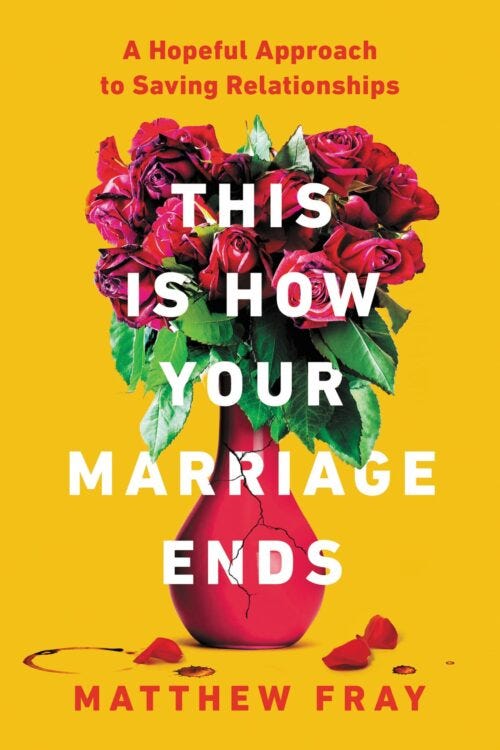
Pre-Order Matthew’s Book:
This Is How Your Marriage Ends: A Hopeful Approach to Saving Relationships
Read more from The Good Men Project on Medium:
The story was previously published on The Good Men Project.
About Matthew Fray
Matthew Fray is a relationship coach and writer who leans on the lessons of his failed marriage and divorce to help others avoid making the same mistakes he did. He got divorced because he left dishes by the sink. Fray writes about that and more on his blogMust Be This Tall To Ride.
Pre-Order Matthew’s Book: This Is How Your Marriage Ends: A Hopeful Approach to Saving Relationships


